
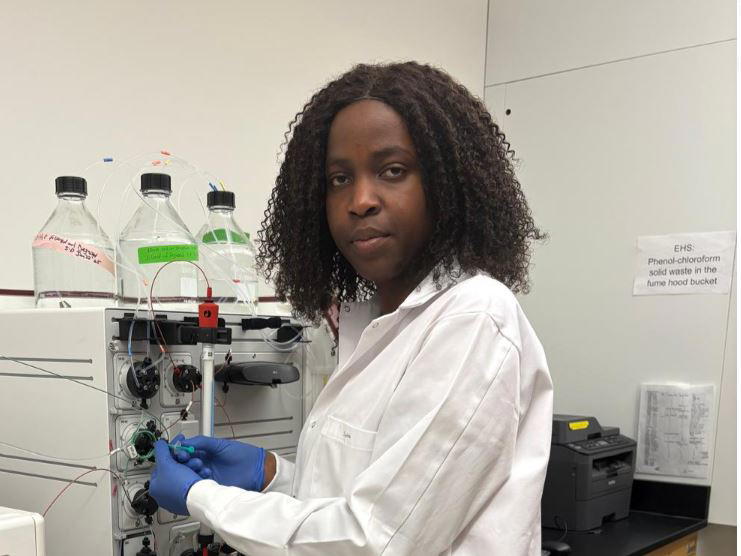
Sedoten Ogun
By Elizabeth Osayande
In groundbreaking research at the University of Nebraska-Lincoln, Sedoten Ogun reveals how common food compounds could prevent atherosclerosis through microbiome modulation, potentially transforming our approach to cardiovascular disease prevention
At the intersection of food science and cardiovascular health, innovative research at the University of Nebraska-Lincoln is uncovering how common food compounds could revolutionize heart disease prevention through their interaction with gut bacteria. This groundbreaking work, funded by the USDA, could transform our approach to preventing one of the world’s leading causes of death.
Ogun, in an exclusive chat with Vanguard, shared more insight about the research.
Excerpts:
Could you introduce yourself and tell us about your role in this important research?
I am Sedoten Ogun, a Ph.D. Student in the Department of Food Science and Technology at the University of Nebraska-Lincoln, where I am conducting research investigating the therapeutic benefits of dietary gamma-glutamyl peptides and their interactions with the gut microbiome. I’m specifically focused on understanding how these compounds could help prevent atherosclerosis, which is a major cause of heart disease.
I currently work between the Food Biopeptide Lab and Gut Microbiology Lab, where our team has made exciting discoveries about how certain food compounds influence heart health through gut bacteria. This research is part of a larger USDA-funded project aimed at developing clinically applicable dietary peptides for treating atherosclerosis and related cardiovascular diseases.
My path to this research has been shaped by my commitment to finding accessible solutions to major public health challenges. After completing my Master’s in Biochemistry from Lagos State University, where my research was focused on Nutritionally Biochemistry, I worked in the food industry as a Lean Six Sigma Coordinator and Quality Assurance Lead. This experience gave me valuable insights into translating scientific discoveries into practical applications, which is crucial for our current work on developing food-based interventions for disease prevention.
Your research represents a fascinating intersection of food science and public health. Could you walk us through how you came to focus on gamma-glutamyl peptides (γ-GPs) and its potential impact on heart health?
My journey into this research began with a fundamental question that affects millions of lives: How can we prevent cardiovascular diseases through dietary interventions rather than just managing symptoms after they develop? This question is particularly crucial given that cardiovascular diseases account for one in three deaths globally.
The focus on γ-GPs emerged from our understanding that certain food compounds have bioactive properties that go beyond basic nutrition. These peptides which are found naturally in foods like aged cheeses and fermented products, caught our attention because of their potential to influence multiple physiological pathways.
What makes our approach unique is that we are not just looking at the direct effects of this compound on cardiovascular health. Instead, we have uncovered a fascinating three-way conversation between diet, gut bacteria, and heart health. In our study with atherosclerosis-prone mice, we observed something remarkable: subjects receiving a specific γ-GP showed significantly decreased fat deposition and inflammation in their arteries compared to those on a high-fat diet alone which was accompanied by the modulation of the gut microbiota. This finding has led us to investigate how the gut microbiota might contribute to the lipid-lowering effects we observed.
This connection between gut bacteria and heart health seems to be a crucial discovery. Could you elaborate on how this finding might change our approach to cardiovascular disease prevention?
This finding represents a paradigm shift in how we think about heart disease prevention. Traditionally, cardiovascular disease prevention has focused primarily on managing factors like cholesterol levels and blood pressure through medication. While these approaches are valuable, our research suggests that we might be able to prevent disease progression through targeted dietary interventions that work by modulating the gut microbiome. Our peptide is not just about reducing plaque formation; we are seeing effects on inflammation and immune response which may be associated with the modulation of gut bacteria. To validate these findings, we are conducting extensive in vitro and in vivo studies to understand the mechanisms by which γ-GPs prevent atherosclerosis in more detail.
Your research seems to have significant implications for both preventive medicine and public health policy. How do you see this work translating into practical applications?
The translation potential of this research is one of its most exciting aspects. We are essentially working toward developing food-based solutions for disease prevention that could be both effective and accessible. This addresses two crucial public health challenges: disease prevention and healthcare accessibility.
On the practical side, we are currently developing protocols for enriching these beneficial peptides in food through fermentation processes. This could lead to the creation of functional foods specifically designed for heart health protection. Imagine having access to foods that not only taste good but also actively work to prevent cardiovascular disease through their interaction with your gut microbiome.
The public health implications are substantial. According to recent healthcare data, the United States spends billions annually on cardiovascular disease treatment. By developing preventive approaches through dietary intervention, we could potentially reduce this burden significantly. Moreover, since these interventions are food-based, they could be more accessible to broader populations compared to expensive medications.
Could you discuss how your current research builds on your previous work and what future directions you are exploring?
My research journey has been cumulative, building from fundamental studies of food compounds to our current complex understanding of diet-microbiome-health interactions. My earlier work examining the antioxidant and anti-inflammatory properties of foods in rat models provided crucial insights into the mechanisms driving chronic diseases. Currently, we are expanding our research in several exciting directions. First, we are researching to understand how γ-GPs interventions work at a mechanistic level.
We are also exploring the development of fermented foods enriched with these beneficial peptides. This involves optimising fermentation conditions and selecting appropriate bacterial strains to maximize the production of beneficial compounds. The goal is to create functional foods that can be easily incorporated into daily diets.
Looking ahead, we are particularly interested in understanding individual variations in response to these interventions. We know that gut microbiome composition varies significantly between individuals, which might affect how people respond to dietary interventions. This could lead to more personalised dietary recommendations based on individual microbiome profiles.
How does your research align with current public health priorities and challenges?
Our research directly addresses several key public health priorities identified by major health organisations. The CDC and WHO have both emphasised the need for innovative approaches to preventing chronic diseases, particularly cardiovascular disease, which remains a leading cause of death globally.
What is particularly relevant is how our work aligns with the growing recognition of the importance of preventive healthcare. The current healthcare system often focuses on treating diseases after they develop, which is both costly and less effective than prevention. Our research suggests a pathway to prevent disease development through dietary intervention, which could significantly impact public health outcomes.
Moreover, our focus on food-based interventions addresses the important issue of healthcare accessibility. While many cutting-edge medical treatments are expensive and may not be available to all populations, dietary interventions can be more widely accessible. This aligns with public health goals of reducing health disparities and providing equitable access to preventive care.
We are also contributing to the growing body of research on the gut microbiome’s role in health and disease. The NIH’s Human Microbiome Project has highlighted the importance of understanding these relationships, and our work provides crucial insights into how dietary compounds can be used to modulate the microbiome for better health outcomes.
What challenges have you encountered in this research, and how have you addressed them?
One of the main challenges in this type of research is the complexity of studying interactions between diet, gut microbiota, and host health. The gut microbiome is incredibly complex, and understanding how specific dietary compounds influence specific bacterial species requires sophisticated analytical approaches.
We have addressed this through a comprehensive, multi-faceted approach. We use advanced DNA sequencing techniques and specific primers to track changes in bacterial populations. We have also developed robust in vitro systems to study direct interactions between γ-GPs and the gut microbiota allowing us to confirm our in vivo observations.
Another challenge is translating laboratory findings into practical dietary recommendations. This requires careful consideration of factors like bioavailability, dose-response relationships, and individual variations in response. We are addressing this through systematic studies of different delivery methods and careful documentation of individual variations in response to our interventions.
The ultimate challenge is ensuring that our findings can be translated into accessible, practical interventions. This requires collaboration with food scientists, nutritionists, and industry partners to develop products that are both effective and appealing to consumers.
Your work seems to bridge several scientific disciplines. How does this interdisciplinary approach enhance the potential impact of your research?
The interdisciplinary nature of our research is one of its greatest strengths. We are combining elements of food science, microbiology, biochemistry, and public health to address complex health challenges. This comprehensive approach allows us to see connections and opportunities that might be missed from a single disciplinary perspective.
For example, my background in Biochemistry and Food Science helped us understand not just what γ-GPs do but how it interacts with biological systems at a molecular level. My experience in Quality Assurance and Lean Six Sigma has been invaluable in developing rigorous, reproducible protocols for our research. This combination of skills has been crucial in moving from basic science to practical applications.
Our research team includes experts in gut microbiology, food science, and metabolic diseases. This diversity of expertise allows us to approach problems from multiple angles. When we’re developing functional foods, we are not just thinking about the bioactive compounds – we are considering factors like shelf stability, taste, texture, and how processing might affect the biological activity of the compounds.
This interdisciplinary approach is particularly important as we work to translate our findings into real-world applications. Developing effective dietary interventions requires understanding not just the science, but also factors like food processing, consumer acceptance, and regulatory requirements.”
Looking ahead, what are the next steps in your research, and what potential impacts do you foresee?
Our immediate next steps focus on several key areas. First, we’re conducting studies to definitively establish the causal relationship between γ-GPs supplementation, gut microbiota modulation, and cardiovascular outcomes. This work is crucial for understanding the precise mechanisms through which our dietary intervention works.
We are also developing protocols for enriching beneficial peptides in food through fermentation. This involves optimising fermentation conditions and selecting appropriate bacterial strains to maximize the production of these compounds. The goal is to create functional foods that can be easily incorporated into daily diets while maintaining their therapeutic benefits.
Looking further ahead, we are interested in understanding individual variations in response to these interventions. We know that gut microbiome composition varies significantly between individuals, which might affect how people respond to dietary interventions. This could lead to more personalized dietary recommendations based on individual microbiome profiles.
The potential impacts of this research are significant. In the short term, we hope to develop specific dietary recommendations and functional food products that could help prevent cardiovascular disease. Long term, our work could contribute to a paradigm shift in how we approach disease prevention, moving from a treatment-focused model to one that emphasizes prevention through dietary intervention.
From a public health perspective, this could lead to reduced healthcare costs, improved health outcomes, and more accessible preventive care options. Given that cardiovascular disease remains a leading cause of death globally, even a modest improvement in prevention could have significant impacts on public health.
How does your research contribute to addressing health disparities and improving access to preventive care?
This is a crucial aspect of our work. Health disparities in cardiovascular disease prevention and treatment are well-documented, with access to care often limited by economic and social factors. Our focus on food-based interventions could help address these disparities in several ways.
First, dietary interventions are generally more accessible than pharmaceutical approaches. By developing functional foods and dietary recommendations based on commonly available ingredients, we’re creating prevention strategies that could be implemented across different socioeconomic groups.
Second, our research into fermentation processes could lead to the development of affordable functional foods. Fermentation is a traditional food processing method that’s both cost-effective and culturally relevant across many communities. By harnessing this process to enhance the beneficial properties of foods, we are working toward solutions that could be implemented globally.
Moreover, our findings about the relationship between diet, gut microbiome, and health could inform public health policies and dietary guidelines. This knowledge could be used to develop more effective, culturally appropriate dietary recommendations for different populations.
What advice would you give to other researchers looking to bridge the gap between basic science and public health applications?
Based on my experience, I believe success in translational research requires several key elements. First, maintain a clear focus on the ultimate goal of improving public health outcomes. While basic science is crucial, we should always be thinking about how our findings could be applied to real-world situations.
Second, cultivate interdisciplinary collaborations. My work has benefited enormously from partnerships with experts in different fields. These collaborations help ensure that our research addresses not just the scientific questions, but also practical considerations for implementation.
Third, stay connected to both the scientific community and public health practitioners. This helps ensure that our research remains relevant and applicable to real-world needs. Participating in conferences, publishing in peer-reviewed journals, and engaging with public health organizations are all important aspects of this.
Finally, always consider the accessibility and scalability of potential solutions. The most brilliant scientific discovery will have limited public health impact if it can’t be implemented widely and affordably.
Disclaimer
Comments expressed here do not reflect the opinions of Vanguard newspapers or any employee thereof.