
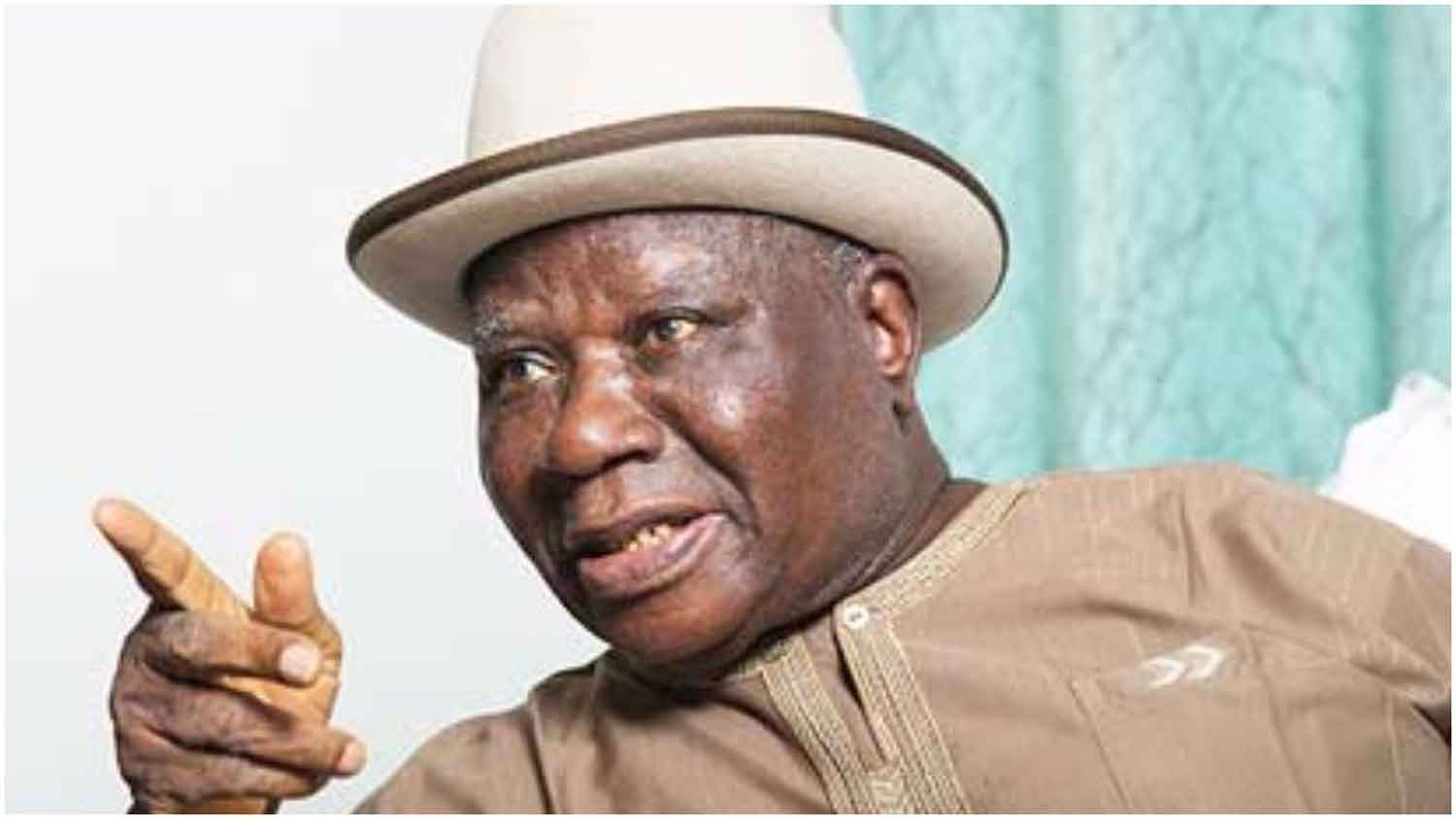
Edwin Clark
John Alechenu, Abuja
Elder Statesman, lawyer and former Federal Commissioner for Information, Chief Edwin Clark, has appealed to the Federal and State Governments as well as school proprietors, to prioritize the welfare of teachers in their employment in order to revive the educational sector.
Clark, who once served as Commissioner for Education in the defunct Midwestern State, made the appeal in Chapter 5 of his Author biography, Brutally Frank,
The elder statesman who also trained as a teacher, said, he dedicated the entire chapter of his book to teachers because of the pivotal role they play in the advancement of soceity.
He maintained that iit was important as Nigeria joins the rest of the world to commemorate the 2023 edition of the World’s Teacher’s Day, to remember to go beyond rhetoric to address the plight of this very important segment of the nation’s workforce.
Chief Clark wrote, “ I sincerely wish to appeal to the Federal Government, State Government and other employers of teachers to put first and foremost the actual welfare of teachers and not mere rhetoric.
“I condemn those employers of teachers who expose their teachers to untold hardship, through unnecessary teacher humiliation by carrying out unnecessary test and sacking of teachers with impunity.
“I also appeal to the employers of teachers to treat them with respect and reward them properly because there the future lies. Congratulation to all the teachers on the teachers’ day which was marked with fanfare.”
He went down memory lane to recall his time in service as Education Commissioner during the administration of the then Colonel Samuel Ogbomidia, and the impact made on the sector in the region.
He wrote, “Whilst being very strict with teachers and disciplining them when nesecary, I also saw to their welfare. A situation where two graduates joined the system from one university; one with Second class Upper degree and the other with second class lower; the one with second class upper becomes an education of officer or teacher in a secondary school while the one with second class lower is employed as an administrative officer.
“The one who is employed to be an education officer would receive less pay, even though they have the same qualification. Whilst the administrative officer received a car, the education officer did not receive such benefit.
“I thought this was unjust and so I prepared a memo to the Governor to that effect, highlighting the disparity. I took my memo to the Executive Council and it was approved that the two types of graduates should be given equal treatment and facility to enhance their jobs, thereby attracting more graduates to the teaching profession.
MY CONCERN FOR THE GIRL CHILD EDUCATION
My Permanent Secretary was Mr. S.N. Enabhokara, a very seasoned educationist. One of the requests I made to the Governor was in the area of girl-child education in Western Ijaw Division which lacked educated people, particularly women. The government then approved that any girl-child from that area that gained admission to a tertiary institution should be given automatic scholarship. Many Ijaw girls benefited from the scholarship scheme, however, male scholarship was spread all over the state.
MAJOR OVERHAUL OF THE EDUCATION SECTOR AS COMMISSIONER FOR EDUCATION
Education was the focal point of Col. Ogbemudia’s administration. As Commissioner for Education, I made it a duty to pay surprise visits to both primary and secondary schools in the state and often held morning assembly with them. On such visits, I was accompanied by my Chief Inspector of Education and other senior education officers. This made teachers and pupils more dedicated and punctual in attendance, and discipline was the order of the day. I also saw it that both teachers and students were properly dressed. At times, I provided school uniforms for the less-privileged pupils, particularly in the primary schools.
EXAMINATION MALPRCTICE
Examination malpractice which was flourishing in many schools before I took over reduced to a minimum because of my frequent visit to schools. I enforced discipline and, in some cases, had to approve the expulsion of some students.
There was a Teacher’s Training College at Abudu with one Chief D.O. Orosanya as principal. I received a report that examination malpractice was being carried out in that school. I left Benin City early one morning accompanied by school inspectors to visit the college in Abudu. On arrival at 9:00a.m, students were taking exams. I went into a classroom and some female students were caught coping from prepared papers. One of the girls confessed that a teacher, Solomon Aguebo, was the brain behind these malpractices for which they paid money, but we later discovered that one of the young ladies was the lecturer’s friend who in turn later confessed. I gave a directive that he should be dismissed and removed from the Register of Teachers and the female student was expelled. I was completely disappointed and ashamed of the behaviour of this handsome teacher who was my classmate in Abraka Teacher Training College in 1950. He made every effort to see me due to our past relationship, but I believed the interest of the general society was paramount and took priority over personal interest. The news of this incident was published in the papers and broadcast over the radio. This created fear in schools and examination malpractice was eventually stamped out.
THE WELFARE OF TEACHERS
Whilst being very strict with teachers and disciplining them when nesecary, I also saw to their welfare. A situation where two graduates joined the system from one university; one with Second class Upper degree and the other with second class lower; the one with second class upper becomes an education of officer or teacher in a secondary school while the one with second class lower is employed as an administrative officer. The one who is employed to be an education officer would receive less pay, even though they have the same qualification. Whilst the administrative officer received a car, the education officer did not receive such benefit. I thought this was unjust and so I prepared a memo to the Governor to that effect, highlighting the disparity. I took my memo to the Executive Council and it was approved that the two types of graduates should be given equal treatment and facility to enhance their jobs, thereby attracting more graduates to the teaching profession.
THE ESTABLISHMENT OF A HEADMASTERS’ INSTITUTE
I also saw to it that the condition of service for teachers which was not good enough, particularly headmasters of schools, was improved upon. I discussed the issue with the Governor who though a military officer, was very committed to the advancement of education in the state and was always ready to lend his support.
During our discussion on this matter, we gave thought to how to raise salaries of headmasters whose bar was nationally fixed. In order to bypass the national scale, we decided to establish a Headmasters’ Institute in Benin to train headmasters who had served as Grade II teachers for at least 25 years, but had no opportunity to go beyond the national scale of salaries for teachers.
We contacted the University of Ibadan which agreed that the headmasters’ institute should be affiliated to the institute of Education at the University of Ibadan. They were then responsible for preparing the scheme of work, the subjects to be taught and at the end of one year, students would take an examination prepared and supervised by the Institute of Education, Ibadan. It became very popular and many headmasters gained access to this programme. At the end of the one-year training, a special salary scale was given to them.
One interesting aspect was that some of the old headmasters I encouraged to apply for admission into the institute did so. I was amazed when two headmasters who taught me in elementary school in the 1940s (between 1940-45) were admitted. One of them was Mr. F.T.F. Appah from Kaiama in then Rivers State now Bayelsa State. He admitted my younger brother and I into elementary school Okrika in Western Ijaw Division. In 1942, we were taken to Akugbene to another Native Authority School, where my headmaster was Mr. G.P. Alabrah. Both of them were still headmasters when I became Commissioner for Education in Mid-West State after I had qualified as a lawyer in Britain.
Disclaimer
Comments expressed here do not reflect the opinions of Vanguard newspapers or any employee thereof.