
By Marie-Therese Nanlong, Jos
Christian and Islamic clerics in Plateau State have been urged to reflect on the impacts of their sermons on their followers and ensure that their messages encourage mutual respect and peaceful coexistence as military actions alone would not restore lasting peace in the State.
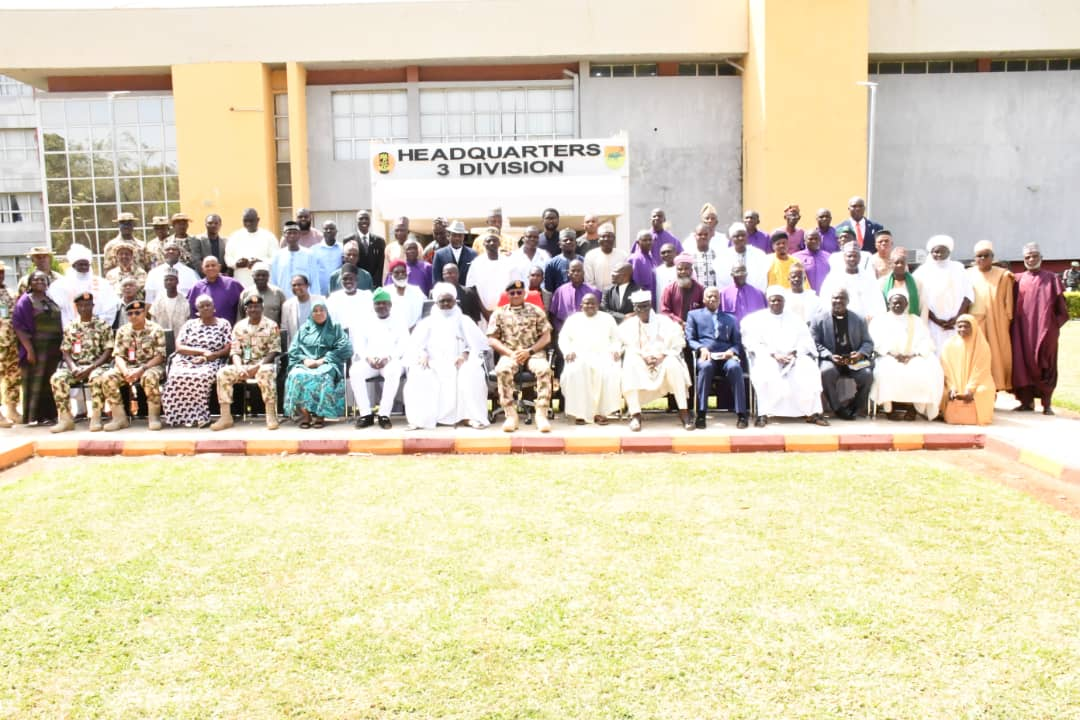
The General Officer Commanding, GOC 3 Division and Commander, Operation Safe Haven, OpSH, Major General Abdulsalam Abubakar, who gave the charge during a symposium organized for religious leaders in the State by Operation Safe Haven at the 3 Division Nigerian Army, Rukuba, reiterated the need for them to lend their support and preach sermons that encourage unity against division in communities.
In a keynote address, Maj-Gen AE Abubakar, decried the artificial barriers incitive sermons from religious leaders are creating among communities, which raise tension and intolerance amongst religious groups and called on erring clerics to turn a new leaf and use their enormous influences in fostering community peace.
He explained that the symposium aims to remind them of the importance of religious leaders as key contributors to peace in society and also present a platform for constructive discussions on how to leverage on sermons to bring lasting peace to Plateau State.
The Deputy Chief Imam of the Jos Central Mosque, Sheikh Ghazali Adam and the Director of Studies, St. Augustine Major Seminary, Jos, Rev. Father Boniface Pius who delivered separate lectures titled: “The Effect of Incitive Religious Messages on Peaceful Coexistence on the Plateau,” from the JNI and CAN perspectives respectively, agreed that wrong perception of religion, stigmatization and stereotypes have damaged the psyche of citizens and religious leaders have roles to play in reversing the trend and fostering peace.
According to the Shiekh, “… The search for religious tolerance in the world has become particularly pressing today in promoting peaceful coexistence in a religiously plural society like Nigeria. In Nigeria, religious tolerance as a means for peace is expedient because of the near frequent occurrences of religious strife during the past three decades…
“A Preacher should, therefore, develop necessary skills that help him carry out his work in all circumstances and try to maintain a purely practical approach with beautiful communication and preaching style. This kind of approach will help Preacher become more acceptable to people.
“In case of hostile reaction, Allah requires Preachers to learn how to repel evil in the best possible way. Therefore, they should be well-prepared and patient enough to face any possible evil; be it in the form of mockery, unnecessary argument, refusal, resistance, or non-acceptance and try to respond in the best possible way. At the same time, the Preacher should demonstrate the highest moral and ethical behaviour to Muslim/non-Muslim communities at all times. The Prophet (Peace
be upon him) said: “The best among you are those who possess the best manners”…
“In recent years there has been an alarming spike in online and offline incitive speech and incitement, both in conflict and in peaceful situations.
On the Plateau, it resulted in chaos, public riots, religious/ethnic crises, and farmland disputes to mention but a few. It even resulted in segregation and living apart in some areas, to the extent that many pupils and students are deprived of the privilege of attending mixed
school, which is a key factor of non-coexistence…”
He advocated “mutual tolerance for one other’s minor mistakes between Muslims and non-Muslims and cooperation for the mutual benefits between Muslims and non-Muslims.”
The Reverend Father asked that the government provide an active platform where incitive sermons by religious leaders could be reported and the perpetrators sanctioned accordingly.
He added, “Religious leaders have deep and trusted relationships with their communities and the ability to reach people’s minds in ways other actors in society cannot. Due to their moral influence, they are an essential conduit of communication for social change and transformation, and they can contribute to shaping social values and fostering dialogue…
“Disparaging or critical preaching is one of the most common causes of religious violence in Nigeria. First, both religions claim a monopoly of religious truths as well as the absolute prerogative to eternity in heaven. This religious cliché is contemptuously imbued in the public preaching of both religious groups, as religious sermons are often laden with messages signifying the monopoly of salvation and truth.
“In extreme cases, the messages transcend the traditional monopolization of essence, thereby delving into the arena of judgemental and scornful delegitimisation of opposing religions and their prophetic symbols. The proliferation of Churches and Mosques in the country and the pervasive electronic media coverage of religious preaching have helped reinforce these disparaging sermons.
“With little or no censorship of the critical content of these sermons, some religious fundamentalists have used these media opportunities to cause serious religious disharmony and subsequent violence… A careful study of the relationship between the two religions shows that instead of using the areas of common interest between them to foster better understanding, the leadership of the two religions particularly the intellectuals use a considerable amount of their efforts in terms of literature and sermons to incite or create sense of hatred and enmity among the followers…”
In their separate remarks, the Emir of Wase and the State Chairman Jamatul Nasir Islam (JNI), Alhaji Muhammadu Haruna and the State Chairman, of the Christian Association of Nigeria (CAN), Reverend Father Polycarp Lubo, said that government and security agencies must not spare religious leaders encouraging violence through inciting sermons and asked the symposium should be stepped down at the local communities.
Also, the Special Adviser on Security to Governor Caleb Mutfwang, Brigadier General Shipi (Rtd), reassured that the Inter-Religious Advisory Council in the State would be strengthened to work effectively and the Chairman, OpSH 55-Man Peace Implementation Committee, Justice Daniel Longji (rtd), said inciting statements create mob action and urged the participants to promote sermons that encourage unity.
Disclaimer
Comments expressed here do not reflect the opinions of Vanguard newspapers or any employee thereof.