
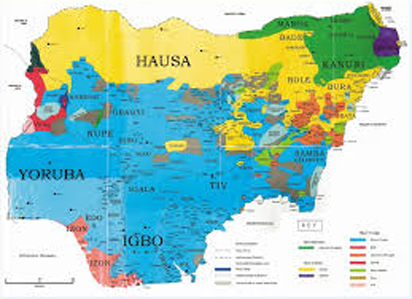
Map-of-Nigeria
By OMOTOYE OLORODE
THE evolution of the political structure of Nigeria was shaped by the administrative convenience of the colonial authorities and their indigenous collaborators. Similarly, the templates, especially of economic development, was laid more than a decade before independence by external imperialist forces that have retained their hegemony since then; again in collaboration with indigenous forces of exploitation.
The major consequence of the contributions of working people in Europe and ordinary peoples of colonised territories, including Africa was the post- World War II anti-colonial agitations and demands not only for decolonisation, but also for socialist and humanistic transformation of the World.
That was what forced the triumphant hegemonists to embark on the reset which generated the United Nations Declaration of Human Rights, UNDHR, the tactical retreat of colonialism and, more importantly, the foundations of “development” and development strategies (Development Decade Strategies) of the UN under the control of the United States and Western Europe and supervised by the Bretton Woods institutions (the IMF and the World Bank) which were birthed in 1944.
The World Bank, the IMF and related Bretton Woods’s institutions had become more and more blatant and more audacious seconding their agents and employees to Nigeria and other former colonies as ministers, technocrats and “advisers”! That is exactly what had happened to Nigeria in the last 20 years especially.
That is where we still are! That is the foundation of the current neocolonial control from the Structural Adjustment Programmes, SAP, in the early 1980s, and entrenched on fresh illusions like Vision 2010, Vision 2020, NEPAD, NEEDS, MDG, SDG, etc. It is the foundation of the permanent social and economic crisis that had been imposed on countries like Nigeria.
Colonisation, colonial conquests, anti-colonial resistance and neo-colonialism
Colonial conquests were aided of course, in many instances, by internal conflicts among indigenous African hegemonies and between developed and less developed or less organised/weaker hegemonies. Internal imperialisms and colonising regimes were established both in many parts of Northern Nigeria (Tiv and Jukun), revolutionary Madhism in the North East, the Arochuckwu hegemony in the South East, Nupe and Fulani imperialisms in central Nigeria and northern Yorubaland, Benin imperialism in Eastern Yorubaland and Ibadan and Oyo imperialism in Central and North Yorubaland. Historical accounts are well known of collaboration of indigenous ruling classes with marauding, European coloniser’s across the length and breadth of Nigeria.
We shall return to some of these issues especially concerning some of the current contrived narratives that seek to promote, and re-write histories and promote the myths of, coherent separatist ethnic nationhoods or even stereotyped cultural identities of certain ethnic groups as arguments for separatist projects and against the possibilities of the emergence of a Nigerian nationhood that guarantees economic well-being, solidarity and equality among Nigeria’s working people.
Let us for example restate that, beyond the convenience of colonial administration which indigenous collaborators enabled, the evidence for the claims that the British colonialists forced our peoples together is tenuous! The truth is really that before the establishment of colonial rule, different ethnic nationalities were already in varying degrees of political, commercial and cultural contact and collaboration.
The first generations of Nigerian nationalists who were domiciled largely in Lagos actually made anti-colonial resistance across Nigeria (in Bida, Calabar, etc.) their legitimate concern. In 1946, when the British colonial authorities sought to impose a regionalist constitution on Nigeria, the more conscious Nigerian nationalists like Herbert Macaulay, Nnamdi Azikiwe, Hadjia Gambo Sawaba, Michael Imuodu, etc., mounted a vigorous campaign around Nigeria against what they saw as a strategy of weakening Nigerians by dividing them.
The truth is also that colonial conquests were helped and aided largely by individual indigenous populations exploiting existing antipathies amongst themselves while colonial exploitation bloomed through the deployment of colonial political power and military force to control commerce, agriculture, and industry; and to impose taxes and extract forced labour. These all were conditions that created, and still promote, venerate, and enforce, colonial culture.
Resistance by beleaguered native populations and collaboration, by local agents were, of course rife in Ijebuland, Benin, Arochukwu in many other parts of Nigeria (East Delta, Delta, Bonny, Borgu, Opobo, Iseyin, Satiru, and in the mines on the Plateau – in what they called “Pacification”. Decolonisation democratisation, adult suffrage by colonising forces in colonial territories, were all elements of tactical withdrawal especially with the state of wars of independence after the Second World War in VietNam, Haiti, and Algeria for example, the dramatic events in Cuba in 1959, and the general anti-imperialist militancy in the colonies led largely by working people and the youth like Nigerian Youth Movement.
The Nigeria Labour Movement and Organised Labour especially since 1978. Needless to emphasise, exploitation of labour engenders organisation for resistance through time and space in human history. And in general, we can be categorical that the labour movement and organised labour in Nigeria did give a credible account of itself as a critical component of the labour movement and as a conscious movement with its role as part of the vanguard of the oppressed and in spite of its numerical limitations that had been, in part, assured by legal encumbrances.
The anti-labour laws: Trade Unions (Disqualification of Certain Persons) Act 15 (1977) by Obasanjo’s military dictatorship leading to the 1978 Trade Union (Amendment) Decree 22, of 1978, reorganisations, and the organisations themselves, assured the current bureaucratisation and other limitations of organised labour so thoroughly that it appears clear that the 1978 Decree was, and remained, essentially an instrument of control by the Nigerian ruling class rather than empowerment of organised labour and Nigerian working people.
To be sure, between 1978 and 1988, the leadership of the mainstream organised labour, NLC (Nigeria Labour Congress under Hassan Sunmonu and Ali Chiroma), being politically committed to working class ideology, fought brilliantly on the sight of Nigeria’s labouring masses (organised labour, women, the students and the youths and socialist and progressives intellectuals academics, professionals – lawyers, doctors, students, journalists, etc.).
These were the years of definitive inauguration of neo-liberalism – SAP, NEEDS, NEPAD, SDG, MDG, etc. Then the total eclipse of the NLC until 1998! Since then, against all odds and obstacles; segments of the left in the labour movement struggled diligently to strengthen organised labour especially via engagements with the NLC headquarters, and with industrial unions at state council and Local Government Chapter levels building vertical and horizontal synergies.
We can, and we must, assert without any fear of contradiction that the keeping at arms-length of a significant segment of labour activists (students, intellectuals, etc.) from the bureaucracy of organised labour and from actual day-to-day organising, worker education, etc. had enabled organised, labour at all levels to deprive Nigeria’s working people of the consciousness and capacity for self-organising, class consciousness and class-oriented politicisation. The situation has also enabled the bureaucracy of organised labour, especially since 1989, to shut out the afore-mentioned categories of labour activists form political organising in the movement!
The leadership of organised labour had thus kept the “political project” of the movement entirely in its custody (some say privatised) with all the consequences of the embarrassing responses of industrial unions and state councils to the question of working class pursuit of state power in the last decade or so.
*Olorode, member of the Secretariat Collective, TPAP-M Campaign for Socialist transformation of Nigeria, wrote via omotoopo@gmail.com
Disclaimer
Comments expressed here do not reflect the opinions of Vanguard newspapers or any employee thereof.