

Mahmood Yakubu
By Jide Ajani
Considering the now manifest futility of the Card Reader, INEC Server, the Bimodal Voter Accreditation System, BVAS, and the INEC Result Viewing portal, IReV, the spectre of gloom that continues to envelop Nigeria’s electoral space is not about to be swept away. This is so because lawmakers who make laws to guide the conduct of elections either do not think through some of the issues or are unmindful of the supremacy of the Constitution or deliberately choose to create confusion with legislations that waffle at best and create alternative realities.
The judicial pronouncements after the 2015 general elections that the Card Reader had no place in the 1999 Constitution and the Electoral Act 2010 and, therefore, was not relevant for the conduct of the 2015 general elections, even after Professor Attahiru Jega, former INEC Chairman, had touted its capabilities, rendered it discombobulate. No case was decided on the merit of the Card Reader.
For the 2019 general elections, Professor Mahmood Yakubu promised Nigerians that an INEC Server would help the Commission warehouse results and it would be impenetrable. This was meant to be an innovation to the process to avoid external interference with results coming from the field. But during the litigation that followed the 2019 presidential election, INEC itself obfuscated issues surrounding the server at the tribunal. The much-touted server did not serve any useful purpose for the 2019 elections. Before the latest round of elections in February and March 2023, Professor Yakubu gave Nigerians and indeed the whole world the impression that all electoral ills would be solved once results are transmitted online and in real-time to the IReV so that Nigerians can check polling unit results with what is posted on IReV. That way, many had hoped, discrepancies would be observed and reported and the fidelity of the process would be guaranteed.
Unfortunately, for three elections that were held on the same day at the same time (February 25, 2023), the results of the House of Representatives and Senate were uploaded online, real-time, but the results of the presidential election “suffered a glitch” and were not uploaded as promised. Apart from other sundry allegations, many Nigerians hinged their participation in the 2023 elections on the belief that Professor Yakubu would deliver on his promise. Had presidential election results been uploaded online, real-time, tensions arising from disputation of election results would have been less, without prejudice to the other issues of alleged rigging and non-qualification. The Supreme Court alluded to this on the issue of confidence in INEC.
The Supreme Court speaks
The Supreme Court of Nigeria has done justice to the appeal brought before it by the presidential candidates of the Peoples Democratic Party, PDP, Alhaji Atiku Abubakar, and the Labour Party, LP, Dr Peter Obi. It gave judgment last week on the vexed issues of admissibility of fresh evidence (the Chicago State University, CSU, deposition), and the seven other issues brought before it as adjudicated upon by the Presidential Election Petition Court, PEPC, which threw out the petitions brought by the candidates earlier.
The seven Justices of the Supreme Court who drew the curtain on the 2023 presidential election were Inyang Okoro, Uwani Abba-Aji, Lawal Garba, Ibrahim Saulawa, Adamu Jauro, Abubakar Tijjani and Emmanuel Akomaye Agim. The seven issues resolved in favour of President Tinubu include: (1) INEC substantially complied with the Electoral Act 2022 and the constitution in the conduct of the poll; (2) the Election cannot be nullified due to the unavailability of results on INEC’s IReV portal; (3) Failure to secure 25 per cent of votes in the Federal Capital Territory, FCT, Abuja cannot invalidate a winner’s election; (4) Petitioners did not prove allegations of rigging against Tinubu; (5) The issue of APC’s double nomination of Vice President Kashim Shettima had earlier been decided by the court on May 26, 2023; (6) Tinubu’s forfeiture of $460, 000 drug money was raised when the Respondents had already filed their process; and (7) Petitioners did not provide alternative results to INEC’s figures.
Also, in a unanimous decision by the seven-member panel of Justices, the apex court held that Obi’s appeal deserved to be dismissed because it lacked merit. In the lead judgment delivered by Inyang Okoro (JSC), the court ruled that the issues Dr. Obi raised in his petition were already decided in the separate appeal filed by the candidate of the PDP, Alhaji Atiku Abubakar. He noted that the only distinct issue that Obi raised in his appeal was that Vice President Kashim Shettima had double nominations from the All Progressives Congress, APC. He then concluded that the Supreme Court had earlier decided the issue on May 26, 2023, in an appeal marked: SC/CV/501/2023. “This court cannot allow the matter to be relitigated in this court. There must be an end to litigation. This matter ought not to have come here. The appeal lacks merit and it is accordingly dismissed.” The Supreme Court passed judgment on the case brought before it but not on the general conduct of the 2023 presidential election.
Lessons
Now that the Supreme Court has given the final verdict in the 2023 presidential election petition circus, there are lessons to learn.
The lessons range from the role of INEC, how elections are conducted; what the politicians can and must do to win; and how election petitions should be packaged to deliver desirable output and outcomes, going forward. In addition, it did not appear that those crying foul were diligent in pursuit of addressing their grievances. The Presidential Election Petition Court, PEPC, and the Supreme Court have made that very clear – you cannot allege and refuse to prove your case.
How to rebrand INEC and inspire confidence
On the appointment of persons to INEC, Ex-President Goodluck Jonathan is still being celebrated today in Nigeria and around the world for his contributions to the improvement of the electoral process in the country and his statesmanly disposition in the decisions he made even though he wanted a second term. Section 154 (3) of the 1999 Constitution as amended, states that (1) Except in the case of ex officio members or where other provisions are made in this Constitution, the Chairman and members of any of the bodies so established shall, subject to the provisions of this Constitution, be appointed by the President and the appointment shall be subject to confirmation by the Senate. (2) In exercising his powers to appoint a person as Chairman or member of the Council of State the National Defence Council or the National Security Council, the President shall not be required to obtain the confirmation of the Senate. (3) In exercising his powers to appoint a person as Chairman or member of the Independent National Electoral Commission, National Judicial Council, the Federal Judicial Service Commission or the National Population Commission, the President shall consult the Council of State.
This was exactly what Jonathan did in consultation with the Council of State and appointed individuals of proven integrity of civil society background like Prof. Jega as Chairman and two other well-known individuals from civil society to re-rebrand INEC and restore public confidence after the rigged elections of 2007. That singular action by former President Jonathan immediately restored public confidence and trust of the Nigerian people in the electoral process. This led to various innovations under his administration such as (1) the Compilation of a successful Biometric register of voters (which put an end of use of manual register) ; (2) The use of PVC identity cards in our elections; and (3) The use of Smart Card Reader, which led the pathway for technology in Nigeria’s electoral process. All the above-mentioned innovations by Jonathan made rigging difficult and that led to the emergence of President Muhammadu Buhari in 2015. But INEC under Buhari engaged in the reverse gear. Card-carrying members of the ruling All Progressives Congress, APC, were brought to INEC. Already, President Tinubu has nominated nine Resident Electoral Commissioners for confirmation. Yet, the constitutional provisions in Section 154 (3) of the 1999 Constitution as amended, are not being followed. This is a recipe for another disastrous outing.
Role of INEC and how elections are conducted
Based on the judgment by the JSCs, it is now incumbent on INEC to ensure that it conducts elections in a manner that inspires confidence in the people. Had Professor Yakubu not over-promised and under-delivered about the inherent magic of the “Bimodal Voter Accreditation System (BVAS) for both voter accreditation and e-transmission of results for collation and the IReV portal”, the level of anxiety in the polity would have been tamed. If this was a marketing gimmick employed by Yakubu to entice the voting public to have a buy-in in the 2023 general elections, it worked because it was based on his promise of an inclusive and transparent process that galvanised the youths who understand the power of technology, to massively participate. But it only worked to the extent that many trooped out to register to vote but many could not have their PVCs before the election. Worse, many who had their PVCs could not vote owing to logistical problems on the part of INEC. The election management body can do better in future elections if it hopes to inspire confidence.
How election petitions should be packaged to deliver desirable output and outcomes
The JSCs declared that in proving an election petition, the petitioner must not only provide all the documents to support the petition, but there must also be eye-witnesses who must come before the tribunal to prove the infractions without doubt – no matter how many they may be. The Supreme Court made it clear that in an election held in 176,866 polling units in 774 LGAs of Nigeria, petitioners must be specific about areas of electoral misconduct. To be clear, they must also provide evidence and witnesses who will speak to the evidence directly. Inviting a state collation agent as an octopod omnipresent and omniscient superman who witnessed electoral malpractices in different polling units at the same time is dubious and dishonest. He would merely provide hearsay. The JSCs said that is not permissible. There are 153 sections in the Electoral Act 2022 as amended. Relying on just a handful of sections allegedly not complied with as a basis for the nullification of an election would not and did not meet the threshold of substantial non-compliance. Relying on just the non-transmission of results online, real-time by INEC cannot invalidate the election.
What the JSCs have said, in effect, is that a petitioner challenging an election must present a watertight petition, present cogent and verifiable evidence and provide witnesses who would also speak to the written evidence as well as provide first-hand observation of malpractices and infractions. All these must be in such a quantum as to constitute substantial non-compliance to enable the judges to come to a determination that would render the election invalid.
Based on the judgment of the Supreme Court, politicians would need to do more in the area of mobilisation and monitoring of their votes. That way acts capable of depriving them of votes would be observed and recorded. Then, there is the issue of polling agents who must be up and doing. However, the cost of appointing polling unit agents in the 176,866 polling units in 774 LGAs remains a huge problem. This in itself can fuel corruption in the system because except with a huge war chest, the cost of 176,866 polling unit agents across the country, in the face of the Supreme Court judgment that every evidence of electoral malpractice must be supported by witnesses is like pulling an elephant through the eye of the needle within the context of substantial compliance. It is a fool’s errand.
Vanishing tribe of Nigerian voters

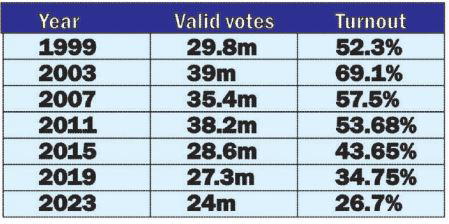
Apart from 2003 when 39 million Nigerians were said to have trooped out to vote, a figure representing 69.1%, the tribe of Nigerians who vote at every general election cycle have continued to dwindle. (See box). In 1999, 29.8 million people were said to have voted (52.3%); in 2007, 35.4 million voted (57.5%); in 2011, 38.2 million voted (53.7%); 2015, 28.6 million voted (43.7%); in 2019, 27.3 million voted (34.8%); and in 2023, 24 million voted (26.7%).
So, why have the figures been shrinking? A combination of factors, ranging from voter apathy occasioned by a lack of trust in INEC and the continuing hardship voters face on the day of the election, logistical issues that appear not to be improving, election day violence which scares voters away and a growing frustration on the part of voters that their votes do not count, is responsible.
Why the problem may get worse in 2027 is that for all the promises and assurances given by Professor Yakubu about the inviolability of BVAS and IReV, promises which galvanised millions of Nigerians to show interest in the election, their hopes were dashed once it was discovered that some results were not uploaded.
The cost of 176,866 polling unit agents across the country, in the face of the Supreme Court judgment that every evidence of electoral malpractice must be supported by witnesses is like pulling an elephant through the eye of the needle within the context of substantial compliance. It is a fool’s errand
Had presidential election results been uploaded online, real-time, tensions arising from disputation of election results would have been less, without prejudice to the other issues of alleged rigging and non-qualification. The Supreme Court alluded to this on the issue of confidence in INEC
Disclaimer
Comments expressed here do not reflect the opinions of Vanguard newspapers or any employee thereof.