
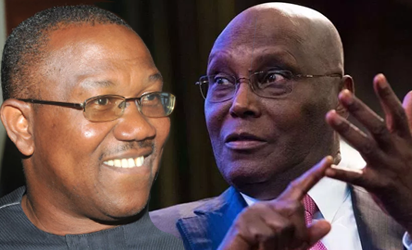
IT is increasingly evident that neither Atiku Abubakar nor Peter Obi, the two major opponents of President Bola Ahmed Tinubu in the February 25 presidential election, is after the truth or justice as both have jointly and differently proclaimed. Theirs is a pursuit of naked ambition in an apparently forlorn enterprise, namely: to be declared president either by hook or crook.
Hence, the doggedness and single-minded focus that is impervious to any other considerations, especially those that pertain to the good and continued existence of the country as one entity, with which they have gone about their quest for victory in and outside the courts since February.
In the weeks before the decision of the Presidential Election Petition Tribunal affirming Tinubu as the winner of the election, Peter Obi of the Labour Party and his supporters came across as the most vociferous and truculent opponents and critics of the president’s victory. They are still very much so. But since that decision by PEPT, Atiku Abubakar of the Peoples Democratic Party has been angling to be the most implacable opponent of the president. He has been inconsolable and as Nyesom Wike did for him only recently, only Tinubu’s ouster will pacify Atiku.
From nowhere, he resurrected the quarter-of-a-century old debate about the educational claims of the president, highlighting dark spots about his identity. While some of this has been resolved by courts in Nigeria, Atiku this time around decided to look beyond the shores of Nigeria to the United States of America, specifically, the Chicago State University from where Tinubu graduated in the summer of 1979. Peter Obi on his part sticks in the main to the same argument he took before PEPT that he and not Tinubu won the election.
This, even when, as the PEPT made clear he could not provide the evidence to support his claim of victory. He continues to speak of reclaiming his ‘stolen mandate’ while both he and Atiku boast of new evidence with which they hope to convince the judges of the Supreme Court to award them victory in the weeks ahead. Neither Atiku nor Obi has conceded to the other. Each has separately proclaimed himself the winner of the presidential election and without resolving this contradiction they are united in their determination that the election result be overturned and each separately declared the winner.
Tinubu fought hard but failed in the US courts to have his academic records concealed from Atiku. The demands of the opposition in their latest campaign for the release of Tinubu’s academic record keep shifting from one point to the other. Initially, their argument seems to be that Tinubu was never at CSU or at best stole the records of some other alumnus, probably a woman, of the institution. But after depositions by the registrar of the university, it was firmly established that Tinubu was admitted to the institution in 1977 as a male and graduated with honours in June 1979. This ought to have put a stop to this judicial expedition which Atiku and other opposition elements continue to say turns negative international attention on Nigeria even when they are the ones painting ugly profiles about their country.
By the way, there is nothing strange or inherently Nigerian about politicians and their struggles of identity crisis. A quick example is Donald Trump, everything about whom, from his self-proclaimed German ancestry of his father (rather than his grandfather’s) and his financial worth for which he is presently enmeshed in litigation in New York, etc, is the subject of controversy. It was the same Trump that led the ‘birther’ controversy about Barack Obama’s date and place of birth, raising questions about his American nationality. Outside the way some are going about it, trying to run the country down while denigrating the person of the president, there is nothing to be ashamed of here.
What we should be asking ourselves or should worry all of us as Nigerians is, at what point Tinubu’s opponents in the 2023 election would stop and allow him to do the bit he can as president at a time of unprecedented economic, political and security crises? Atiku on his part has said that can only be after the decision of the Supreme Court. This is as it should be except that in his judicial gambit abroad in the last couple of weeks, he has appeared more to be on a mission of personal vendetta aimed at destroying his erstwhile friend and ally in past battles. He cannot bear to see Tinubu win at first attempt what he couldn’t achieve after seven attempts.
As for Obi and his supporters, they have been the most destructive in their campaign of calumny. Obi may have been adept at concealing his hands but he periodically stirs up his base with inciting rhetoric when it seems inadequately responsive to his claims of mandate-theft, steering it in the direction of attacking anything and everything sacred about the Nigerian state. There is no doubt that most of his Obidients are South-Easterners and a sprinkling of Nigerians from other parts. Following his loss, they returned to spewing bigotry and hatred for Nigeria and Nigerians of other ethnicities, especially those they believe stopped their political messiah, Peter Obi, in his track and jailed Nnamdi Kanu.
This is the difference between Obi and Atiku- their respective base, their supporters. I have heard some say that Atiku’s pursuits in the courts have neither resulted in ethnic backlash nor invited imprecations on the Fulani or Northerners. Such attacks have no place in any civilised society and should be vehemently condemned. But neither Atiku nor his supporters have adopted the violent bigotry, ethnic baiting and cussing that can be randomly associated with Obi’s supporters. Nor has Atiku postured or been portrayed as a symbol of ethnic retrieval and nativist aspiration as Peter Obi has.
For this, Obi far more than Atiku now in the end-days of his political career, stands to lose a lot. His future as a cross-ethnic politician is greatly imperilled and it is doubtful if he would ever attain the height he reached in the last election. The bile, hatred and selfishness with which he and his supporters have pursued his political ambition in the last one and half years, has surely done far more damage to him than they may care to know. No election is perfect and when politicians concede victory to their opponents it is not for lack of grievance but for their political future, the good of their institutions and well-being of their country.
Disclaimer
Comments expressed here do not reflect the opinions of Vanguard newspapers or any employee thereof.