
By David Adonri, Vice Chairman, Highcap Securities Ltd
The incidence of boom, bubble and burst is a cyclical feature that assaults all stock markets in the world. No market has succeeded in overcoming this phenomenon.
The cyclical nature of the economy and markets, generally, mean that periods of high growth booms are followed by tortuous market corrections through precipitous declines.
According to Investopedia, “A boom illustrates a period of elevated or increased growth within a business, market, industry or economy”. A company or industry boom results in an increase in output, jobs and investment in it. On a more aggregate level, a boom is a period of rapid economic expansion indicated by increasing output and income, employment, prices, profit and inflation rate.
Throughout the 1920s in the USA, a long boom took stock prices to peaks never seen. From 1920 to 1929, stocks in the US more than quadrupled in value. The same scenario played out in Nigeria between 1999 and 2008 when The Nigerian Stock Exchange, now the Nigerian Exchange Limited (NGX), enjoyed a decade long boom which peaked at All Share Index (ASI) of 66,371.20 and market capitalization of N15.64 trillion on 5th March 2008.
During any boom, stupendous fortunes are made. Many investors become convinced that stocks are a sure thing and borrow heavily to invest more in the market. In boom periods, investor’s confidence is high and no one wants to miss out on profits. Investors get carried away in their optimism, sometimes borrowing a lot of money to invest even in risky companies and ignoring warning signs.
When a boom extends beyond its reasonable life or if prices extend far beyond the fundamental growth trend where buyers become irrationally exuberant, it can turn into a bubble. Bubble, in an economic context, generally refers to a situation where the price for something, whether an asset, an entire sector or market exceeds its fundamental value by a wide margin. Speculative demand rather than intrinsic worth usually fuels the inflation of prices that precipitate bubble formation. Behavioral finance theory attributes stock market bubbles to cognitive biases arising from “herd behavior” which is doing something because everyone else is; ‘Short term thinking” which is just looking at the immediate returns, or thinking that you can beat the market and time a quick exit; and “cognitive dissonance” which is only accepting information that confirms an already held belief, and ignoring anything that does not. The stock market exemplifies suspension of disbelief mostly by market participants when the spectacular price surge is occurring. It is only in retrospect, after the bubble has burst, that they are recognized in regret. Other theoretical explanations of stock market bubbles have suggested that they are rational, intrinsic and contagious.
There are five stages in the life cycle of asset bubbles depicting the pattern to their rise and fall which can guide the unwary investor from getting entangled in their deceptive web. These are:
1) The “Displacement Stage” which occurs when investors get enamored by a “new paradigm” , e.g a huge decline in interest rate can sow seeds for a housing bubble.
2) In “Boom Phase”, the precursor triggers a frenzy which draws more and more speculators thereby orchestrating and transforming demand into a boom.
3) The “Euphoria Phase” is when caution is thrown to the wind, as asset prices skyrocket. New valuations are touted to justify the relentless rise.
4) In the “Profit Taking Phase”, the “smart investors” heeding the warning signals that the bubble has popped to the point of bursting, starts selling positions and taking profits. However, predicting the exact time a bubble will burst can be futile because markets can stay irrational longer than you can stay solvent.
5) In the “Panic Phase”, it only takes a relatively minor event to prick a bubble but once it bursts, the bubble cannot inflate again. In the panic stage, asset prices reverse course and descend as rapidly as they had risen.
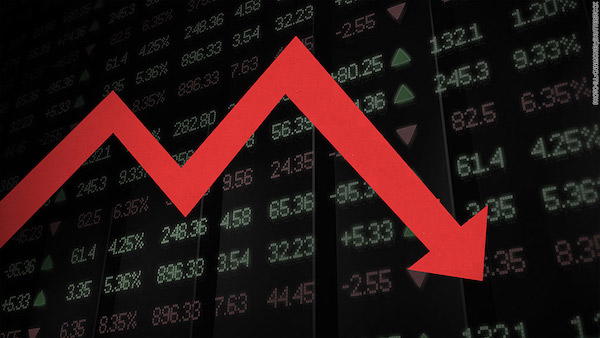
When a bubble bursts, it can trigger a stock market crash, a general economic recession or even a depression. The damage caused depends on the economic sectors involved, whether the extent of participation is widespread or localized and to what degree debt is involved in inflating the bubble. Debt fueled equities bubble have been found to cause longer and more severe recessions.
The bursting of equities and real estate bubbles in Japan in 1989 – 1992 led to a ten year period of Stagflation often referred to as the “Lost Decade”. In the US, burst of the “dotcom bubble” in 2000 and the residential real estate bubble in 2007/2008 led to severe recessions.
The “Great Depression” in the US that lasted for several years emanated from bursting of asset bubble that occurred in 1929. History is replete with incidents of bubble in global financial markets, from the Dutch “Tulipmania” of the 17th century which was the first major financial bubble to the Nigerian stock market bubble and crash in 2008. When the bubble burst in Nigeria, the devastation wreaked incalculable havoc on the banking and real estate industries. It also completely wiped out retail investors from the market.
What resembles a boom is currently going on in the Nigerian stock market. It commenced in 2020 when the expansionary macroeconomic policy of the Federal Government to combat Covid19 – induced stagflation, misfired. Instead of the expanded money supply to flow into the productive sector as targeted by policy, it inundated the equities market, causing an unexpected bonanza. The equities market defied sour economic fundamentals in that year to appreciate by 50.03%, with ASI advancing from 26,842.07 it opened on 1st January 2020 to close at 40,270.72 on 31st December 2020.
That year, equities market capitalization grew from N19 trillion to N21.1 trillion. Growth continued in 2021 with ASI appreciating by 6.07% to close the year at 42,716.44 and market capitalization at N22.297 trillion. The surging equities market again beat every postulation attendant to the penultimate election year to appreciate by 20%, closing at 51,251.06 at end of 2022. Between 1st January 2023 and 30th May 2023, ASI grew moderately by 3.06% to end the month at 52,822.93.
Thereafter, it proceeded on a galloping race which took it to 68,143.34 on 8th September 2023, thus shattering its 15 years old record of 66,371.20 attained on 5th March 2008. Market capitalization advanced to N37.3 trillion on that day. Since the rally started in 2020, the ASI has advanced from 26,842.07 to 68,143.34 as of 8th September 2023, resulting in 154.5% appreciation. This is the 4th year of sustenance of the current rally which has metamorphosed into a boom.
Paradoxically, the boom is occurring when the economy is gripped by galloping inflation which started rising steadily from 11.02% in August 2019 and now trending around 25.8% according to August 2023 figures released by NBS. Can this boom therefore be a fall out from the attribute of equities to always match up with inflation or it is purely a speculative attack aimed at pecuniary gains.
When compared to the earlier stock market boom in Nigeria, the equities market caved in under the weight of a market capitalization of N15.64 trillion but current market capitalization is N37.3 trillion which some analysts believe can withstand further weight if the rally continues.
Another opinion is that this meteoric rise may be indicative of continued shallowness of the equities market despite the new stocks and commodities investment outlets.
While watching how the market plays out, retail investors who may not have access to hedging through derivatives can diversify beyond equities. In spite of everything, the cycle of boom and bust may not materially hurt a long term investor since with time, another boom will certainly come which can restore what had diminished.
Disclaimer
Comments expressed here do not reflect the opinions of Vanguard newspapers or any employee thereof.