
By Rita Okoye
An eminent historian at the University of Texas at Austin, Professor Toyin Falola, has described Africa’s religious syncretism as the continent’s proof of its ability to adapt and grow.
Falola noted that “Africa’s kaleidoscope of religious traditions is not only a tribute to its rich history but also a lighthouse illuminating the path to its future. Traditional African faiths play an important role in this dynamic interplay, which cannot be overlooked. These traditions, which are deeply founded in African history, have served as the bedrock of ethical norms, molding both communal relationships and individual moral compasses.
However, like any other society, Africa’s religious landscape has been influenced by outside forces. The arrival of Islam and Christianity on the continent did not destroy local faiths. Instead, these faiths coexisted and frequently intertwined with native spiritual practices, exhibiting Africa’s inherent ability to adapt and grow. This technique, known as syncretism, highlights the continent’s unique ability to blend disparate materials into a seamless fabric.”
Stretching this reality, Falola added “The inherent flexibility of African religious principles emerges as a strong strength as we delve deeper into this fascinating narrative. Just as rivers meander and adapt to their surroundings, the continent’s spiritual traditions have demonstrated extraordinary adaptability in the face of social shifts. This fluidity, on the other hand, does not imply a lack of depth or stability; rather, it represents an adaptive resilience that anchors these values in both continuity and change.
In this enormous sphere of religious debate, personal experiences, communal standards, and global impacts all intersect. Religion, in all of its African expressions – whether indigenous spiritualities, Islam, Christianity, or new faiths – acts as both a protector and a guide. It shapes a society’s ethical architecture while also providing individuals with a framework for understanding their role in the world and defining their moral bounds.”
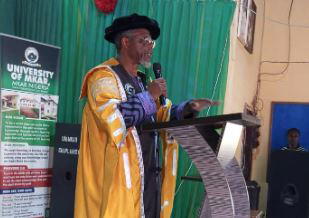
Falola, who is the Jacob & Frances Sanger Mossiker Chair in the Humanities, and University Distinguished Teaching Professor at The University of Texas at Austin, gave this submission while delivering the convocation lecture on religion and values at the University of Mkar, Gboko, Benue State, on Friday.
Graduating students, top academics, and the public were led by the Vice Chancellor, Professor Zacharys Gundu.
Falola in his lecture also stated that women’s crucial role in constructing religious and ethical ideas cannot be ignored. For him, “women have historically served as both keepers and innovators in the spiritual realm. Understanding their influence in evolving religious contexts can provide insights into gender dynamics, power structures, and prospects for more equitable communities as the continent progresses.
Despite this kaleidoscope of possibilities, challenges, and opportunities, one thing shines out: religion’s lasting role in defining Africa’s ethical environment. The continent is at a crossroads, with one foot firmly planted in its illustrious past and the other confidently stepping into the future. The interaction between its various theological tenets and modern moral inquiries as it traverses these temporal dimensions will surely shape the societies of tomorrow.”
Earlier in his address, he stated that the changing societal circumstances need the reconsideration of religious ideas. According to him, “Given the rising complexity of ethical quandaries confronting African nations, it is reasonable to speculate that religious systems may evolve. For example, deep-rooted African love for nature can combine with global environmentalist beliefs, possibly combining principles of responsible stewardship from Islam or Christianity. Such convergence has the potential to result in an interfaith ethical framework advocating environmental protection.
However, transformation is rarely easy, especially at the intersection between tradition and modernity. The process of harmonizing religious ideas with current challenges may face opposition. Fundamentalist movements aiming for the restoration of pure religious practices and traditional virtues may emerge in response to societal changes. The struggle between innovation and tradition, global influences and local identities, and unity and division will undoubtedly affect Africa’s future trajectory of religion and ethics.
The delicate dance of religion and values in Africa is a riveting story, embodying a fluidity that embodies the various spirits of the region. But, despite this turbulence, one thing is certain: religion plays a critical role in establishing ethical frameworks. It is still a beacon of moral insight, a venue for ethical debate, and a spark for communal action.”
Disclaimer
Comments expressed here do not reflect the opinions of Vanguard newspapers or any employee thereof.