
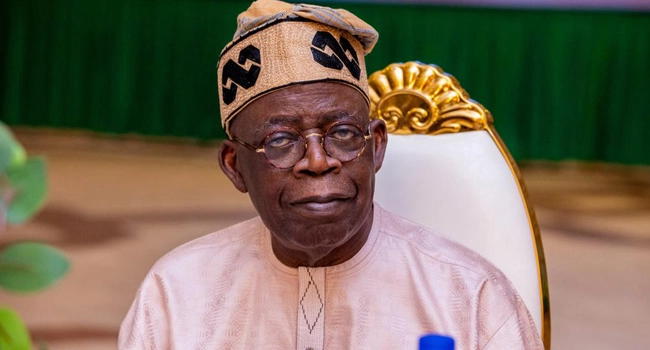
President Bola Tinubu
By Victor AhiumaYoung
The first 100 days of President Bola Tinubu’s administration has been torturous and frustrating for Nigerian workers and masses.
The enthusiasm of leaving the past eight years of President Muhammadu Buhari behind has so been dashed even from day one.
Since the President famous declaration that “Subsidy is gone” during his inaugural speech, workers like other Nigerians with the exception of few privileged ones, have been wallowing in pains and excruciating suffering.
Other pronouncements by the government in its 100 days have worsened the woes and socioeconomic conditions of workers.
Today, those in employment are not better than those without employment as workers find it extremely difficult to meet their responsibilities to their immediate families not to talk about other dependents.
The palliative measures promised by the government to assuage the negative and dehumanising consequences of the subsidy removal have remained a mirage 100 days after.
Besides the adhoc nature of the subsidy trick, as expected, the whole charade is manifesting as a political patronage and jingoism.
While all these are happening, the Nigerian workers have descended towards destitution as being manifested and characterised by unpaid salaries, delayed wages, job losses, casualisation of employment and other forms of precarious employment practices.
In the other hand, the prices of essential commodities, transportation and education among others, have continued to maintain ferocious rise beyond the roof.
The naked deception that money saved from petrol subsidy removal would be channeled into education and health services among others, has been exposed by trending increases in tuition fees across all public schools from primary to tertiary.
Last month, Nigeria Labour Congress, NLC, alongside its civil society allies held a nationwide protest to draw the attention of the government to the hardships its programmes and policies have been unleashing on the citizens especially workers.
Between Tuesday and Wednesday (yesterday) NLC embarked on a nationwide warning strike again to protest perceived care free attitude of government to the hardships and pains its policies have inflicted on the workers and other Nigerians.
NUCFRLANMPE
Lamenting the plight of workers in the manufacturing industry was President of the National Union of Chemical, Footwear, Rubber, Leather and Non-Metallic Products Employees, NUCFRLANMPE, Babatunde Olatunji, at a seminar on ‘’Social Dialogue as a Vehicle for Promoting Decent Work and Industrial Harmony”, in Ado Ekiti, Ekiti State.
He said: “We plead with the government to hasten up with policies to lessen the suffering Nigerians, especially workers are passing through because of the removal of subsidy on Petrol. Nigerians are really suffering.
“Presently, the interest rate stands at double digit discouraging investment and constituting hindrances to the manufacturing sector. In the same vein, inflation has gone beyond bearable limit with negative impact on the quality of life of both corporate organizations and individuals.
” One of the effects is job losses arising from redundancies and factories closure. Another effect is slashing of salaries and other welfare packages of workers. Some management have devised strange practices such as outsourcing and contracting staff against normal employment practices to break-even. For instance, workers in some factories work beyond normal eight hours a day without over-time payment while in some cases, outrageous targets are set for workers .
CAMPEF
Corroborating him, Executive Secretary of Chemical and Non-Metallic Products Employers’ Federation, CAMPEF, Femi Oke, said “the manufacturing sector is not growing because of the numerous challenges it is facing which include the Foreign Exchange, FX, policy scarcity and cost, removal of fuel subsidy, increase in electricity tariff, multiplicity of taxes and so on.
“We are experiencing poor capacity utilisation and shutting down of some operations. Thus leading to job rationalisation and losses. The government should focus on how to improve the manufacturing sector because they are the largest employer of labour.”
Continuing, he said “The fuel subsidy removal and the new foreign exchange policy is having an adverse effect on the manufacturing companies in the chemical sector. Some of the effects include increased cost of production/operational cost, reduction in sales as a result of reduced purchasing power by the customers, reduction of bottom line as a result of increased cost of operations.
Govt response
What has government been doing to cushion the negative effects of its policies on the people especially workers?
It appears that it has been motion without movement on the part of government. Even talking to leaders and representatives of workers has become a luxury.
The principle of social dialogue seems to have become alien to the government in its first 100 days in the office. In fact, one of the reasons giving by leaders of NLC for the two day warning strike was government apathy towards social dialogue. As at today, none of the committees including the main committee set up to work out measures to cushion the effects of subsidy removal has met since inauguration.
“The main committee (the Steering Committee) and the three sub-committees on Mass Transit, Energy and Compressed Natural Gas, CNG, have remained dormant while the federal and state governments are busy dishing out unsustainable, unrealizable and uncoordinated palliative measures that cannot assuage the hardships being inflicted on the majority of Nigerians especially workers and the poor masses by the fuel subsidy removal and other perceived anti-poor policies”, according to the labour leaders.
However, one glaring action the government is said to have taken in its first 100 days is to interfer in union’s matters by drafting its agents to occupy the National Secretariat of the National Union of Road Transport Workers, NURTW, after allegedly harassing, intimidating , arresting and even locking up the union’s leaders.
Recall that the NLC had earlier been raising the alarm over the government’s interference in unions’ affairs.
On August 28, the National Administrative Council, NAC, of the NLC after its meeting, faulted government takeover of NURTW headquarters in Abuja, saying “NAC-in-Session after exhaustively deliberating on the unlawful invasion of the National Secretariat of the National Union of Road Transport Workers, NURTW, by thugs and hoodlums escorted by the Police who peddled the name of the President of the federation in the course of their action and called for immediate withdrawal to avoid unrest
NECA’s petition
Even the Nigeria Employers Consultative Association, NECA, through its Director General, Adewale-Smatt Oyerinde, recently wrote to the Minister of Labour and Employment, Simon Lalong , warning against such interference as it goes contrary to the International Labour Organization,ILO, Convention 87 among others ratified by Nigeria.
Labour laws review
The 100 days have not given any signs that the government is ready to urgently address the issue of obsolete labour laws despite a ground work already done by immediate past government to review same and bring the laws up to speed with the current reality.
Recall that the last administration alongside social partners including NLC, Trade Union Congress of Nigeria, TUC, NECA, ILO, others, has worked on the review. What is left is for these stakeholders in the National Labour Advisory Council, NLAC, to meet and agree on the final draft for an executive bill to be forwarded to the National Assembly to legislate on.
It was expected that one of the urgent industrial relations matters the government should have prioritised was the review of the laws. Presently, stakeholders are worried over moves by certain interests to alter the draft bill. The government seemingly nonchalance attitude towards this in its 100 day has already set tongue wagging.
It is believed that if the draft bill is legislated on as agreed, it will go a long way toward addressing most lapses in labour relations in the country including issues of precarious and indecent employment practices and policies.
Disclaimer
Comments expressed here do not reflect the opinions of Vanguard newspapers or any employee thereof.