
•UNICEF laments learning crisis as NLP hits 501,174 users
By Chioma Obinna
Nigeria is facing twin crises of Out-of-school Children and Severe Learning Poverty.
Today, millions of children and young people are not developing even the basic skills they need to break out of poverty due to the destruction of schooling and learning by incessant insecurity.
The COVID-19 disruptions also worsened learning in schools but the birth of digital learning through the Nigeria Learning Passport, NLP, by UNICEF and partners is gradually boosting foundational learning nationwide.
Statistics by the United Nations Children’s Fund, UNICEF showed that Nigeria is facing twin crises of Out-of-school Children, OOSC, and Severe Learning Poverty with 3 out of every 20 OOSCs globally in Nigeria. Also, 3 out of 4 children, and even more of the poorest children, cannot read or solve simple math problems.
Worse still, the report revealed that deprivations are most severe in the Northern part of the country. According to a UNICEF Education Specialist, Babagana Aminu, statistics showed that Nigeria contributes 15 per cent to out-of-school children globally while Sub-Saharan African countries contribute 50 per cent to out-of-school children.
For a change in Nigeria’s foundational learning system, states like Edo have made progress through its Edo Basic Education Sector Transformation Programme (EdoBEST), in reducing the number of out-of-school children as well as boosting their literacy and numeracy skills.
Since the inception of EdoBEST, there has been a tremendous increase in the enrollment of children into Early Childhood Care, Development and Education, ECCDE.
Edo state ranks among Nigerian States with the lowest number of out-of-school children with 76,446, but the state government said the programme was implemented to improve basic education across the state and tackle learning poverty.
Currently, the Edo State Universal Basic Education Board (EdoSUBEB) said the state has recorded over 40 per cent of school enrollment increase yearly.
A visit to some of the schools in the state was revealing. Testimonies abound.
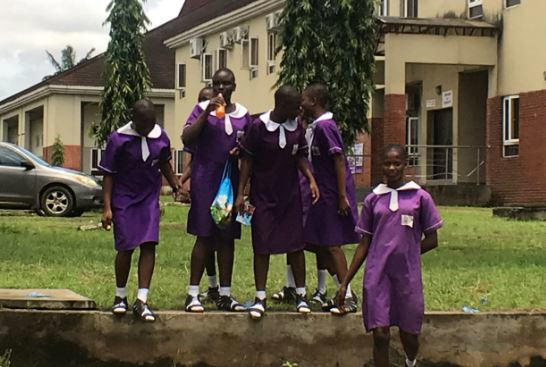
“I am 15 years old. I should have been in SS2 but my parents were not able to pay my school fees in my former school,” Esther Osahon, one of the students at the Samuel Ogbemudia Secondary School, Benin, recalled how the EdoBest programme brought her back to school.
According to Esther, she was attending one of the private schools in Benin when her father lost his job and could no longer pay her school fees.
“There is no difference between how we were taught in private school and this school. The new way of teaching with the tablet has also made learning easy for me.
“We are given textbooks free of charge and no school fees. The government has given people like me hope. I am happy,” she said with a smile
Like Esther, the Teachers also confirmed that the Edobest programme which introduced digital learning in the state has boosted teaching and reduced the volume of work.
“I studied education but I never liked teaching but when I saw this programme I decided to apply and I was interviewed and employed. Compared to analogue learning, digital learning has simplified teaching. We no longer write lesson notes because everything is contained in the tablet.
“Punctuality is key. Teachers are now being monitored. It has boosted the morale of students who are now excited to come to school and attend lessons. Those who don’t like asking questions during lessons now ask questions and we can measure their learning ability,’ a female Geography teacher, Akintunde Osaro, at the Samuel Ogbemudia Secondary School, Benin told Vanguard.
Osaro who also noted that the Edo state digital learning tagged: “EdoBest” has revolutionalised both learning and teaching in the state, said delivering lessons has become much easier and simpler.
Another teacher at the school, Florence Kehinde Oriakhi added that the tablet has been effective and beautiful in terms of the subject being taught, time management and punctuality as well as the number in class compared to the period of analogue.
“It is more comfortable for me as a teacher. The voluminous scheme of work is reduced with the digital system, notes are already prepared for us and what we have to do is to review the lesson notes before the lesson. The era of students trying to gaze at your facial expression to understand what you were trying to explain is over. The facts are there and it is at a glance.
“It has helped me a lot as a teacher. The student has also accepted it. The scheme of work is written online too. Everything is on the tablet, At the end of each class, the students applaud you and say thank you and that gives us joy. At the end of the class, there is evaluation and the children are also being helped at home by their parents,” Florence said.
The Executive Chairman, of EdoSUBEB, Mrs Eyitayo Salami, said the tremendous increase in the enrollment of children into ECCDE, which has culminated in the overall enrollment of children into Junior and Senior Primary schools has reduced the number of out-of-school children.
Salami who explained that early childhood education was about developing and moulding the whole child, which will serve as the foundation for their lifelong journey said EdoBEST has increased the amount of teaching, teacher technology, and textbooks in each school.
“Teachers now deliver high-quality and supportive learning experiences; pupils also engage in productive learning activities. The state has recorded seven per cent larger learning gains in numeracy and six per cent larger learning gains in literacy in EdoBEST schools compared with non-EdoBEST schools,” she stated.
The State Commissioner for Education, Edo State Ministry of Education, Dr. Joan Oviawe, said the state government has ensured that the education of an Edo child is a priority.
“For the last six years, we have focused on quality education, literacy and numeracy under our EdoBest education reform programme. This is why in 2013, Edo state was selected as one of the accelerator countries. We are the only state in Nigeria, that was selected among other African countries, because of the progress we have made in the eradication of learning poverty,” she said.
Oviawe added that in the last few years, the state has focused on tracking learning patterns to be in line with the National standard. We have also introduced the learning assessment, which helps us to assess pupils at each level. We are testing them when moving to primary two, primary six and JSS 3.
“With the learning assessment, we were able to measure both aspects from the perceptive of the learners and the teachers. Having corrected the foundational literacy and numeracy, we are now at the point in Edo state, where we are now focusing on replications. For those at the higher level, who do not know how to read and write, we cannot just send them away, hence the reason the government has set up the ‘operation, every child must read and write’, programme.
“The state governor has ensured that we bring education to everybody, irrespective of their age. You don’t have to go to a physical school to learn how to read and write. We have made the provision available; we have made the necessary content available. You can have your private tutor to teach you how to read and write. With all these interventions, Edo state is on the way to having a proper education system that ensures access to education and promotes quality education.”
In the views of Yetunde Oluwatosin, Education Specialist, with UNICEF Nigeria, Foundational learning skills which include; basic literacy, numeracy & transferable skills are the building blocks for all other learning, knowledge & higher-order skills and are imperative for continued learning & sustainable development.
She said foundational learning enables children to reach their full potential to participate in society.
She explained that the learning poverty rate would be reduced by 2030 to 38 per cent from pre-pandemic levels if countries keep their commitments and SDG4 pledges.
In Nigeria, according to the Multiple Indicator Cluster Surveys (MICS), only 1 in 4 children (ages 7-14) in Nigeria demonstrate foundational skills, and 73 per cent of 10-year-olds cannot read a simple text with understanding.
Speaking on Nigeria Learning Passport, Education Specialist, UNICEF, Babagana Aminu, who regretted that COVID-19 increased the learning poverty rate in low- and lower-middle-income countries from 57 per cent to 72 per cent in three years said LP provides continuous access to education for all children, youth, and teachers around the world and drive improved learning outcomes through high-quality, portable education in formal and non-formal education settings.
In Nigeria, Aminu disclosed that the Nigerian Learning platform has helped close the learning gaps in the country and enrolled 501,174, now in 18 states.
“With support from Airtel, 520 Primary and Junior Secondary schools and 100 IQS/Non-Formal schools have received devices with LP app, connected to the internet by Airtel Nigeria with a target to connect 300 more in 2023.
Also, 30,000 teachers were trained in 2022 with a target of 27,000 in 2023. IHS towers have also connected 187 schools and provided connectivity/signal to 400 unconnected communities in 2022 with a target of 200 schools in 2023.
“In the pipeline for the end of the year 2023, UNICEF intends to provide 100 solar systems (to power devices and modems in schools with no or unreliable electricity) and create 150 offline hub devices.
Disclaimer
Comments expressed here do not reflect the opinions of Vanguard newspapers or any employee thereof.