
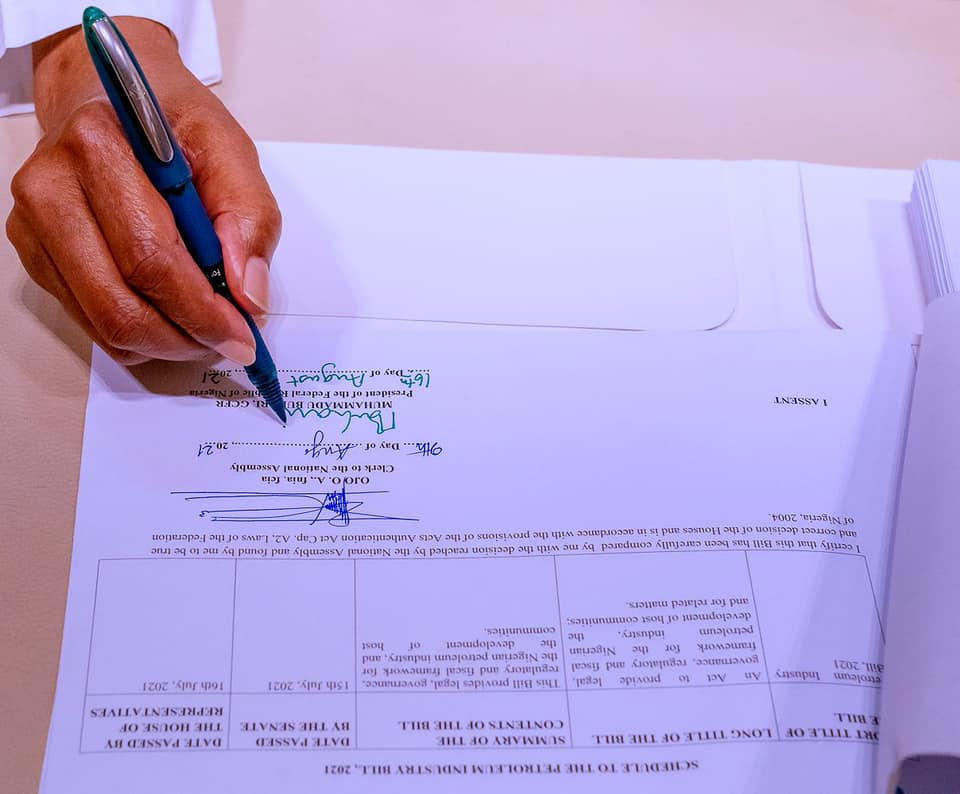
File image of then President, Muhammadu Buhari, signing the Petroleum Industry Bill, PIA, on August 16, 2021.
••• as Environmental Remediation Fund, others await execution; delay dividends delivery
••• while NUPRC lists achievements, calls for amendment
By Udeme Akpan, Energy Editor
Administrative challenges, inadequate funding, lack of infrastructure and limited collaboration among stakeholders have constrained the implementation of Nigeria’s Petroleum Industry Act, PIA, barely a year after it was signed into law.
The PIA, a comprehensive legislation targeted at achieving increased restructuring, more investments, improved operations as well as enhanced transparency and accountability in the oil and gas industry, was passed into law in 2021.
The Chief Executive of Nigerian Upstream Petroleum Regulatory Commission, NUPRC, Engr. Gbenga Komolafe, who confirmed the problems in his response to Vanguard enquiry, said: “The Environmental Remediation Fund, ERF, is yet to be implemented because the Upstream Environmental Remediation Fund Regulation 2023, a major regulatory instrument for its operationalisation is undergoing stakeholders’ alignment, prior to issuance.
“Also, the Environmental Management Plan, EMP, is awaiting the conclusion of the Upstream Environmental Management Regulation, UEMR, 2023, which is a major regulatory instrument for its implementation. The UEMR 2023 is currently undergoing stakeholders’ alignment prior to issuance.
“However, there is no lacuna in the environmental management process as there is a robust procedure currently in place that takes into full consideration the essence of environmental management.
“The implementation of Section 233 of the PIA which highlights the maintenance and management of the Decommissioning and Abandonment Fund is awaiting the Nigeria Upstream Decommissioning and Abandonment Regulations 2023, which is a major regulatory instrument for its implementation. The regulation is currently at the gazetting stage.
“The administration of economic interest securities is currently awaiting stakeholders’ alignment and would be operationalised the moment the Nigerian Upstream Petroleum Commercial Operations Regulations 2023 is issued.
“The numbering of parcels and zones to allow for subdivision and aggregation is yet to be operationalised because it is still undergoing necessary requirement procedures. It is a stipulation of Section 69(3)(4)(5).”
Delay dividends delivery to economy
Vanguard gathered that the delay in the implementation of the legislation had hindered the full delivery of expected benefits to the nation’s oil and gas industry and by extension, Nigeria’s entire economy.
For instance, in its June 2023 Monthly Oil Market Report, MOMR, obtained by Vanguard, the Organisation of Petroleum Exporting Countries, OPEC, disclosed that Nigeria’s rig count, an index of measuring upstream activities, stagnated at 13 in May 2023.
This looks too meagre, compared to the rig counts of other African nations, especially Algeria and Libya, which stood at 32 and 14, respectively during the period.
Major achievements
The NUPRC boss said: “As prescribed in the PIA, the commission, in consultation with the Surveyor-General of the Federation, has adopted a national grid system for acreage management.
“In line with Section 9 of the PIA, the Frontier Basins Exploration Fund Administration Regulation 2023 has been gazetted.
“In a bid to guarantee reserves sustainability, one Petroleum Exploration Licence, PEL, was granted for the acquisition of 56,000 sq.km of 3D seismic and gravity data offshore Niger Delta (water depth range 40m – 4000m)
“The 2020 marginal field bid round has been concluded with the issuance of Petroleum Prospecting Licences to 50 indigenous companies that successfully participated in the bid round.
“All marginal fields awarded prior to January 1, 2021, have been converted to PPLs and PMLs as applicable, conducting a licensing round for the award of seven deep water blocks, about 16 years since the last deep-water block bid round.
“Model contracts have been developed and signed. The contracts define work programme expectations that will enhance value creation to quickly attain the first oil.”
Reacting to the development weekend, the Executive Director of Emmanuel Egbogah Foundation, Prof. Omowumi Iledare, one of the industry leaders that played pivotal roles in the emergence of the Act, noted that some accomplishments had been made.
He urged the government, its agencies and other parties to collaborate in order to fully implement the provisions of the nation’s PIA.
Also reacting, the Executive Director, Spaces for Change, Victoria Ibezim-Ohaeri, called on the government and other stakeholders to address issues affecting full implementation of the PIA, adding that it equally made sense to amend the PIA as soon as possible.
According to her, the amendment is to end the conflicting roles of the NUPRC and NMDPRA as well as other concerns in the new legislation.
Disclaimer
Comments expressed here do not reflect the opinions of Vanguard newspapers or any employee thereof.