
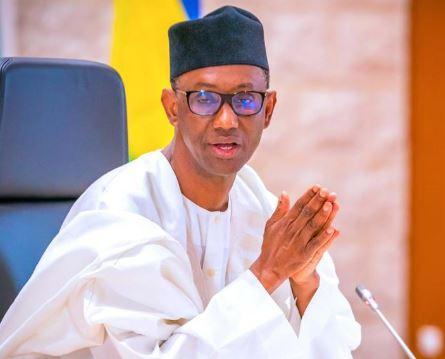
Ribadu
*Why he must get it right
By Clifford Ndujihe
PIONEER Chairman of the Economic and Financial Crimes Commission, EFCC, Mallam Nuhu Ribadu, has his hands full. As the 10th National Security Adviser, NSA, a position he was elevated to by President Bola Tinubu, on June 19, Ribadu must hammer out solutions and decisively advise the president on measures that will halt the billowing dust of insecurity in Nigeria, the world’s largest black nation.
Essentially, his primary duties entail analysing security issues, assessing expected trends, prioritising activities, playing an advisory role and making recommendations to President Tinubu.
Practically, he is expected to manage national security on behalf of Tinubu and serve as the chief adviser of the head of state on all matters that are vital to the country’s survival.
With his appointment, Ribadu, who retired as Assistant Inspector General, AIG, of the Police in 2007 is the first National Security Adviser without military background since the return to democratic rule in 1999 but the third retired police officer to be so appointed after the late Gambo Jimeta and Ismaila Gwarzo.
Thus, Ribabu’s appointment is a paradigm shift from what had prevailed since May 29, 1999 and is considered to be in line with the global trend that is tilting towards intelligence-led security.
What Ribadu must do
Speaking on Ribadu’s appointment and the job before him, a security expert said the former EFCC boss has rich security experience, is deserving of his new job and cannot afford to fail.
“The NSA should first cleanse the military of the remaining Fifth columnists, who were left to thrive under former President Muhammadu Buhari. After that he must begin the serious task of re-orientating the military which, under Buhari became clumsy, disoriented and more interested in making money than fighting terror. He has the task of fighting corruption in the military. Corruption negatively affects professionalism. And the military that Buhari left behind cannot adequately fight terrorists, oil thieves, bandits and criminals,” the security expert said on condition of anonymity.
Indeed, Ribadu has a salad of security issues before him. Many lives are still being wasted daily across the country from the activities of bandits and terrorists in North-West and North-Central zones; Boko Haram and Islamist insurgents in Borno; Biafra separatists and gunmen in the South-East; oil thieves in the Niger Delta; and kidnappers and criminals in the South-South and South-West zones.
Working with new service chiefs
To get things done, Ribadu has to work with new service chiefs, who were appointed on the same day as him. The service chiefs who are well-trained professionals are also younger and are his juniors in service.
The new service chiefs are Maj. Gen. C.G Musa, Chief of Defence Staff; Maj. Gen. T. A Lagbaja, Chief of Army Staff; Rear Admiral E. A Ogalla, Chief of Naval Staff; AVM H.B Abubakar, Chief of Air Staff; Kayode Egbetokun, Acting Inspector-General of Police and Maj. Gen. EPA Undiandeye, Chief of Defence Intelligence.
Apart from Egbetokun, who was born in 1964, four years after Ribadu, the rest were born between 1967 and 1970. They were part of Course 38 or 39 of the Nigeria Defence Academy, NDA. Most of them have Master’s degrees with Bachelor’s degrees in courses like Mathematics, Geography and Engineering.
Can Ribadu, through concise advice, get President Tinubu to harness these vast qualities, professional and intellectual resources for the betterment of Nigeria, security-wise?
Although, he was five years old when his father, Mallam Muhammadu Ribadu (1909 -1965), died, the NSA has a chance to improve on what his father did on the security terrain.
The late Muhammadu Ribadu was Minister of Land, Mines and Power in 1954, and in 1959, he was Minister of Land and Lagos Affairs. In 1960, he was appointed Minister of Defence
The late Ribadu took over the Ministry of Defence as the country became independent in 1960. His administration oversaw an increase in the numerical strength of the armed forces, an upgrade of military hardware, the development of the infant Navy and the establishment of a Nigerian Air Force. He also built and renovated military barracks across the country.
He completed the Nigerianisation of the Nigerian Army and was credited as one of the most outstanding Defence Ministers Nigeria ever had. On May1, 1965, he was to be honoured along with the then Prime Minister, Sir Abubakar Tafawa Balewa (1912–66) by the then Premier of Northern Nigeria, Sir Ahmadu Bello (1909–66) with gold medals of the Usmamiya order in Kaduna. He died on the morning of that day at the age of 55.
So, for NSA Ribadu opportunity beckons. His father was credited with Nigerianising the Nigerian Army. Can he be credited with championing the curbing of insecurity in Nigeria?
With his education, experience, exposure, and human resources at his disposal, Ribadu has no excuse not to deliver.
His pedigree
Born on November 21, 1960, the New NSA was an intelligence police operative, who retired as AIG.
His first major national assignment was as a star prosecutor at the Oputa Panel, which former President Olusegun Obasanjo created in 1999 to investigate human rights abuses during the military era.
He was later appointed chairman of the Petroleum Special Revenue Task Force before he became the pioneer chairman of the EFCC, which the Obasanjo government saddled with the task of combating graft in Nigeria.
Ribadu’s unique approach to intelligence gathering and crime-fighting as EFCC boss earned him global recognition and awards.
His efforts led to the de-listing of Nigeria from the Financial Action Task Force List of Non-Cooperative Countries and Territories; admission into the prestigious Egmont Group, and the withdrawal of the US Treasury’s Financial Crimes Enforcement Network Advisory on Nigeria.
Ribadu was promoted to the rank of AIG in March 2007 in acknowledgement of these rare achievements.
The African Union (AU) put him on its advisory board on anti-corruption matters, and he was invited to join the advisory board of the Friends of the World Bank/UNODC initiative on Stolen Asset Recovery.
Ribadu was a visiting fellow at the Center for Global Development, a TED Fellow, and a Senior Fellow in St. Antony’s College, University of Oxford, UK.
The 2011 presidential candidate of the Action Congress of Nigeria, ACN, and two-time governorship aspirant in Adamawa State, read Law at the Ahmadu Bello University, Zaria, graduating in 1983. He graduated from the Nigerian Law School and was called to the bar in 1984. He joined the Nigeria Police Force, NPF, immediately after his national youth service.
Ribadu holds an LLM degree with an emphasis on the jurisprudence of corruption in Nigeria from Ahmadu Bello University, Zaria. In 2008, he was at the Harvard Business School where he did a programme on strategic management of law enforcement agencies.
In 2008, Ribadu completed the senior executive course at the Nigeria Institute of Policy and Strategic Studies where he was conferred with Membership of the National Institute, MNI. In June 2010, Ribadu was awarded the Doctor of Laws (honoris causa) by Babcock University, Ogun State, in recognition of his “resolute courage” and “fierce stance against corruption.”
In 2012, Ribadu left a United Nations assignment in Afghanistan to take up a special inquest into the government’s revenue from the oil sector, an assignment he handled with passion and dexterity and turned in a report that has become a reference point on reforming Nigeria’s oil industry.
Will he handle the NSA job with the same passion and dexterity, and deliver the much-desired results? Only time will tell.
Disclaimer
Comments expressed here do not reflect the opinions of Vanguard newspapers or any employee thereof.