
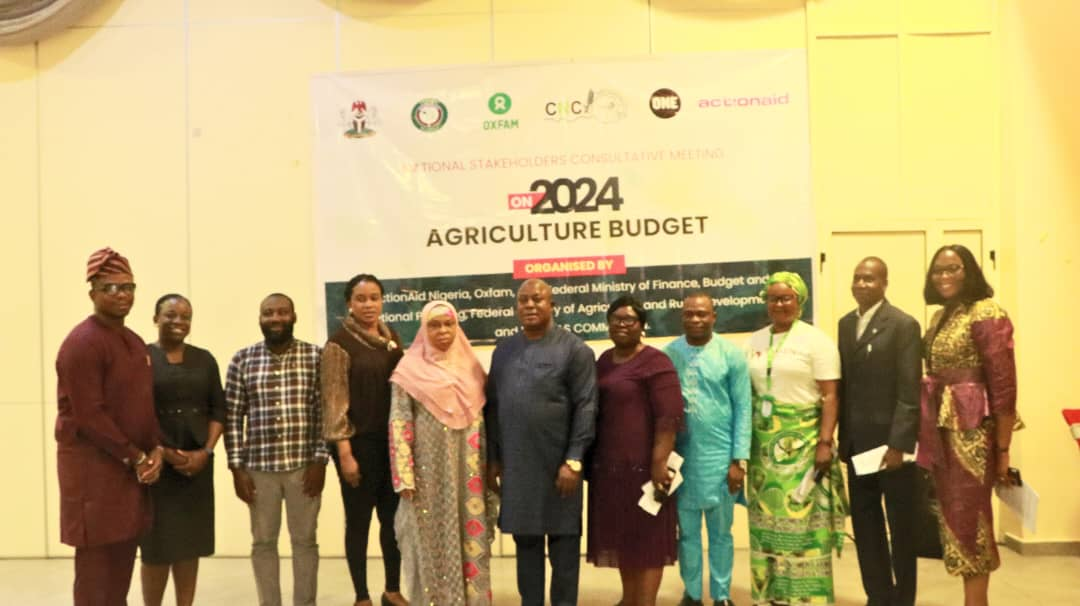
L-R Azubuike Nwokoye (Programme Manager, Food and Agric, ActionAid Nigeria), Williamson Mfon (Min of Budget, Planning, Research and Monitoring, Ebonyi State), Razak Fatai (Policy & Advocacy Manager, ONE Campaign), Rosemary Effiong (Chairperson, Non State Actors, CADEP), Lawal Lamy Saratu (Permanent Secretary Min. of Agric Kogi State), Okosor Oyere, (Budget Officer, Fed. Min of Agric and Rural Dev), Lasekan Modupeola (Fed Min of Finance, Budget & National Planning), Mary Afan (National President, Small Scale Holder Farmers Association of Nigeria), Haruna Umar (Dir. Planning Research & Statistics, Agric and Rural Dev Secretariat, FCTA, Abuja), Akanbi Olubunmi (Nigeria Governors Forum Secretariat)
….Say, there’s a need to declare a state of emergency on pesticides use
By Ebunoluwa Sessou
Federal and State Executives, National and State Houses of Assembly have been called to scale up public investment in agriculture and ensure timely consideration, passage, budget releases and utilization as a strategic approach to increase food production, reduce hunger and poverty to achieve the Maputo/Malabo commitments.
The call was made at a 2-day National Stakeholders Consultative Meeting on the 2024 Agriculture Budget organized by ActionAid Nigeria, AAN, Federal Ministry of Finance, Budget and National Planning, Federal Ministry of Agriculture and Rural Development, FMARD, Oxfam, ONE Campaign as well as Department of Agriculture and Rural Development of the ECOWAS commission which was held in Lagos.
ActionAid Nigeria alongside other organizations, ministries, departments, agencies, institutes and civil society groups in a 8-page communique disclosed that the meeting was aimed at facilitating conversations amongst key stakeholders connecting the continental framework, the Comprehensive Africa Agriculture Development Programme (CAADP) targets and Government intentions within the National Agricultural Technology and Innovation Policy (NATIP) in Nigeria and strengthening citizens’ participation towards making 2024 Agriculture budget responsive for food security and wealth creation.
Accordingly, the meeting was also an avenue to provide stakeholders the opportunity especially smallholder women farmers to participate in agriculture policy and budget formulation processes resulting to changes in priority budget line items that are pro-poor and even in the approach of government’s implementation of programmes and projects.
While calling for a state of emergency to be declared on pesticides use, the Programme Manager, Food and Agric, ActionAid Nigeria, Azubuike Nwokoye who represented over 63 organizations and other civil society organizations in a communique lamented that, Nigeria’s agricultural sector is largely proliferated by hazardous agrochemicals and further compounded with its wrong application by farmers. Adding that, government budget spending through the FMARD and the CBN farmer’s anchor borrower programs favour inorganic pesticides over organic bio-agro inputs.
“These pesticides are often highly hazardous to humans particularly when wrongly applied, the environment, and biodiversity and cause a loss in foreign revenue resulting in food export rejection.
“Nigeria loses about $362.5m yearly in terms of foreign exchange to the ban on the exportation of beans in the last eight years, hence the importance of reducing the use of hazardous chemicals to help the country save money, export good and acceptable agricultural produce in the global market and promote sustainable agricultural practises”, it said.
Some of the observations contained in the communique revealed that “Progress in the agricultural sector has been slowed as a result of climate change, insecurity in the country and the ongoing Russia-Ukraine crisis; these have further exposed the vulnerability of our food system.
“There is need to push for the Creation of a Separate Agriculture Emergency Fund outside the 2023 agriculture budget to avert the looming food crisis caused by several challenges to the sector including the devastating floods, hence the supplementary budget with allocation to the agriculture sector.
“Of the N19.2 billion (which was initially N69 billion) allocated to Agriculture in the 2022 Supplementary Budget of N819.5 billion, it is glaring that there were no releases to avert the looming food crisis as even the Food and Agriculture Organisation (FAO) has projected that about 25.3 million people in Nigeria would face acute food insecurity during the June to August 2023 lean season.
However, it was agreed by all stakeholders that in order to move the country forward, the 2024 and subsequent years agriculture budget should be gender sensitive and responsive by providing line items for the implementation of the National Gender Policy in Agriculture that addresses specific challenges that affect women farmers different from men as well as avoid lumping up budget for women farmers and other groups such as youths.
“Parliamentarians should ensure that their proposed zonal intervention (constituency) projects are agricultural and evidence-based to create meaningful impact in the communities.
“The implementation of the National Agricultural Transformation and Innovation Policy-NATIP) should be aligned to targets and indicators to the Biennial Review indicators to ensure Nigeria is on track in meeting the Malabo Commitments.
“There should be political will to allocate at least 10% of annual budgets and actuals of revenues to the agriculture sector with appropriate budget lines so that Nigeria will be on track in the next Biennial Reporting to the African Union Heads of States and Government in line with the Malabo Declaration and Commitments of 2014.
“FMARD, State Ministries of Agriculture and other Ministries, Departments and Agencies (MDAs) should consistently create budget lines to ensure wider stakeholder consultations in the budget formulation, provide continued coordination and the implementation of the Stakeholders Consultative Meeting on the Agriculture Budget annually at the Federal and State levels.
“Federal and State governments should allocate more public investments in agriculture to address the strategic areas of investments that would increase the agricultural GDP to at least 6%.
“These strategic areas of investments include Extension Services, Access to Credit, Women in Agriculture, Youth in Agriculture, Appropriate Labour-Saving Technologies, Inputs, Post-Harvest Losses Reduction Supports (processing facilities, storage facilities, trainings, market access, among others.) Climate Resilient Sustainable Agriculture (CRSA)/Agroecology, Research and Development, Monitoring and Evaluation, as well as Coordination.The agriculture sector requires a special funding to enable FMARD achieve its mandate.
“The Federal Government should release a take-off grant for the implementation of the National Agricultural Development Fund as FMARD has committed to strengthen access to credit for smallholder women farmers. State Ministries of Agriculture should create a yearly budget line to strengthen access to credit.
“This funding should focus on getting consultants or consultancy firms to support women, youth and farmers living with disability cooperatives to be able to navigate the too cumbersome access to credit in Nigeria.
“The team or consultancy firm will handhold the cooperatives to access existing CBN agricultural credit facilities through preparing their business proposals, interfacing, and negotiating with BOA, Bank of Industry, NIRSAL, commercial and microfinance banks. The team or consultancy firm will ensure that the cooperatives access such credit facilities and other services as extension, insurance, among others and even market access and they are able to pay back at the end of each cycle, among others.
“The proposed National Agricultural Growth Scheme and Agro Pocket (NAGSAP) should be well funded and executed to address the inputs gaps experienced by smallholder farmers, especially women.FMARD and State Ministries of Agriculture should create a yearly budget line for Support for smallholder women farmers reflecting on what should be prioritized especially in the 2024 budget based on realities on ground.
“National Centre for Agricultural Mechanization (NCAM), established for the purpose of adaptive research leading to design and development of efficient and gender-friendly agricultural machines and technologies to reduce drudgery and improve the quality of agricultural production, should be adequately funded and strengthened and facilitate linkages for commercialization of innovative technologies.
“Small modular processing and storage facilities in communities based on different commodities should be promoted as an innovative approach to reduce post-harvest losses in the 2024 agriculture budget and subsequent years, as the larger Staple Crops Processing Zones (SCPZ) are most likely not to reach remote areas. Introduction of community grain bank is also another step to curb post-harvest losses. Considering the agricultural risk; rising insecurity in farms; farm raiding, cattle rustling, and kidnapping, climate change and other natural disasters, farmers are not encouraged to continue farm practices without risk covers.
“Federal and state governments should promote early warning system and the enrolment of agricultural insurance policies for smallholder farmers, while challenging the poor security issues that threatens our farms. in rising insecurity as the quest for pasture is one of the major causes for farmers-herders conflict.
“States should develop their own Agricultural Investment Plans. This will enable the efforts at the states and local government levels to be recognized in the overall determination of the country’s commitment to the CAADP and enable accurate data for the Biennial Review (BR) Reporting.
“FMARD should begin to develop pesticide policies and enforce the legislation that prohibited hazardous agrochemicals, and a significant shift made towards sustainable farm systems like agroecology.
“To achieve this, the government needs to develop a safe sustainable food strategy that reduces the use of highly toxic synthetic chemical pesticides by 50% by 2030; 25% by 2040, a maximum of 5% by 2050 and strong support to be given to farmers in their transition towards agroecology.
“FMARD, CBN and NIRSAL need to educate all farmers groups, listed vendors, manufacturers, and importers of agrochemicals about the appropriate use and the negative impact of Highly Hazardous Pesticides (HHPs) on Nigeria’s public health, environment, and foreign revenue.
“FMARD, CBN (NIRSAL), Bank of Agriculture (BOA) and Bank of Industry (BOI) should mandate agrochemical dealers in their anchor-borrower programmes to remove all HHPs from their programmes and encourage them to supply more organic inputs such as biopesticides, organic fertilizers among others.
“FMARD and State Ministries of Agriculture should increase budget allocation for organic inputs, bio-pesticides, and agroecology. To ensure the successful implementation of agroecological projects, the federal and states government need to be deliberate in collaboration with organisations and institutions that have proven record of successful agroecological farms across Nigeria.
“There is need to strengthen the monitoring of implementation of Agricultural projects in the budget by all relevant stakeholders such as FMARD, Federal Ministry of Finance, Budget and National Planning, State Ministries of Agriculture and Agriculture Committees in the NASS and State Assemblies, Farmers and CSOs using an adapted CAADP Results measurement framework and reports documented, shared, and reviewed to enhance lessons learning and improvement in budget implementation.
“Strengthen Fisheries and aquaculture value chain through a structured innovative lending and regulatory model to reduce import in Fish and aquatic products.
“Promote private investment in agriculture through incentives and policy reviews”, the communique reads.
Disclaimer
Comments expressed here do not reflect the opinions of Vanguard newspapers or any employee thereof.