
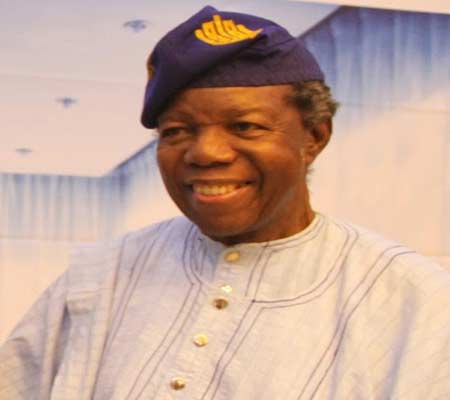
•Omolayole
•Tells Apapa Rotary Club at 50 story
The first Nigerian indigenous Chairman and MD, of Lever Brothers, now Unilever Nigeria PLC, Dr. Michael Omolayole, a chartered member of Apapa Rotary Club, speaks on the challenges and strides of the club as it turns 50.
By Udo Ibuot & Elizabeth Osayande
Tell us about your journey as a chartered Rotarian, and how you and others started the Apapa Rotary Club.
It all started in 1973, which was 50 years ago. But I will go back a little before 1973. Incidentally, 1973 was the year a lot of things happened. It so happened that in 1973, Lever Brothers was 50 years old. And it will be 100 this year. 1973 also saw the first indigenisation decree that established the capital market. Those were the things I could remember. The Rotary Club has existed in Nigeria since the early 1960s. History told us it started in Kano shortly before Lagos, while Lagos started in early 1960. The Rotary Club in Lagos was meeting at the Federal Palace Hotel just after independence. I had many friends who were members of the Rotary Club of Lagos. One was Chief Ephraim Oshidayo. He was the first Nigerian chairman of the Inland Revenue and a chartered accountant. The second one was Edmond Ayoola, he too was a chartered accountant. They were all friends of mine, including the late Joko Paul, who was a pharmacist.
I met all three of them in Britain. At that time, I was a postgraduate student at Oxford University. They urged me to become a member, but working in Apapa, and lunch arrangements, which means one and a half hours, and the traffic to Lagos and back would take more than one and a half hours. I said no, my work will not allow me to join. I also had friends in the Rotary Club of Ikeja. I knew a lot about Rotary before it was brought to Apapa. The moving force was Will Smart, MD, Niger Motors, Creek Road. He was already a member of the Rotary Club, and a few members in Lagos decided to organise the Rotary Club of Apapa. So, on May 30, 1973, Rotary Club Apapa got chartered. That year, I had just got back from Harvard Business School, and although I was already an executive vice chairman of Lever Brothers, I was made chairman of the company.
So, 1973 was a year when many things happened. The Apapa Rotary Club took off with a bang. The chartered members were 34, and we had several expatriates, probably up to 12 to 144. The rest were Nigerian. I used to say Apapa Club was a polyglot club, as it started with people from many nations. I was completely at ease with what was going on in Rotary, as certain things endeared me to them. Rotary believes very well in punctuality, and the management of time, and I believe in punctuality, which I took from my late old man. My late father was the original early bird. If he was going anywhere, even if it meant leaving home at 4.00 a.m., he would do so to be there early. The other thing about Rotary is selfless service. Whatever you do, you do it selflessly, not for what you are going to gain but for what you are going to give. It is more blessed to give than to receive, and to do so happily and with a smile.
The other thing that endeared me to Rotary was the issue of integrity and character. No matter how intelligent you are in the world, if you have no character, you won’t go very far. If you go to any university, no matter how brilliant you are, if you have no character, you will not graduate. At graduation, you are told, you have been found worthy both in character and learning. The character even comes first in the dictionary before learning. So integrity is very important in life. And Rotary emphasizes it at all times. So if you put selflessness, integrity, and timekeeping together, you have all the core values worthy of emulation to be a reasonable person in life. In addition, we start all our gatherings with a prayer while acknowledging the existence of Almighty God.
What will you say about the Apapa Rotary Club at 50?
Well, there have been many challenges as a whole. But my principle in life is to paint a balance sheet of things that are good and bad. By and large, you cannot live through life with only good things. There must be challenges. Since I have been a member of Rotary for over 50 years, one thing has been a big challenge. Before Rotary came to Apapa, it was a nice little place to live. It was a port city, and everyone knew about it. It was the biggest port, and practically, eighty per cent of all imports come into Apapa before disappearing into different parts of the federation. And most of our exports will come by rail to Apapa before leaving for their destinations abroad. That was how we got our foreign exchange. The port itself was quite efficient in those days. Most of the goods were by train. We never saw the road juggernauts we now see on the road. I can amuse you by saying that up until 1960, I never saw a truck that had more than four tyres.
Now, you can see a juggernaut with 24 tyres on the road. Then, the train did all of that work.
Unfortunately, for reasons I do not know, instead of expanding the rail system, we started to concentrate on the road, and the juggernaut ruined the roads. So, the more roads we build, the more juggernauts there are. Presently, as I talk with you now, maybe you will find 50 trailers standing still on Apapa Road. That is not so pleasant. On the other hand, many thriving businesses and factories had moved out of Apapa. The company for which I worked for nearly 30 years moved out of Apapa and is now in Oregun, and the factory is in Apapa. Cadbury started in Apapa, and eventually went to Agidingbi; Nestle started here, and eventually went to Ilupeju and Apapa. The first Coca-Cola plant was on Mali Road, it is still there, but no longer the biggest in the country. We also had companies like GSK, which used to be Glaxo, among others. Luckily, Flour Mill is still here, as is Dangote. We had several forwarding and clearing agents, and even shipping agents, which have been moribund. Apapa has seen glorious days. My prayer is that we can bring back the glory, and happiness of Apapa.
The Apapa of my dream
What I honestly would want to see is that, first and foremost, the federal government must recognize that a Port is one of the infrastructural facilities that can make a county great. There is no country in this world that will not pay attention to its port. For well over 70 years, including the expansion to Tin-Can Island, the Port of Apapa has been virtually the only port functioning efficiently, and this is weird, and not good enough. This is a country of over 200 million people with a great land mass. The goods that come to Nigeria, which easily should have gone to Port Harcourt, and to their destinations: Onitsha or Abia, all come to Apapa. That situation is certainly not good. It will create enormous hardships and challenges. We have thrown a lot of words at solving our problems. If words alone can make a country develop, Nigeria will be one of the most developed countries in the world.
Actions are better than words. We have got to follow all our words with action. We must not make promises easily. When we make promises, we must stick to them. That is one of the core values of Rotary: you should be held to your word. Four core values: Is it the truth? Is it fair to all concerned; etc.?
One other thing I wish to get out of my mind. Fifty years ago, in the Lagos environs, there were three Rotary clubs. Now, what you call District 9110 has over 2000 Rotary clubs. Why is the impact of integrity not felt in Lagos? That is a big question for everyone. We know integrity in this country, selflessness in this country, and a lack of greed in this country, all these things are not as high, as membership in Rotary Clubs should suggest. Has Rotary become just an emblem? In which case 90 per cent of our members are only rhinos; they are there for what they have to gain only. But it should be the other way around: 10 per cent rhinos and 90 per cent Rotarians.
The only thing that I have been proud of in terms of the Rotary Club in Nigeria is the eradication of polio. I am very proud of it. We started from a poor beginning in Nigeria. Afghanistan, Pakistan, and India were the three worst places in the entire world. It took a lot of effort, and eventually, Nigeria was declared free of polio. Although secondary polio may come, it will not be the original nasty type, which has been eradicated. I always doff my hat each time I read the history of polio for the energy and persistence of Bill Gates.
Advice to younger Nigerians who do not believe in Rotary, and those who want to join Rotary
What I believe is that whatever challenges we have can be solved. First, find out the facts. If something is not right, find out the reason. How long has it been like that? What and who is responsible? Ask all the questions. And when you put the facts together, including talking to others, reading, and studying, you will begin to see how you can marry all the information with some of the issues that may arise. When you have done all of that, you then say to yourself: What is my objective from the facts? Do I want an instance, a gradual, or a lasting solution? What will be the cost-benefit analysis of what I have done? This means that you need a systematic way of tackling challenges, whether they are human, physical or economic problems or social problems. And when you have gone through the entire system, you go back and check the results, and modify them if necessary.
In all these cases, whether you are a human being or an institution, you must be guarded by a moral compass. When you go on a journey, you have no idea where you are going. The compass will help you. Also, as an individual, there are so many challenges relating to character, and relationships with other people, and others, this is where your moral compass comes in. If you don’t know what is good, and what is bad, you are no better than an animal. Your conscience should be able to tell you the truth. And you should not allow it to be dead. I believe that spiritually, God lives in all of us through our conscience. So, whatever we do, we must also have a spiritual angle to it.
Rotary is one of the most successful moral organisations in the world. It was established in 1905. Paul Harris will never be forgotten. It started in a very small way and has grown as it continues to adapt dynamically with time. The Rotary of today is a lot different from the Rotary of 100 years ago. In the number of members, the diversity of countries, and the number of things they tackle. And all along, those core values have been there. And therefore, whoever wants to join must be prepared to do selfless service. You must be prepared to allow your treasury, time, talent, and thoughts, and I will add, your energy, as I wish I could do far more for Rotary as I have little time. Most importantly, aside from coming with their energy, they need to come with their treasury. When I joined Rotary, we didn’t talk about money. Of all the 34 of us, none of us was at least the head of the department. We had MDs, and Directors, among others. We didn’t talk about money simply because whatever you were asked to pay, you did so without a grudge. If there was anything that needed donations, several donated more than was expected. It was not a question of banging on the table like a tax collector.
Tell us about yourself
I am a young man who, by the grace of God, will be 95 this year. My name is Dr. Michael Omolayole. I had worked and lived in Apapa since 1958. I started working in Apapa in 1958, and in 1964 I became a resident of Apapa. And I have been living in Apapa ever since. I retired from active work in 1984 as chairman, and managing director of Lever Brothers, now Unilever Nigeria Plc. I sympathise with the state of the country. Our currency has taken a big beating and bashing. If I tell you that the first cycle that a friend of mine bought soon after we left secondary school was eight pounds, which is the equivalent of N16.00, a brand new bicycle in 1968. What can N16.00 do now? These are some of our problems. The Daily Times was a standard newspaper 80 years ago. When I was at school, it was selling for one penny. The equivalent papers today are sold for N250. Twelve pence make one shilling. Twenty shillings make one pound. You get 240 pence in a pound. It means one naira will buy you 240 newspapers during those days. Our currency has been bastardised, and consequently, everyone feels the pain. So, we must cut our coats according to our clothes.
You must live within your means. If you are not able to join Rotary now, aim to join when your economic status will enable you to do all you are supposed to do. Don’t hurry. If you join by hook or crook, you will not be able to live a fulfilled life. One other thing is that, irrespective of the economic situation, young people do not save. The habit of saving even under hardship should be what I call the core value of every individual. If you earn only N10,000 in a month, make it a point to save a hundred, because if you save a hundred regularly, and consistently, when you earn N100,000, you will save more. But, if you don’t save when you earn N10,000, you will keep procrastinating.
My advice is that the core values of Rotary should be learned and practiced and not only read. When you go into Rotary, no matter how young or old you are, you can always make a contribution that will make Rotary great. Over the years, I am bold to say, that our club has made a lasting contribution to Rotary International. Not in monetary terms, but in terms of intellectual contribution. When I joined Rotary, the entire club had less than one million members. There is a song, Rotary, my Rotary, that has a stanza: ‘When a thousand sing from pole to pole’. Ten years after we were established, we found out we had reached 1.2 million. We at Rotary Apapa suggested that that song be changed to ‘When a million sings instead of a thousand sings.’ Rotary International accepted our suggestion. That has been our contribution to the intellectual property of Rotary Club International. Again, women were not part of Rotary. So we in the Rotary Club of Apapa suggested that the particular song that talked about my brothers should no longer be My Brothers, but ‘When All Persons’. Again, Rotary International accepted. We also regarded that as our contribution to the intellectual property of Rotary Club International.
Disclaimer
Comments expressed here do not reflect the opinions of Vanguard newspapers or any employee thereof.