
Asks FG to avoid further borrowing, mobilise enough revenue
By Victor Ahiuma-Young
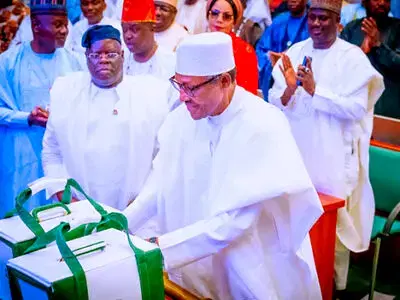
The Nigeria Employers Consultative Association, NECA, has expressed concerns over the 2023 national budget, saying poverty, unemployment, rising debt profile, and others are not likely to change as President Mohammad Buhari, signs N9.73 trillion estimated appropriation to law today.
The umbrella body for employers and voice of business in the country said it was imperative for the government to effectively mobilize and strengthen all available revenue sources to avoid financing the budget through high-interest-rate borrowing, thus increasing future debt service.
Speaking with Vanguard on the 2023 Budget and its implication for business, the Director-General of NECA, Wale-Smatt Oyerinde, said: “The “Budget of Fiscal Sustainability and Transition” as it is called, was designed to achieve, among other things, the strategic objectives of the National Development Plan 2021–2025.
”With estimated N9.73 trillion and N21.83 trillion budgeted as revenue and expenditure respectively and a fiscal deficit provision of N12.1 trillion, the budget is ambitious while there are concerns about its basic fundamentals.
“The ‘rushed’ passage of the budget by both chambers of the National Assembly calls for concern as this could not have enabled the wide consultation of critical stakeholders whose input would have added value to the budget proposal.
Analysis
“The US$75 per barrel oil price assumption for 2023 looks realistic, given that the commodity averaged $99pb in 2022 even as OPEC+ remains fixated on regulating oil production to stabilize energy prices.
”However, global recession fears in 2023 could dampen oil demand with an adverse effect on prices. The oil production benchmark of 1.69 million/barrels per day also seems somewhat ambitious.
“The combination of factors such as large-scale oil theft, frequent shut-ins, vandalism, and International Oil Companies, IOCs’ divestment have continued to depress oil production in 2022.
”According to the National Bureau of Statistics NBS, crude production averaged 1.2 million/per day in Q3-2023, the lowest level since 2013. With continued fuel subsidy payment in 2023, the likely gain from global increasing crude oil prices would have an insignificant effect.
”The resultant pressure on revenue will further deny the government the needed funds for developmental projects.
“Also of concern is the Exchange Rate of N435.57/US$. The benchmark rate does not reflect the fair or fundamental value of the local currency. In a fact, the naira traded at N461 per dollar on The Nigerian Autonomous Foreign Exchange Rate Fixing, NAFEX window by end-December 2022 and could likely fall further amid lingering liquidity issues.
”The inflation benchmark of 17.2% is somewhat realistic and this requires effective coordination of monetary and fiscal policies to address the legacy factors driving consumer prices – insecurity, foreign exchange, FX-pass-through effect, high energy prices, fiscal deficit monetization, etc.
“Aggregate federal government revenue for 2023 was set at N9.7 trillion. The bulk of the revenue (55 percent) is expected from independent sources; 25 percent of the proposed revenue is expected to come from non-oil sources, while 20 percent is from oil sources.
”The target yet again appears ambitious going by the persisting challenge around revenue generation in the country. The historical trend shows that Nigeria has failed to meet (let alone surpass) its revenue target in the last six years.
”Going by the budget implementation report, Nigeria achieved 64 percent of its prorated target between January and August 2022. While non-oil revenue exceeded its prorated tar…
Disclaimer
Comments expressed here do not reflect the opinions of Vanguard newspapers or any employee thereof.