
By Johnbosco Agbakwuru
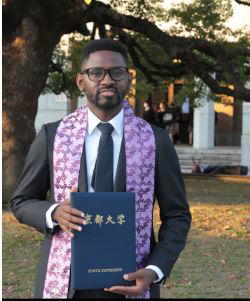
Meet Dr Patrick Ocheja, The young engineer who bagged a first class degree in Electronic Engineering from the University of Nigeria Nsukka and also recently broke record as the first Nigerian to be awarded a PhD in Informatics from the prestigious Kyoto University Japan.
Dr Ocheja did not just earn a PhD, he did so with an outstanding performance and is one of two Africans to have ever won the Information Processing Society of Japan (IPSJ) Yamashita Award in more than 30 years of its existence and his dissertation was also voted to be the best among his fellow graduands. In this interview, he says he left Nigeria to Japan in search of knowledge to solve problems in education sector
I understand that you are out of the university environment now, but tell us, what was a typical day like for you during your undergraduate graduate days, and what do you do as fun activities, are there unique memories of your days at UNN you would like to share?
Thank you for having me. My undergraduate days at UNN was filled with lots of good memories. In a typical day, I would wake up as early as 3-4 am to revise the previous lecture notes for the classes I have on that day. This is a special time as I tend to understand better. I also use this time to check that all assignments (if any) are ready to be turned-in. At 5am, I took my bath and went for morning mass. Because I lived in the hostel for most parts of my undergraduate days, waking up early would usually help me overcome queues and rush for limited facilities in the hostel. After mass, I try to take some light breakfast (or not) depending on the day. I made it a habit to be in class between 7:15 and 7:30 am so that I can get a good seat in front of class. After lectures, I would return to the hostel briefly to have a power nap before rushing off to tutorial classes (sometimes organized by me or by other students). In the evening, I try my best to look at the notes I took during the day’s class and then plan a schedule for completing the assignments given (if any). After this, I go to bed, latest, by 10 pm. On some days, I joined in social activities such as going to see friends, football matches, play soccer or see a movie. In all this, what stood out for me was the consistency. I did my best to keep a consistent habit on how I spent my time. I hardly compromised on evening revisions, my sleep time and early morning preparations. I think these three things were crucial to my success in UNN. Of course, tutorial classes with peers helped as well. This brings me to your question on your unique memories. The memories that stood out for me were the friends I made. The friends I made at UNN were really exceptional and they often challenged me to hold myself to higher standard of excellence, character, and aspirations.
There’s this perception or a Nigerian bias that it is difficult if not nearly impossible for someone from a different ethnic background to gain admission into a university in another state outside of theirs, not to talk of graduating with a first class and being named the best student of the graduating class. Tell us about your initial experiences prior to entering University of Nigeria Nsukka and if you faced any discrimination on grounds of tribal affiliation during your studies there.
During my time in UNN, I did not experience this bias. However, it will be unfair to deny the existence of such bias based on a single data point. I gained admission into UNN based on the federal character/quota policy, that is, being from Kogi State, which is classified as an educationally less disadvantage state. We were only two from my state in the department of electronic engineering. Surprisingly, many of my classmates thought I had one of the highest Post UTME scores. That is not true, in fact, maybe one of the lowest (I think 194.5 out of 400). But this became a primary motivation to make a first class. During the holidays, I made it a personal goal to complete the next semester’s work especially courses that are known to be challenging. Upon resuming for the semester, I attended classes as a revision of what I had studied during the holiday. We also organized tutorial classes where I taught my classmates. We (my classmates) all looked out for one another and sought ways to always help each other in academics and general day-to-day campus life.
Would you say you are in your dream profession, and have you always had a fascination with computers and other gadgets right from a young age?
Yes, I cannot ask for a more satisfying profession. From a young age, I have always been fascinated about how electronics work. In Elementary four, I received an award for being the best in Computer (Science). At that time, my school had just bought a mini computer and a corps member taught us how to use it. In JSS 2, I became familiar with using the internet, thanks to Dr. Martin Threat who donated some computers with internet connection to my secondary school. In SS 1, I built my first website (blog on blogger.com) using a mobile phone. I taught myself programming from HTML to JAVA programming language using the same mobile phone. In the second year of my bachelors, I built a conference registration portal for the Society of Petroleum Engineers (SPE) Students’ Technical Conference and Exhibitions (STCE). The following year I built an app that was ranked top 10 in the Google Cloud Developer Challenge (GCDC) 2013 by Google. At the same time, I excelled in my academics; winning the prestigious Etisalat merit award for academic excellence for staying top of my class from first year to third year. In all these, consistency and growth mindset were key factors that helped me advance steadily. Eventually, I received the prize of best graduating student.
Who would you say have had the greatest influence on your personality and why is that so?
It is a bit difficult to attribute my greatest influence to one person. But if I am compelled to choose, I would say my father (of blessed memory). From him, I learnt to plan, remain contented, and reach for the sky (excellence is possible). We were really close friends. Every semester, we calculated my GPA together and discussed how to stay consistent or do better.
It is also important to mention that my formative years in junior and high school at St. Kizito Seminary Idah taught me one of the best habits: time management. If you can manage your time, you can be the best in your craft. I mastered this early and it made a huge difference.
Let’s talk about your life after graduation from UNN, you have worked in so many companies and government agencies and in the course of this also helped build their IT sectors with innovative systems and softwares. What drives you and how are you able to sustain such culture of excellence in your work life?
That is true. I started my professional career as a graduate software engineer at Gidi Mobile Limited: one of the foremost edtech and mobile learning platforms in Africa. Gidi Mobile was quick to identify the talent I had and offered me a position even before my final results were out. At Gidi Mobile, I wore many hats including backend engineer, frontend engineer, mobile engineer, in fact, I had the opportunity to become a fullstack from the very start. This was possible because of the vibrant working environment, my relentless inquisition to know how things worked and ability to learn fast. Luckily, I had very experienced tech leads and peers to learn from: notable among them are software engineers who pioneered the current internet banking that most fintech now thrive on. After two years at Gidi Mobile, I moved to Enugu Electricity Distribution Company (EEDC) to champion a new drive for data-informed and technology-driven bills collection. At EEDC, we built systems that enabled ageing analysis of debts and various payments integrations. This was a very short stint because three months down the line, I received a scholarship from the Japanese government to do a master’s at Kyoto University. Subsequently, I returned to Lagos to prepare for my travel. Upon return to Lagos, I took on contract roles to work with various organizations including Lagos State Ministry of Education and United Bank of Africa (UBA) as a Software Engineer and Consultant. All these happened within three years of graduating from UNN. Since that time, I have also worked at many international companies including Microsoft (Japan).
Dr Patrick, tell us about your migration from Nigeria to Japan. For many people the reason for their “Japa” is always hinged on the need to leave Nigeria for greener pastures or in search of a society where their skills are valued higher: was this your case too? Because I believe you had very good jobs prior to leaving Nigeria for your Masters program.
I left Nigeria primarily because I wanted to get more knowledge to solve some problems in the education sector. I had firsthand experience of how students graduate from high school but are unable to get admission into the university due to limited slots. I wanted to research on ways to deliver learning at scale to anyone, anywhere without having them go to a physical school environment constrained by quota or slots. Companies like Gidi Mobile had (still have) similar vision at the time and working there informed my decision on post graduate study in learning technologies. The choice of Japan is primarily due to the nature of education in Japan which is research focused. And choosing Kyoto University, a top school with 8 Nobel laureates, was an easy one.
While studying in Kyoto University Japan in your early days as a Masters student, what were your culture shocks and how do you rate the Japanese educational system in comparison to the Western countries and perhaps Nigeria too.
I left Nigeria for Japan in 2017 with mixed feelings. This was because I did not know what to expect as I did not speak the language (Japanese). But now that I look back, I am convinced I made the best decision. My first culture shock is the quietness especially on public transportation. People rarely talked or made phone calls. Also, the food was different; I did not think eating white rice without sauce (or stew) would be normal. But this culture I have come to love and appreciate. The people are so kind. A Japanese person can put their journey on hold just to make sure a foreigner gets to their destination. Also, everyone understands and appreciates hard work. When you work in a Japanese environment, it feels like a system where everyone plays a functional role: everyone tries to deliver their best to ensure maximum efficiency. The Japanese education system is not so different. For postgraduate studies (master’s and PhD), there is more focus on research and not just coursework as seen in Western countries. Compared to the education system in Nigeria, I would say it is a bit more engaging. Most of my courses were at the cutting edge of technology and the student-teacher relationship tends to be more supportive/collaborative than instructive. However, I have heard of few students who had a different experience. In general, excellence is always the goal and at Kyoto University, you almost certainly cannot miss this.
You are one of those who are very lucky to get federal government scholarship on merit without any connection or pulling any strings. What category of scholarship was this and how did you make it?
The scholarship I received is not a federal government scholarship but the Japan Ministry of Education (MEXT) scholarship. I first learnt about the scholarship as one of the Federal government of Nigeria’s bilateral scholarships. I was hesitant to apply because I did not trust the process given the general perception of nepotism being at play in this type of scholarship. My mindset changed when I learnt that the scholarship process is entirely managed by the Embassy of Japan in Nigeria. I did not know anyone at the embassy: I simply followed the documents submission procedures, got invited for the examination and interviews and I was one of the top eight out of about 900 applicants. I think I stood out because I had the prerequisite requirements. For example, in final year of undergraduate program, I published two journals and two conference papers. Also, I had relevant experience working with an education technology company: an area I was seeking to pursue a master’s degree. The icing on the cake were the numerous awards I had previously received. I think the interview committee made a good call based on these qualities. But I must also say that at the Embassy of Japan in Nigeria, Nigerians worked there and were in charge of the scholarship. Mr. John and his team are doing an amazing work! Also, part of the interview committee were previous scholars of the MEXT scholarship program (dating back to the 90’s). The transparency in the process is second to none. So, yes, Nigerians have high integrity and have the capacity to deliver good judgment devoid of nepotism or preferential treatments. If you meet the requirements for the scholarship, by means, I urge you to apply.
What is your advice for many young people with sterling educational background yet are not yet lucky with a scholarship opportunity like yourself?
First, I want to encourage all young, promising and talented Nigerians to never give up on their dreams. Your dreams and aspirations are valid: it would only take time and some bumpy ride. But in the end, it will come true. Continue to give your best in all you do. One of the best gifts you can give to yourself is being prepared ahead of time. If you are currently in the university (undergraduate) I will recommend you look beyond your current environment and I try to know what your peers in other countries are doing. You can go online and take a peep at curriculum of undergraduate programs in top schools in the world. That way, you will get a sense of what is expected of you beyond the curriculum available at your current school. While it may be difficult, it will be helpful if you can learn to learn on your own. Your teachers can only do enough to expose you to what they know. Do not just settle for getting A’s in school. The A’s are definitely important but may not be enough. It is also important to seek mentors who have walked the path you want to follow. There is no quicker journey than one where you follow an informed leader (“follow who know road”). Of course, you can reach out to me on LinkedIn (@patrickocheja or Twitter (@ochejapatrick) and I’ll be happy to help.
Do you see yourself going back to the classroom ? Of course I mean now as a lecturer not a student anymore ( Laughs)
Hahaha. I am always in the classroom; I’ve never left. After graduating from UNN, I returned in 2016 as a guest lecturer (invited by the department) to deliver a hands-on training and lecture to students in 3rd and 4th year of the Electronic Engineering undergraduate program. I have also mentored many students and young software engineers over the years. In my spare time, I work at a coding school in Canada remotely as a mentor. I support students through their academic journey, and prepare them for their transition into an exciting new career in tech. I coach these students through any roadblocks they might be experiencing, give them tips on solving problems, and generally provide them with support and advice. On whether I will return to classroom as a lecturer in Nigeria, I have always kept that door open. Currently, I am a Japan Society for the Promotion of Science (JSPS) research fellow at Kyoto University. I am open to collaborating with lecturers in Universities across Nigeria (and Africa) on various research projects including education data mining, learning analytics, technology driven education and AI. Also, if you are a recent graduate (undergraduate or master’s program) and would like to explore research opportunities in the area of educational data mining and learning analytics, you can reach out to me (I might have an opening for you).
What projects are you currently working on and what are your plans for the coming years?
I am building a blockchain for connecting educational data across multiple schools. This blockchain is called the ed3chain and it is based on the results from my Ph.D. dissertation. The ed3chain platform provides a seamless way for learners to move with their educational records as they change school or learning environment. One of the big problems this project solves is that it helps teachers to quickly identify what specific challenges and successful habits their students possess. The teachers can then decide what aspects to focus or build on. Using learning analytics (data mining and AI), we analyze lifelong learning data from multiple sources to extract useful insights that can be used to help students advance in the right direction throughout their learning journey. The blockchain makes the security of the data and linking across different schools possible. We have run series of experiments in schools in Japan and have published the outcome in top journals and conferences. In the next few months, we will be rolling out the opensource version of this project for public use.
Disclaimer
Comments expressed here do not reflect the opinions of Vanguard newspapers or any employee thereof.