
By Gabriel Ewepu, Abuja
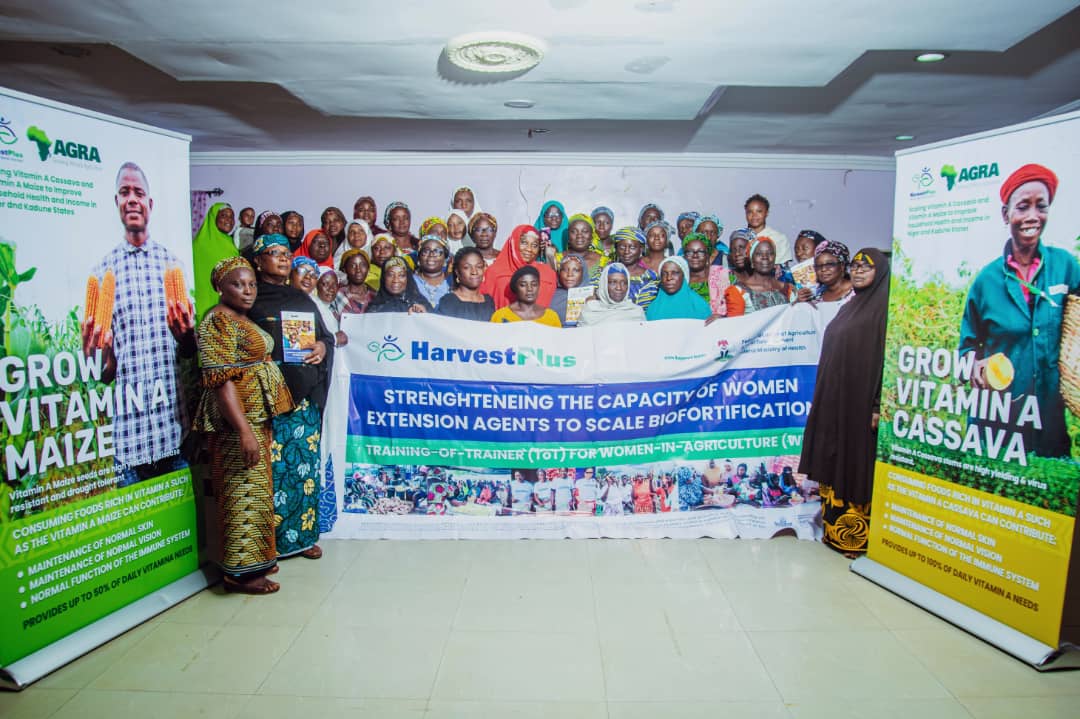
HarvestPlus partners with the Ministry of Agriculture and Rural Development’s Agricultural Development Program (ADP) through the ADP’s Women in Agriculture (WIA) Extension Program to boost nutrition, and earning capacity of women through biofortification. HarvestPlus disclosed that the funding and support are from the Alliance for a Green Revolution in Africa (AGRA).
The essence of the partnership and its objectives, is in a bid to scale up the production and consumption of Vitamin A Cassava and Vitamin A Maize at household and community level in Niger and Kaduna States.
The Country Manager HarvestPlus Nigeria, Dr. Yusuf Dollah enlightened the WIA women groups and other community members at the event about the relationship between not eating nutritious foods and hidden hunger.
Dollah presented a maize planter to the community farmers to ensure adherence to good agricultural practices.
The WIA programme is a medium for the transfer of agriculture and nutrition-proven innovations and technologies in production, processing, marketing, consumption and nutrition to families, and disseminates agriculture and nutrition information by stepping down knowledge and skills acquired at trainings to the community and household levels.
Notably, HarvestPlus is involved with promoting healthy diet practices and nutrition through biofortification.
In recent times, HarvestPlus is focused on strengthening the knowledge and capacity of WIA officers in selected states with the aim of reaching households with the right information that can make them improve their dietary practices.
These WIA officers will subsequently step down biofortification messages during fortnight training using an extension training tool, developed by HarvestPlus to promote effective gender-based extension delivery methods.
The training modules cut across production, processing, distribution and consumption of biofortified foods, including nutrition education.
It also encourages the women at the household level to utilize biofortified crops such as vitamin A maize and cassava to address malnutrition and stimulate new sources of income for women.
The training in Niger State was conducted across 194 LGAs of the three Agricultural Zones in the state. Niger State is located in the North-Central zone of Nigeria. WIA officers were selected from these LGAs to participate in the program.
The training of WIA officers was also extended to the Women Field Day in the model village. The field day made them to learn how to translate the training they received into practical community program.
The WIA learnt that they have to encourage the production, processing consumption and investments in vitamin A maize and cassava in similar ways so that these more nutritious varieties and value added food products will be readily available, accessible and affordable around them.
Halima Abubakar, Deputy Head WIA, at the Niger State Agricultural and Mechanization Development Authority (NAMDA) coordinated the affair of the WIA women in the state.
Women extension agents in Niger State have become ambassadors of biofortification and this strategy believes that once a woman is reached, her entire family is a beneficiary and consequently, the community at large.
Abubakar said that this training is of the essence at this point in time when many households are struggling to put food on their tables and women who have the job of preparing household meals the look up to the women extension agents in their local communities for advice.
She applauded AGRA, HarvestPlus, and other partners for advocating for the eradication of hidden hunger, which is a major malnutrition challenge in the country.
She added that illiteracy also serves as a barrier to accepting new innovations.
The Niger State Nutrition Officer (SNO) under the State Ministry of Health, Hajiya Asamau Abubakar Mohammed, was happy to be a part of this training. She encouraged women to become entrepreneurs, as she emphasized that increased promotion, utilization and consumption of Vitamin A maize and cassava under the biofortification programme can become a huge way to generate more income for women in Niger State. She mentioned the benefits about biofortification for women and children under the age of five years, which include good vision, fetal development and maintaining a healthy immune system.
She also advised women to consider the option of healthy nutrition and seize these opportunities since they are cost-effective in addressing malnutrition at the household and community levels
Meanwhile, Olatundun Kalejaiye, Nutrition and Post-Harvest Officer at HarvestPlus was also pleased to have facilitated the training to strengthen capacities on how to deliver nutrition and biofortification massages to vulnerable women.
Kalejaiye highlighted the aim of the training, which was to empower and equip the WIA women with the knowledge to train other women how to increase income, as they process and sell vitamin A maize and cassava foods and also make use of these recipes at the household level to improve on the nutritional quality of their family meals.
She said, “Conventional foods eaten in this part of the world are starchy food but with the biofortification of staple crops, malnutrition, including hidden hunger will be addressed”
On behalf of HarvestPlus, Olatundun Kalejaiye distributed start-up packages to various cooperative groups to help improve their knowledge on processing, packaging and distribution. She demonstrated the use of each gadget to the women processors.
These tools included: Weighing scale; Sealing machine; Moisture content meter, and packaging nylon
In conclusion, Kalejaiye reminded the processors of the importance of vitamin A in household nutrition and encourage them to be creative and skillful as HarvestPlus awaits their testimonies and see them generate more income.
The AGRA-HarvestPlus programme does not focus on consumption without ensuring improved marketing and livelihood of rural women.
The essence is to ensure the retention of vitamin A maize in processed maize flour and introduce the processors to simple packaging technologies to enhance quality packaged vitamin A maize flour.
One of the beneficiaries, Hauwa Ibrahim said, “I believe that women need to learn more about the diversification of foods, in order to curb malnutrition.
“I will tell other women about the training and the value of vitamin A maize and vitamin A cassava and advise them to join cooperative societies so they can partake in the benefits of new technology.”
Also, Mallam Yahaya Umar, a miller at Dagodnagbe village testified on the general acceptability of biofortified maize within the community.
“We, in the community have generally accepted vitamin A maize due to its health benefits and nutritional value. In addition to all of these, vitamin A maize tastes sweeter and better, is weighty in nature and rises after preparing our local dish ‘tuwo’. The number of villagers that patronizes my milling machine with vitamin A maize has also increased”, Umar said.
Disclaimer
Comments expressed here do not reflect the opinions of Vanguard newspapers or any employee thereof.