
By Chioma Obinna
Children born with cleftlip and/or palate, in poor-income countries like Nigeria no doubt face a lot of social rejection. This stigma disadvantages them in education, employment, marriage, and community, and is worsened by barriers to care.
But nutrition experts from Smile Train say nutrition is key to saving these children as they will be born with challenges with feeding because of the anatomy of having a cleft or a palate.
Cleft lip and cleft palate are facial and oral malformations that occur very early in pregnancy, while the baby is developing inside the mother.
In the views of a Clinical Nutritionist and Smile Train Nutrition Advisor, Miriam Nabie, due to the inability of children born with cleft and palate to latch on the breast and feed properly, many of them are exposed to malnutrition which often leads to death or rob them early life-saving surgical intervention.
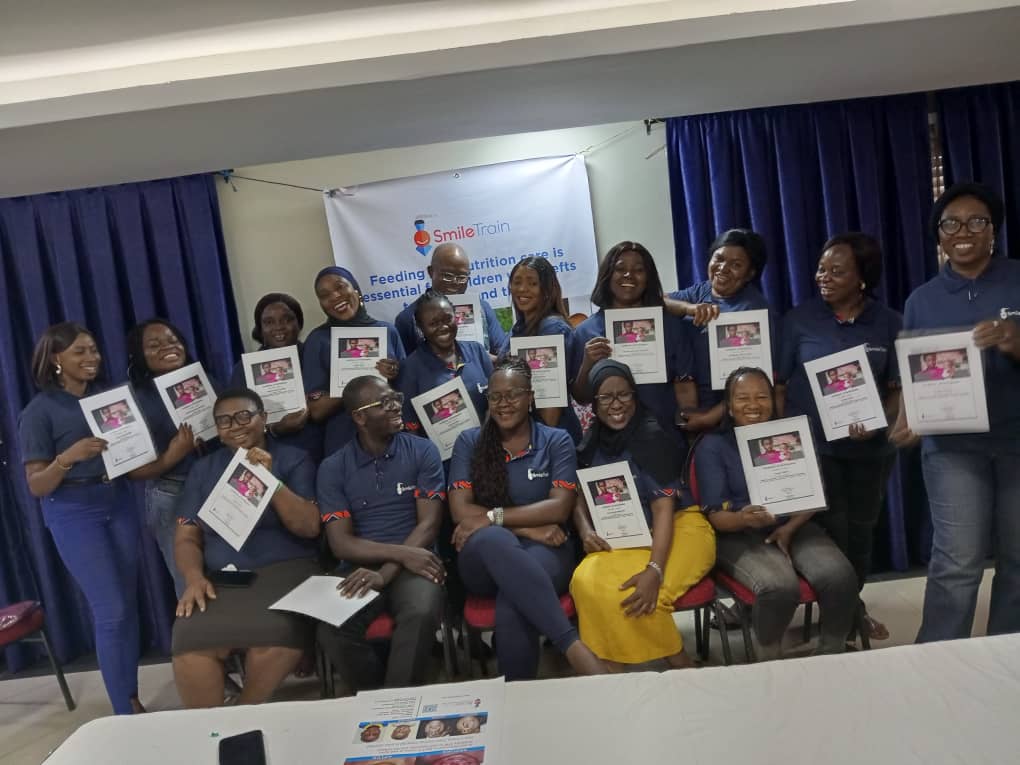
Nabie, the facilitator at a 5-day workshop for nutritionists, dieticians and nurses selected from Smile Train partner hospitals in Nigeria, lamented that many mothers cannot feed their children due to a lack of information .
She explained that when there is a delay in initiating breastfeeding and other forms of feeding the baby may be exposed to malnutrition as lactation may no longer be possible in the mother.
“Our minimum age as per Smile Train surgery is three months for cleft lip and one year for cleft palate. So nutrition is important in order not to delay or sideline the surgery for the child, because we could lose some of these children to malnutrition. And it has been reported that most of them were losing these children because no one knows how to feed them.”
She explained that since a child with a cleft lip/palate cannot latch to the breast to suck milk, the mothers are taught different breastfeeding positions, different from the normal child, hence, the need for the Smile Train workshop.
Speaking on other feeding alternatives, Nabie who works with Tofem Dreamland Mission Hospital, Kenya said: “The first option would be for the mother to express her milk in the appropriate steps and give her child the milk using special cups for children with cleft lip called nifty cups or we use specialised bottles which may not be easily accessible here in Nigeria and are quite expensive.
“In case it’s a mother who cannot breastfeed due to delay, then the next option would be the commercial infant formulas with all the hygiene parameters in place.”
She said the training focused on supporting comprehensive cleft care through nutrition, and feeding and empowered healthcare providers to be able to incorporate nutrition in their department so that they can support and promote breastfeeding for children with cleft lip and palate once they are brought to the hospital on time.
The Senior Programme Manager for smile train West Africa, Mrs Victoria Awazie, explained that the nutrition training programme for nutritionists working in their partner hospitals was to ensure that these nutritionists offer treatment to cleft patients that are malnourished as well as stop children born with cleft lip and cleft palate from dying of malnutrition.
She said findings by Smile Train have shown that one problem these children usually have remains malnutrition because when they are born the mothers don’t know how to feed them. “So this training will empower the nutritionists and dieticians to train the mothers of these children.
“The link between nutrition and these conditions is that when the child is born they are underweight and because of the cleft lip and palate the baby finds it difficult to suck so the mother will be educated on how to extract breast milk to feed the baby, there is a position the child will be positioned on the breast to be able to latch on the breast. So if the mother doesn’t have that knowledge they will not be able to feed the child and again a lot of them because of their condition don’t eat well so they will not gain the weight needed for the surgery, so the child needs to be built up nutritionally to be able to have the adequate weight for the surgery.”
Awazie said they are training 15 participants selected from Lagos State University Teaching Hospital, University of Port Harcourt Teaching Hospital, Metro Consultant, Gombe, Galaxy Eastern Foundation, Imo, National Orthopaedic Hospital, Enugu, Edinma’s Specialist Hospital, Anambra, Sambo Hospital, and Noma Hospital Sokoto.
On her part, one of the participants who is also a Chief Dietician at the University College Hospital, Ibadan, Ann Ozoh who acknowledged that the training was impactful and an eye opener said they were exposed to areas such as management of cleft and the importance of breastfeeding and steps to ensure that babies born with cleft and palate are breastfed. “I learnt about the growth, growth monitoring in standards patterns, how to plot it and then how to ensure that my patient comes out with healthy nutritional status. I learnt the different feeding steps and breastfeeding positions for babies.
Acknowledging that the cleft and palate was also a huge problem in Nigeria, Ozoh hinted that about 5 new cases of cleft lip and palate are seen each visit at her centre and that in a month more than 20 new cases are seen.
Disclaimer
Comments expressed here do not reflect the opinions of Vanguard newspapers or any employee thereof.