
By Sunny Ikhioya
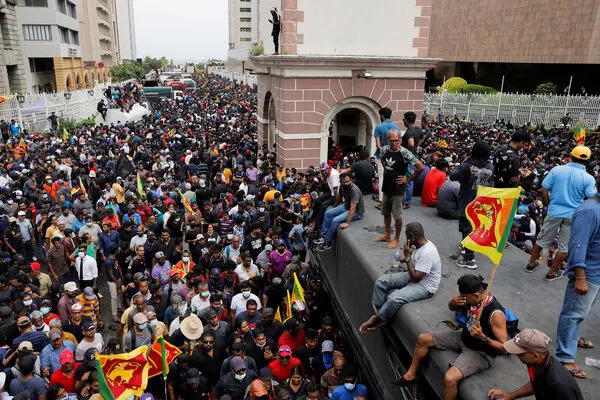
LAST week, the whole world woke up to the realities of mass protests in Sri Lanka, with graphic pictures of people taking over the residences of the President, Gotabaya Rajapaksa and the Prime Minister, Ramil Wickremesinghe. The Prime Minister has agreed to resign from office. It has been building up in the past few months.
The previous Prime Minister was also forced out of office, culminating into what we are seeing now. It is a picture of a frustrated, hungry and very angry people, with no alternative but to vent their spleen on their rulers. Even a fool will understand that putting up physical resistance against this mob is an exercise in futility.
According to the Associated Press, AP, the country “ran out of money to pay for food and fuel, short of cash to pay for import of such necessities and already defaulting on its debts. It is seeking help from neighbouring India, China and from the International Monetary Fund, IMF… Sri Lankans are skipping meals as they endure shortages and lining up for hours to try to buy scarce fuel.
It is a harsh reality for a country whose economy had been growing quickly, with a growing and comfortable middle class until the latest crisis deepened”. The Daily Independent went further to report that “political corruption is also a problem, not only did it play a role in the country squandering its wealth, but it also complicates any financial rescue for Sri Lanka“. It also noted that the protesters have received serious backlash from government agents in the past, with the resistance growing with each attempt to suppress them.
Now, there is lawlessness in the land, the government is in abeyance and nobody knows what the outcome of this roller-coasting moments will look like. Suffice to say that the people have taken over in a mob fashion and under such situations, there is confusion; no rational government; and tempers will continue to flare, amidst destructions, until the people come to their senses.
The government will suffer, the people will suffer too as witnessed in our EndSARS demonstrations. And when the roll call is taken at the end of it all, people will be wondering about the essence of it; something that should have been totally avoided now stuck in the jugular because of a non-performing government, coupled with a people with an urgent need for a change. Will this action solve the Sri Lankan problems? What should have been done to avoid it? Where there good role models in the leadership? Any lessons for other developing and debt-ridden nations?
The confusion will remain for sometime in Sri Lanka as the solution is not immediate but very dependent on the goodwill of friendly nations and international agencies like the IMF. They have to be organised and appear credible for international agencies to take them seriously, the earlier they settle down and stay focused on the solutions, the earlier they will resolve the crisis.
It is also important for leaders with unimpeachable integrity to come out to lead the people at this crucial period. The only way to pacify a mob is to deal with them in openness and fairness. If they must make sacrifices, they must see and feel what they are sacrificing for; you cannot expect the people to be skipping meals whilst the leadership is living in luxury.
That is why they must look for a pivotal leader, a role model who the people will listen to at this critical period. Doing otherwise will place the country in very grave danger, not forgetting the activities of the Tamil Tigers (insurgents) in that country in the past years. When people are hungry, they can resort to anti-government activities, especially in defiance to legitimate laws of the land.
Sri Lanka is not the first country to witness such people resistance, it is happening in countries like Sudan and Tunisia. When people are hungry, their survival takes precedence. The Sudanese military authorities are now amenable to a people’s democratic government that will comprise only civilians, a shift from their previous hard stance.
If people are pushed to the wall and decide to react, no government can withstand their force; that is the lesson for other despotic leaders all over the world, including in our own Nigeria. The moods and sentiments of the people must be regularly monitored. What happened in Sri Lanka is not different from what is going on here in Nigeria, with our rising debt profile and debilitating fuel situation.
When a people lack basic means of subsistence, when our naira is losing value on a daily basis, when there is corruption and maladministration in the land, when there is pervasive insecurity, with safety of lives not guaranteed, and where there is lack of fairness, equity and justice, anything can happen.
That is the lesson we must take away from the Sri Lankan crisis. Our politicians must begin to take cognisance of the danger creeping into our system with cost of living skyrocketing and people hungry; so government must do something. It is the responsibility of government to see to the welfare of its citizens.
Crying over subsidy is an excuse for failure. Other democracies grant subsidies to almost all sectors of their economy – they give welfare to unemployed adults, give school grants to parents who have children in school, provide subsidies for farmers to ensure price stability and enough food for the people; during the COVID-19 pandemic we saw how they were distributing money and food palliatives to people, not talking of research grants and other forms of support for technology development.
There is nothing wrong with subsidy; the only thing wrong with ours is the way and manner it is being run, including our foreign exchange management. It leaves room for corruption and a racketeering class, profiting at the expense of the poor masses. That fuel is being smuggled out of the country is no reason to say subsidy cannot be controlled.
How can you say we cannot stop smuggling when we have security agencies all over the places? How can you convince the people that you are ruling for their interests when they see you as a leader, living in opulence and conspicuous display of wealth that you didn’t have before you came into government? How can you see the profligacy in the way our National Assembly officials operate and expect the people to make sacrifices?
How can the people trust you when armed men will overrun their farmlands, rape their women and kidnap them without appropriate response by government to bring the perpetrators to justice? Such is the setting for the kind of things we are seeing in Sri Lanka; it is the Sri Lanka in us.
Ikhioya wrote viawww.southsouthecho.com
Disclaimer
Comments expressed here do not reflect the opinions of Vanguard newspapers or any employee thereof.