
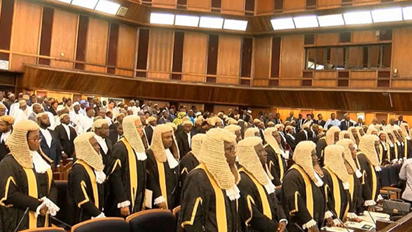
File: Picture used to illustrate the story
By Henry Ojelu& Onozure Dania
The 1999 Constitution under chapter two makes elaborate provisions for the socio-economic rights of the citizens.
These include the right to education, welfare, security, health, employment etc. The chapter particularly states that the fundamental objectives and directive principles of government policies shall be the provision of those rights.
Ironically, chapter six of the same constitution stripped the court of the power to adjudicate on any matter brought under chapter two; meaning that ordinary citizens cannot sue the government for the failure to ensure adequate provision of those essential necessities of life.
Worried about this decade-long problem, the Nigerian Bar Association Section on Public Interest and Development Law, NBA-SPIDEL, held a town hall meeting in Lagos on Monday to seek pragmatic measures to hold the government accountable for the provision of socio-economic rights of Nigerians. The theme of the hybrid event held at Lagos Marriot Hotel, Ikeja Lagos was: Justiciability of Chapter two of 1999 Constitution: Pragmatic Measures for Government Accountability.
READ ALSO: 9mobile FutureCEO Initiative: Telco unveils judges, announces top entries for finale
Speakers at the event which was divided into two plenaries include Justice of the Supreme Court, Justice Helen Ogunwumiju; Chief Judge of Abia State, Justice Onuoha Ogwe, Attorney-General of Sokoto State, Suleiman Usman; Attorney-General of Ekiti State, Olawale Fapohunda, SAN; Chairman, House of Representatives Committee on Judiciary, Hon. Onofiok Luke; Nigerian Bar Association, NBA, President, Olumide Akpata, NBA-SPIDEL Chairman, Dr. Monday Ubani; Femi Falana, SAN; Executive Secretary, National Human Rights Commission, NHRC, Anthony Ojukwu, SAN; Deputy Director, Socio-Economic Rights and Accountability Project, SERAP, Kolawole Oluwadare; Head, Democracy and Good Governance, Economic Community of West African States, ECOWAS, Emmanuel Okorodudu amongst others.
Lawyers should explore alternative enactments —Falana
Lead speaker of the event, Falana in his presentation challenged the notion that socio-economic rights are non-justiciable, pointing out that several local and international legislative enactments and judicial pronouncement have upheld that the government can indeed be held accountable for such rights.
He said: “Notwithstanding the several decisions of domestic and regional courts which have upheld the socio-economic rights of the people, lawyers and judges have continued to give the misleading impression that only civil and political aspects of fundamental rights are enforceable in Nigeria. Thus, the victims of violations of socio-economic rights have been left without access to the remedies provided by law.
“To compound the crisis, some judges in the High Courts have continued to invoke the anachronistic doctrine of locus standi to dismiss or strike out public interest cases filed by public interest litigators to secure the enforcement of socio-economic rights of disadvantaged citizens or groups.”
Falana went on to highlight several ways that socio-economic rights can be enforced. According to him, victims of socio-economic rights abuse may petition and seek redress in the National Human Rights Commission. The Commission has been vested with the power to apply all international human rights treaties that have been ratified by Nigeria.
“In view of the interconnectedness between some fundamental objectives, it submitted that socio-economic rights may be enforced via Chapter 4 of the Constitution. For instance, the right to freedom of movement and from discrimination as well as the right to dignity of the human person and right to health, may be enforced under the fundamental rights enshrined in Chapter 4 of the Constitution.
“By virtue of the Fundamental Rights (Enforcement Procedure) Rules 2009, the socio-economic rights entrenched in the African Charter on Human and Peoples Rights (Ratification and Enforcement) Act Cap A9 Laws of the Federation of Nigeria, 2004, may be enforced in a High Court in the State where a breach has occurred.”
Falana suggested that while more judges and lawyers are encouraged to tow the path of citizens by ensuring that government is held to account in the provision of socio-economic right, Attorneys-General who encourage government to disregard court judgment should henceforth be sanctioned by the NBA.
Govt must safeguard socio-economic rights—Akpata
Earlier in his opening remarks, Olumide Akpata pointed out that the assessment of the President Muhammadu Buhari administration’s fulfillment of its election campaign promises of upholding the socio-economic rights of the citizens, clearly showed that government…..
He said: “It is a well-known fact that we have an entire Chapter in the 1999 Constitution dedicated to the provision of socio-economic rights titled: Fundamental Objectives and Directive Principles of State Policy. That chapter provides in no unclear terms that it shall be the duty and responsibility of all organs of government, and of all authorities and persons, exercising legislative, executive, or judicial powers, to conform to, observe and apply the provisions of this chapter of this Constitution. How have we fared? To answer this question, let us take a look at the raw numbers.
“The World Poverty Clock records Nigeria as the country with the highest number of persons (circa 90 million) living in extreme poverty, an unwanted feat that we attained after overtaking India. When you consider the fact that the population of India is almost seven times that of Nigeria, then you can understand the implication of that statistic.
“According to data from the government-run National Bureau of Statistics, unemployment rate in Nigeria is at an all-time high of above 33 per cent, with almost 65 per cent of the country’s youth either unemployed or underemployed. As we begin the countdown to the 2023 election season, characterised by another round of political promises, it is time to take account and to put these issues in proper perspective. The Nigerian government can and must do better in the provision and safeguarding of the socio-economic rights of Nigerians.”
Rights meaningless without enforcement —Ubani
Also addressing the gathering, NBA-SPIDEL Chairman, Monday Ubani noted that nothing is fundamental about human rights in Chapter 4 if the socio-economic rights in Chapter 2 are not given any meaning. He said: “The essence of this gathering is to remind major stakeholders in Nigeria that time to enforce the terms of the fundamental objectives and directive principles of state policy is now. Enough of rhetorics and empty promises. As we approach 2023 general election, the agenda for governance must be set and met.
“Nothing is fundamental about our human rights in Chapter 4 if the socio-economic rights in Chapter 2 are not given any meaning. Your life and mine are empty if there are no medical facilities to preserve it. Our existence is terribly threatened if that life can be cut short at any time by a bandit, armed robber, kidnapper or worse still, a terrorist.”
Judges must be proactive in legal interpretation —Ojukwu, SAN
NHRC boss, Anthony Ojukwu, in his presentation observed that the Nigerian Judiciary is a little too cautious in the legal enforcement of directive principle, saying that perhaps it was as a result of the relatively infant nature of constitutional democracy and the consequent adoption of directive principles in the constitution.
He said: “The Nigerian judiciary is with due respect, enjoined to adopt some of the pro-active approaches taken by the judiciary in other jurisdictions like India and South Africa in her creative effort towards enhancing the enforceability of Directive Principles. These approaches include the declaration of the indivisibility of the fundamental rights on the one hand, and the Directive Principles of State Policy on the other.
The assertion of the Doctrine of Substantive Due Process as permeating the entire Chapter 4 of the 1999 Constitution is similar to Part III of the Indian Constitution comprising the fundamental rights. Thus, in order to pass judicial scrutiny, an executive, quasi-judicial or legislative action would have to satisfy the ‘just’ ‘fair’ and ‘reasonable’ test.
“The innovation of Public Interest Litigation (PIL) as a tool to achieve social objectives by enabling easy access to courts for those disadvantaged socially and economically: a conscious attempt made to relax the rules of standing and procedure and free litigants from the strangle hold of formal law and lawyering.
“The Directive Principle of State Policy is like a beneficial or social welfare legislation, therefore, the Nigerian Courts must interpret it to achieve that benefit for which it is inserted in the constitution. The courts must adopt a very liberal construction and ensure that every doubt is resolved in favour of the citizens for whose benefits the chapter was introduced. The court therefore needs to be liberal, innovative, dynamic and pragmatic in the interpretation of the provisions of Chapter 2.”
Lawyers must seek proper reliefs — Abia CJ, Onuoha
Responding to comments on the need for judges to adopt judicial activism in ensuring that the provisions of the Chapter 2 are enforceable, Justice Onuoha noted that the challenge is not with adjudication but about relief sought by lawyers who file suits under the chapter.
He challenged lawyers to properly prepare their cases before approaching the courts, saying that several recent court judgments have indicated the willingness of the judiciary to grant rights sought by citizens especially when such rights have been breached by the government or its agencies.
NBA should sanction AGs for disregard for judgments- Onofiok
Chairman of House of Representatives Committee on Judiciary noted that several subsidiary laws have been enacted by the legislature to tackle the issues of socio economic right abuses but observed that the problem lies with the enforcement of those rights especially when judgment has been delivered. He called on the NBA to consider sanctioning Attorneys-General who fail to appropriately advice the government they are serving to obey such a judgment.
“I think we in the legislative arm have done our bit by enacting laws to take care of these issues. The problem is that when the courts deliver judgments on these issues, the government is often reluctant to obey such judgment. We find also that these governments are aided by Attorneys-General who advise them not to obey such court judgments. NBA must begin to consider sanctioning these Attorneys-General as a deterrent to others.”
Disclaimer
Comments expressed here do not reflect the opinions of Vanguard newspapers or any employee thereof.