
•Call for mobilisation of private capital to bridge gap
By Nkiruka Nnorom
Investment analysts have indicated that 2022 budget performance will lag behind the two previous years especially in the capital expenditure implementation.
Ironically they fingered the rising oil price as the main downside at the backdrop of subsidy obligations.
Though the increase in the crude oil price around $100 per barrel is supposed to positively impact revenue, the analysts observed that the restoration of subsidy would drain the revenue and thus impair the capital budget implementation.
They, therefore, called for the mobilisation of private capital by the government to help bridge the revenue gap.
Historically, the execution of the FG’s annual budget has always fallen below 100 percent, partly due to the shortfall in revenue receipts and what analysts described as lack of commitment by the government to follow through with the implementation.
2020/2021 budgets
For instance, both the 2020 and 2021 budgets’ implementation fell below 100 percent execution level despite the extension of the life cycle of both budgets by some months.
Though the 2020 budget was revised and deadline for the implementation extended to May 31, 2021 in the face of the Covid-19 pandemic, yet the execution lagged expectation.
Breakdown shows that in 2020, the government achieved over 100 percent execution level on the total expenditure side. Of the N10.12 trillion budgeted for total expenditure during the year, the government expended N9.97 trillion, N43.34 billion or 0.43 percent above the budgeted sum.
On the recurrent expenditure side, a total of N4.65 trillion was executed, indicating a shortfall of N297.07 billion or 6.01 percent below the annual estimate of N4.94 trillion. This showed 93.99 percent implementation level.
However, the capital expenditure implementation was 21.7 percent below actual budget provision as N1.95 trillion out of N2.49 trillion budgeted was disbursed. This indicated 78.3 percent execution level.
These shortfall came at the backdrop of a 41.4 percent (N2.42trillion) shortfall in the revenue receipts during the year. Actual government revenue stood at N3.42 trillion compared to N5.84 trillion budgeted for the year.
Speaking on the constraints on the implementation of the 2020 budget, Ben Akabueze, Director General, Budget Office of the Federation, said: “Revenue projection and mobilization remains a key challenge for budget implementation in Nigeria, especially as the key source has precisely remained concentrated in the very volatile oil sector.
“Revenue receipts in 2020 have significantly performed below targets. The execution of the 2020 budget was made further challenging due to the impact of COVID-19 which led to the collapse of the global economy and resulted in the revision of the budget.
“Despite these challenges, the government was able to deliver N1.95 trllion capital expenditure under the 2020 budget by the end of 31st May, 2021.
“This considerably contributed to the positive GDP growth recorded in the last quarter of the year. The extension of the 2020 capital budget to 31st May, 2021 was to enable Ministries, Departments and Agencies (MDAs) complete all outstanding procurement processes and utilize the funds allocated and released to them for their 2020 capital projects/programmes.”
2021 budget
Just like the 2020 budget, the fiscal year 2021 has also been extended to March 31, 2022 to allow for full implementation.
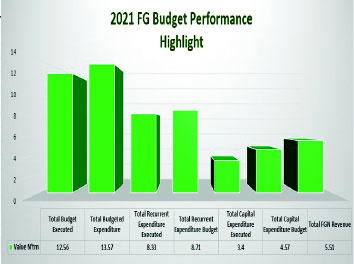
As at November 30, 2021, total expenditure was 94.1 percent executed.
Analysis shows that N12.56 trillion (or 94.1%) has been spent out of the N13.57 trillion budgeted.
On the recurrent expenditure side, of N8.33 trillion targeted for the year, N8.71 trillion has been spent, which is 4.5 percent above the budgeted figure.
Capital expenditure so far is 74.4 percent executed as N3.4 trillion out of N4.57 trillion budgeted has been utilised on capital projects.
Further breakdown shows that as at November 30, 2021, FGN’s aggregate revenue was N5.51 trillion, 74 percent of the target.
Budget projections should be realistic – Analysts
Meanwhile, investment analysts who spoke to Vanguard Public Finance, stressed the need to ensure that budget estimates are based on realistic projections and revenue generation estimate in order to guarantee higher implementation level.
Ayodeji Ebo, Head, Retail Investment at Chapel Hill Denham, said: “Based on the statistics, we would say that the implementation was impressive but we can still see that it is still lagging behind recurrent expenditure.
“So, there is a lot of more focus in terms of implementing recurrent expenditure while the capital expenditure always comes from behind.
“While we may say that this is impressive, when we look at infrastructure deficit in Nigeria, which has been estimated that about $1 trillion is required annually to bridge that gap, we would see that there is still a significant gap.”
Continuing, he said: “The federal government should work with the Central Bank of Nigeria (CBN) to ensure that Infrastructure Corporation (InfraCorp) that has been set up starts so that they can mobilise private capital to also bridge that gap for capital expenditure.
“So, it is important that they create an enabling environment for the private sector to also come in more to bridge that gap.
“In 2022, with the current oil price, it is going to be a tough one for the government to be able to fully implement the capital expenditure because the subsidy payment would reduce what is available to the federal government.
“Government will even have to borrow more to meet up to its non-debt recurrent expenditure. So, I feel that this year may be more challenging as a result of that and there would be need for more borrowings.
‘‘But if we are able to get the Infrastructure Corporation started and the private sector is able to mobilise more investment, then it may also bridge the gap.”
In his own views, Marvellous Nwachukwu of Global Markets, Parthian Partners, said: “The revenue projection for 2022 was increased by 32 percent from the previous year with oil price assumption at $62 per barrel.
“While it is true that crude oil prices are on the rise (currently hovering around $100/b )with the Russia/Ukraine tension being a primary factor. This could mean more revenue for the government. However, the existing subsidy regime might erode the gains.”
Victor Chiazor, Head, Research and Investment, FSL Securities, opined that the major issues around budget implementation in Nigeria has to do with raising the required capital to finance the budget and the actual time the budget is passed by the legislative and executive arm of the government.
He stated that for a January to December cycle, the budget should be passed before the next calendar year to enable the various arms of government to run with it.
On the implementation level, he said: “It would be very hard for the government to achieve 100 percent budget implementation for capital expenditures as the government lacks the required revenue to meet such targets within the set calendar year.
“However, on the area of recurrent expenditure, we have over the years observed that it has recorded a higher implementation level when compared to the implementation level for capital expenditure and we expect this status to be repeated into 2022.
“Until we begin to pass realistic budget that are based on proper projections and revenue expectations, our budget implementation levels will remain low and we would be forced to extend the cut off date to allow for further implementation in order to achieve a higher implementation level.”
David Adonri, Vice Chairman, Highcap Securities, expressed concern over the elongation of the cut-off date for budget implementation, saying that time is of essence for execution of any plan.
He stated that the fact that implementation of one budget spilled over to another budget year means that the process is flawed and exhibits planning indiscipline.
He said: “For maximum benefit to be derived from any plan, it must be executed within the stipulated time frame. Elongation of implementation can also cause escalation of cost. This is why many abandoned government projects litter the environment.
“Although, the disruptions inflicted by Covid-19 pandemic in 2020 was sufficient to derail any plan, government ought to have done necessary adjustments to ensure that the budget was implementable.
“FGN reacted effeminately to the threats and was caught napping at end of the day. 2021 budget had no reason for poor implementation because the global economy had opened up. Examination of the budget showed that it was unrealistic and over ambitious.
“2022 budget is even more unrealistic and unreasonably ambitious. I suspect it is so because politicians are targeting the budget as an avenue to siphon money needed for campaign.
“The weak revenue side of the budget is also capable of crippling it. I am not sure that implementation of 2022 budget will be better than 2021. Nigerians should expect nothing tangible from 2022 budget but see hope from 2024.”
Disclaimer
Comments expressed here do not reflect the opinions of Vanguard newspapers or any employee thereof.