
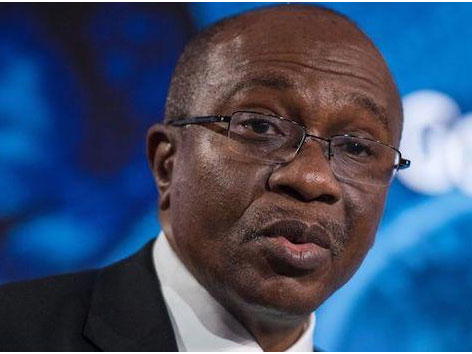
Godwin Ifeanyichukwu Emefiele was born on August 4, 1961, in Lagos State, while his roots are firmly anchored in Ika South Local Government Area of Delta State.
He attended Government Primary School (formally Ansar-U Deen Primary School), Lagos between 1967 and 1973.
He had his secondary education at Maryland Comprehensive Secondary School, Ikeja, Lagos, where he obtained his West African School Certificate in June 1978.
Emefiele holds a B.Sc. degree in Finance (1984), and an MBA in Finance in 1986, both from the University of Nigeria, Nsukka (UNN).
He is also an alumnus of Executive Education at Stanford University, Harvard University (2004) and Wharton School of Business (2005), where he took courses in Negotiation, Service Excellence, Critical Thinking, Leading Change and Strategy.
Prior to his joining the Central Bank of Nigeria (CBN), Emefiele spent over 26 years in commercial banking, icing it with his tenure as Group Managing Director and Chief Executive Officer of Zenith Bank PLC, one of Nigeria’s largest banks with over 7,000 staff, about US$3.2bn in shareholders’ funds, and subsidiaries in Ghana, Sierra Leone, Gambia, South Africa, China, and the United Kingdom.
He had earlier served as director at Zenith Bank Plc and Zenith Bank (Gambia) Limited.
Under Emefiele’s leadership, Zenith Bank had strengthened its position as a leading financial institution in Africa, winning recognitions and endorsements at home and abroad for giant strides in key performance areas like corporate governance, service delivery and deployment of cutting-edge ICT.
Before his banking career, On June 3, 2014, the then President Goodluck Jonathan appointed Godwin Ifeanyichukwu Emefiele as the 11th substantive CBN governor.
He replaced Sanusi Lamido Sanusi.
Emefiele, as the CBN governor, has continued to spearhead the diversification of Nigeria’s economy through long and medium-term strategies.
Under him, the CBN has established initiatives to genuinely tackle challenges of job creation, economic productivity, poverty eradication and food security. For instance, there are ongoing intervention schemes for four commodities – rice, fish, sugar and wheat – which consume about N1.3 trillion annually in imports, to improve domestic supply and eventually moderate pressure on foreign reserves.
The Bank’s Anchor Borrowers’ Programme, piloted in Kebbi State, has financed 4.5 million farmers that have cultivated 5.3 million hectares across 21 commodities through 23 Participating Financial Institutions in the 36 States of the federation and FCT.
Emefiele was twice named LEADERSHIP Person of the Year, first in 2016 and then in 2020, for adding the concept of social business to the portfolio of Nigeria’s apex bank and ever anticipating areas of intervention; and for cushioning the economic backlash of the outbreak of COVID-19 on ordinary Nigerians.
Disclaimer
Comments expressed here do not reflect the opinions of Vanguard newspapers or any employee thereof.