
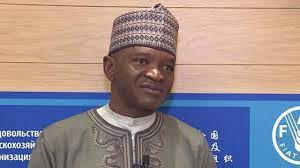
Minister of Agriculture, Dr Mohammed Abubakar, above and Adesuwa Ifedi, Senior Vice President for Heifer Programs in Africa,
Commissions soil testing, GIS laboratories
By Gabriel Ewepu – Abuja
The Minister of Agriculture and Rural Development, Dr Mohammed Abubakar, Monday, tasked Department of Agric Land and Climate Change Management Services on sensitizing farmers on soil testing for effective crop and livestock production.
Abubakar gave the charge while commissioning of the Soil Testing and Geographic Information System, GIS, Laboratories of the Federal Ministry of Agriculture and Rural Development in Abuja.
Speaking on the importance of the laboratory for farmers and other stakeholders, he disclosed that the Ministry now has four national soil laboratories in Abuja, Kaduna, Ibadan and Umudike, each equipped with Mid-Infrared Spectrophotometer (MIR) for dry chemistry analytical procedures.
READ ALSO: NALDA to train 30,000 graduates on soil testing, extension services
He said: “The laboratories we are commissioning today will further strengthen the capacity of the department in this respect.
“The Ministry now has four National Soil laboratories in Abuja, Kaduna, Ibadan and Umudike each equipped with Mid-Infrared Spectrophotometer (MIR) for dry chemistry analytical procedures.
“The equipment has the capacity for analyzing large quantities of soil samples rapidly. The four laboratories will go a long way in expanding our soil testing capacity.
“The department should embark on nationwide sensitization of farmers on the importance and benefits of soil testing in crop and livestock production, because declining yield per hectare of farm land is attributed to declining soil fertility.
“Soil fertility cannot be managed effectively without knowing the fertility status of the soil. Interpretation of soil testing results will reveal the soil fertility status and amendment needed to enhance soil fertility for increase crop output per hectare.
“The GIS laboratory I am commissioning with the soil lab also has capacity to receive soil field data real-time for processing, analyses and mapping. The GIS technology with its versatility will facilitate the production of soil fertility maps for different parts of the country.”
He also said that the lab will provide current information on the suitability and capability of lands for the production of different crops and land use.
“The maps will provide information on crop and location specific types of fertilizer for blending by our blenders to enhance agricultural productivity and stop blind application of fertilisers in the country.
“To ensure proper maintenance and operation of this equipment training of some ministry staff is ongoing.
“Resource Persons from the World Agroforestry Centre (International Centre for Research on Agroforestry, ICRAF, Kenya are conducting the training due to their years of experience in soil analysis using MIR”, he said.
He added that the Ministry will go into more collaboration with ICRAF in the area of soil analytical services.
Also in a remark, the Permanent Secretary in the Ministry, Dr Ernest Umakhihe, maintained that the Ministry is now in a position to provide technology-driven services for effective land resources management nationwide.
“In our drive towards attaining food self-sufficiency, the facilities we are commissioning today are expected to contribute substantially in driving the process because the soil is the starting point when we talk of food security.
“These laboratories are expected to expand soil analytical services in the country and bring soil testing services closer to our farming communities.
“In order to stop blind application of fertiliser and ensure sustainable land use, the country needs detailed soil survey and soil fertility maps for a good understanding of the best ways of evaluating the potentials of our soils for agricultural production.
“The Ministry therefore initiated the process for a national soil survey and soil fertility mapping last year. The nationwide soil survey has now commenced with Jigawa,Gombe,Edo and Oyo states out of the 36 states and FCT.
“The soil testing and GIS laboratories being commissioned today will facilitate the production of national soil survey and soil fertility maps for the country. We hope to complete the project in three years, subject to availability of resources”, he stated.
Meanwhile, he (Umakhihe) made it known that the Nigerian Soil Information Service, NISIS, will be established at the end of the nationwide detailed soil survey.
He also commended the Director and staff of the Department for working hard to acquire the equipment for soil analysis and enhancing GIS capability of the ministry.
In a goodwill message, a Lead Resources Person from International Centre for Research on Agroforestry, ICRAF, Nairobi, Kenya, Wullow Elvis, commended the Federal Government on instrument made on the equipment, and promised to assist Nigeria develop the National Soil Information System.
“We have agreed to help Nigeria to develop its own Nigeria National Soil Information System and we have seen its effort and we believe these will also enhance information sharing”, he said.
Earlier, the Director, Department of Agric Land and Climate Change Management Services, Engr Shehu Bello, said the GIS Laboratory will be a dedicated server set to serve as central data support center for the departments in the Ministry.
According to Bello, it will provide technical services for continuous real-time online farmers’ registration, map the size and shapes of farms, identify those farms with water bodies where irrigation facilities can be deployed.
Disclaimer
Comments expressed here do not reflect the opinions of Vanguard newspapers or any employee thereof.