
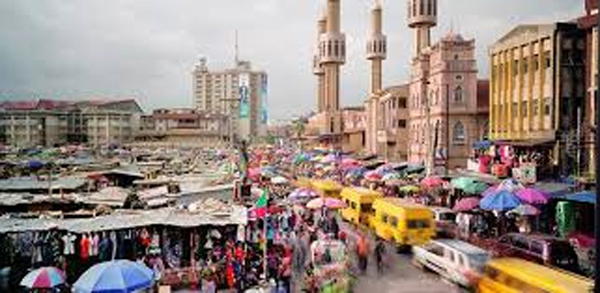
File image Balogun Market, Lagos.
By David Adonai
Many people, especially retail investors, erroneously think that investment starts and ends with equities (shares) and debt (bonds). A game changing revolution in Nigeria’s investment space that can change this thought is speedily taking place with commodity exchanges springing up all over the country.
Through these platforms, several investors can access various commodity investment products as alternative to equities and debt. As commodity prices rise globally, post Covid-19 lockdown, this alternative asset class is capturing the attention of investors everywhere.
READ ALSO:Soji Akanbi celebrates, as baby of the family calls to Bar
Commodities are basic raw materials or generic, unprocessed goods that are either consumed or used to make other products. They are bulk products that are produced and graded to meet standard specifications. Commodities are generally not differentiated based on brands or benefits but bought and sold purely on price.
Commodities are principally grouped into four categories which are :
1) Metals (ferrous and non-ferrous metals eg. iron ore, copper, silver, gold, bauxite, tin, lead etc. )
2) Energy (fossil and non-fossil Fuel eg. crude oil, natural gas, coal, hydro etc.)
3) Livestock and meat (cattle, sheep, poultry, pig)
4) Agricultural produce (corn, wheat, sorghum, soya beans, sugar, rubber, cocoa, coffee, etc)
The commodities market is largest in the world. It cuts across villages, cities and continents. It is the very essence of international trade. The commodities market is the backbone of the global economy. Every year, the global commodities market trades over $20 trillion worth of commodities. One can actually tap from the vast financial opportunities offered by the expansiveness of the commodities market by venturing into it. The commodities market can be easily accessed now by investors, even from the comfort of their homes as a result of increasing formalization of the commodities trading ecosystem anchored on commodity exchanges.
Commodities are tradable assets with primary and secondary trading properties. An investor can buy and sell these assets on a commodities trading platform called commodities exchange.
The commodities exchange is a formal and regulated modern efficient market. It is classified into two segments which are the cash or spot market and the derivatives market. In the spot market, transactions are conducted for immediate delivery of physical commodities, while in the derivatives market, delivery is at a future date. Spot transactions are easy in contrast to futures contracts (derivatives) which requires execution through expert derivatives broker. Futures trade on margin which is the collateral an investor puts up to trade and it is a percentage of the security’s price.
There is an initial margin to open a position and the maintenance margin to keep the account active. If value of the collateral falls, it will warrant a margin call requiring more money to balance the account. Also, futures contracts have expiration dates and traders must manage the rolling of contracts, that is, move a position from an expiring contract to a new one. If an investor allows the contract to expire, he must take delivery. Sometimes, contracts are cash settled rather than through delivery. This means the money value of the contract proceeds is received instead.
The role of the commodities exchange ecosystem is standardization of contract terms. The standardization in turn drives trading and liquidity. Trading on an exchange enables enforceability of contracts which protect all parties. The exchange facilitates price discovery and guarantees performance by all parties. Exchanges serve as accurate information centers which provides market based price setting mechanism. These help in enhancing investor’s capacity to make informed investment decisions.
While commodity exchanges are the primary centers for buying and selling of commodities and their futures, investors can also gain exposure to commodities through stock markets. They can invest in shares of listed companies on Nigerian Exchange Limited (NGX) like Okomu Oil Palm, Presco Plc, Total Nigeria Plc, Transcorp, etc which produce commodities. Exposure can also be acquired by investing in commodities exchange traded funds (ETFs) like ABSA New gold on NGX and various indexes of commodity producers packaged as ETFs.
The commodities exchange is an efficient center for spot transactions. Traders can access standardized products under transparent pricing mechanism, for immediate delivery.
The only active commodities exchange in Nigeria, AFEX in Abuja, does active trades in spots for agricultural produce like maize, paddy rice and sorghum. It is yet to commence trading on metals, energy and others. The oldest commodities exchange in Nigeria, the Nigerian commodities exchange (NCX) also in Abuja started operations in spots but stopped after a while. It is now being recapitalized by CBN with N50 billion to revive it’s activities.
The newly established Lagos Commodities & Futures Exchange (LCFE) deals in a long list of highly diversified asset classes including agricultural produce like paddy rice, maize, sorghum, soya beans, cocoa; energy products like crude oil, etc. LCFE is poised to taking off by trading on spots very soon.
Just like in Nigeria, on the world scene, as economies rebound from pandemic induced lockdown and spending rises, demand for commodities is increasing.
This is a big shift from 2020 when commodity prices fell, and crude oil price became negative. Some commodities such as gold may be reflecting increased inflation concerns with economies awash with fiscal and monetary stimulus. Other commodities such as copper are seeing a structural demand shift since the metal is used in products like electric vehicles and to build infrastructures, Although metals are not yet available on Nigeria’s commodity exchanges, they will, sooner or later. So, investors need to be conversant with their behaviours.
The world’s most traded commodities are crude oil, coffee, natural gas, gold, wheat, cotton, corn and sugar but aluminum, zinc and copper are the most stable commodities when compared to prices of other metals because of the supply stability. As the Nigerian commodity exchanges take firm roots, these popular commodities that are not already formally traded will become available to investors in Nigeria.
Commodities are numerous and display varied characteristics and behaviours. Care must be exercised in building a portfolio out of them. Picking specific commodity investment, like betting on the directional movement of crude oil or sorghum is quite speculative. It is best left to the judgment of a professional commodities broker. Doing it yourself may be better by investing in a broad commodity fund unless you are very knowledgeable about a particular commodity. Whether you invest by yourself or through funds, you must be aware that investing in commodities bring risks that are distinct from the perils of the stock and bonds market.
Many variables affect derivative’s pricing. Risks differ from product to product. Generally, in the commodities space, prices are extremely volatile. Within a short time, commodity prices can peak and trough dramatically. Foreign exchange risk and price interventions by cartels like OPEC can heighten the risks in commodities market. It must also be understood that commodities investing is cyclical and distinct, so, it offers varying returns over time. In the past 10 years, the S&P GSCI global Index price which peaked in 2012 near 713 and bottomed in April 2020 at around 230 when it was dragged down by the catastrophic fall in crude oil price is currently around 530.
in spite of it’s risk, commodities provide a massive hedge against inflation, as they perform well during periods of rising inflation. Commodities are not correlated with traditional asset classes such as bonds and shares. Goldman Sachs call commodities a ‘Portfolio Enhancer’. According to this investment banker, “commodities are significantly negatively correlated with both debt and equities, implying that even a small allocation to commodities will reduce portfolio volatility. This extols the virtues of commodities as potent diversification and hedging tools.
The Nigerian commodities market is largely informal and primitive. In spite of it’s huge potentials, emanating from abundant mineral resources and agrarian endowments, the commodities market is underdeveloped.
As a result, investor’s appetite for commodities backed instruments have been suppressed until recently when commodity exchanges started springing up to formalize the space. Through formalization of the mining sector and eradication of illegal mining, precious metals like gold, silver, platinum, palladium, etc can become available in coins and bars which can also be listed for trading on Nigerian commodity exchanges.
The formal nature of commodity exchanges in Nigeria, now gives impetus to exploitation of bulk solid minerals like coal, iron ore, bauxite, etc which are abundant, for spot trading or securitized instruments.
The opportunity for investors to make money from commodities is fast emerging in Nigeria. The infrastructure to formalize the market and support profitable, liquid and safe investment in the Nigerian commodities market is advancing with undiminished intensity. When Nigeria overcomes her current rural insecurity that has depressed agriculture and mining, the commodities market shall become the critical point and indeed essence of the economy.
Disclaimer
Comments expressed here do not reflect the opinions of Vanguard newspapers or any employee thereof.