
By Chukwuma Ajakah
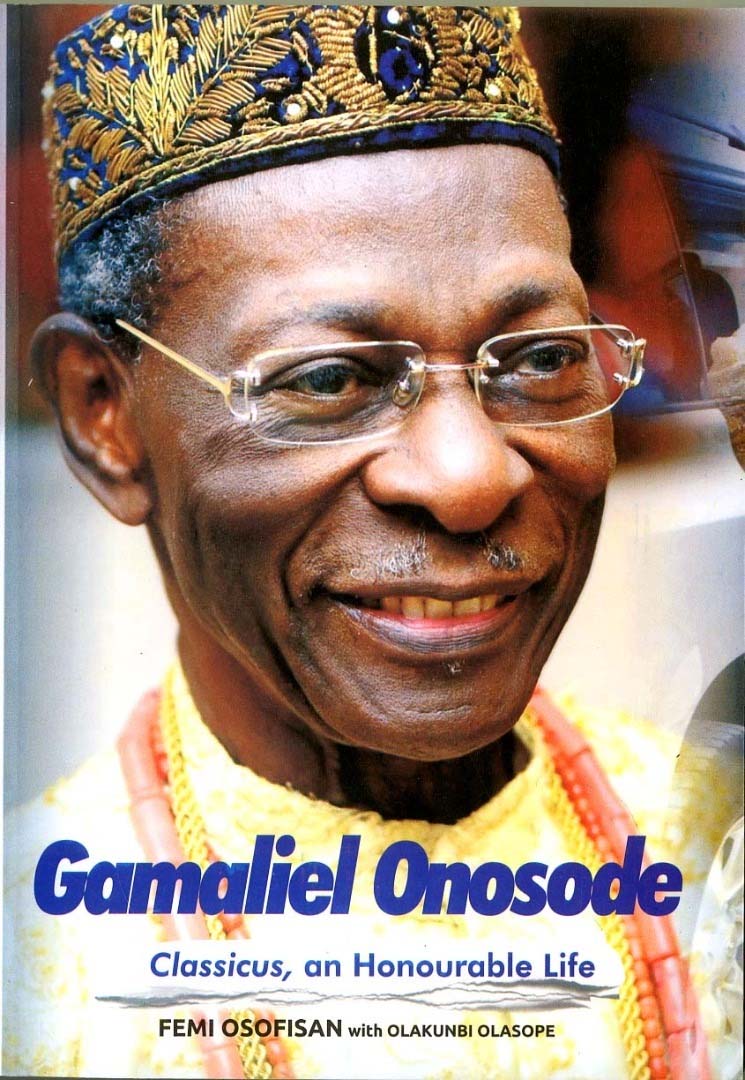
There is sure to be an intriguing interplay of facts and fiction in a biography written by a master craftsman like the renowned creative writer, playwright and poet, Professor Femi Osofisan, especially when the subject matter is a man with a towering profile, Gamaliel Oforitsenere Onosode, astute businessman, veteran banker and revered university administrator.
Right from the introduction to the book titled, Gamaliel Onosode: Classicus, an Honourable Life, the biographer, Femi Osofisan-assisted by Olakunbi Olasope, prepares the reader to expect the unusual as he explores uncovered aspects of the sage’s life. Unequivocally, the iconic wordsmith promises his prospective readers: “I want to bring into the Onosode narrative, something more earthy than bald facts and figures and dates…; Something that goes beyond the glittering catalogue of certificates and awards, but yet without erasing the exemplary significance of these achievements. I am talking of a credible three-dimensional portrait that I hope people can easily identify with and take inspiration from.”
The uniqueness of the new biography, published by Mosuro Publishers, Nigeria (2020) anchors on multifaceted factors which include the unusual narrative style, an elongated scope that transcends the already profiled public face, infusion of interviews with both the protagonist and others, the creation of a semi-omniscient narrator, using the pseudonym, Wehinmi – a feminine voice to co-ordinate interlocutors, a humour laden dialogical presentation and simplicity of language.
As typical with biographies, the 289-page book encompasses essential aspects of the well lived life of the enigmatic boardroom politics guru, but the author ingeniously delves into virtually every aspect of the subject matter. To do this effectively, he has to bring his mastery of the language of literature and experiences as not only a prolific writer, but a celebrated academic to bear.
The author presents his thoughts on the assignment thus: “Before me was such an icon now, offering me the challenge…my mind began to consider the options. There is already a public profile of Onosode, I tell myself, that is well-known and well-documented. He is universally celebrated as a man of rectitude, if not even as Mr. Rectitude itself, and one of uncompromising probity, something that is a rare attribute in contemporary Nigeria. He is also a committed Baptist Minister, a highly successful business magnate and Patron of intellectuals…A new biography therefore, will be interesting or valuable, only if it strikes a different note and pursues a totally fresh direction…”
Away from the main title, Gamaliel Onosode: Classicus, an Honourable Life, a glimpse at the following subtopics gives the impression that one is about to read a fictional narrative rather than a non-fiction as creativity echoes through each of them: A Museum of Memories, A Man of Miracles, Of Plural Names and Origins, Dawn Trip and Revelation, The Touch of the Bible and Methodical Habits, A Village Man in Lagos, A Sacred Covenant, Discipline at the Homefront and Decisive Turn, Childhood in the Village and the Transforming Path, Ibadan, Again and A Chivalrous New Turn.
In the actual narration of the real-life episodes, the writer’s ingenuity at creativity also comes into play. There is an infusion of diverse narrative techniques and perspectives, ranging from the first person to the omniscient. Moreover, pictures-taken within and outside Nigeria, are elaborately used to depict the various spheres and phases of the life of the protagonist-background and relationships, family life, career, business, public appointments, religion and philosophical disposition.
Among these are pictures of his parents, Rev. P.E. Onosode and Mrs. E.A. Onosode, childhood, school life-Government College, Ughelli and University College, Ibadan, corporate life-Dunlop Nigeria, Commerce Bank, LNG, political life-Presidential Bid (1998/1999), with some former Governors and Presidents, wife (Mrs. Susan Onosode) and children.
The book portrays Gamaliel Onosode as a cosmopolitan man who despite his exposure to Western civilization is so broad-minded that he remains in constant touch with his roots.
He proudly associates with traditional chiefs even on formal occasions like when the Honorary Fellowship of the Nigeria Academy of Letters was conferred on him in August, 2000. He is photographed with the traditional ruler of the Ughelli Kingdom, His Royal Highness Ovie of Ughelli as seen on pages 94 and 175. Surprisingly, however, he remains simply Mr. Gamaliel Onosode, a testimony to his avowed preference to a modest lifestyle. He would neither be Chief nor High Chief like many of his contemporaries.
Moreover, the book showcases the protagonist as a deeply religious man. His level of devotion to the Christian faith is instantiated in his unashamed involvement in open air crusades and other religious gatherings organized by his local church community. He is referred to as a minister of the gospel in the book and described as “a religious man” in one of the pictures (page 174). However, unlike his father Reverend Pinnock Onosode, he seems to be averse to the idea of adding the title of a clergy as prefix to his name.
Another interesting feature of the compelling narrative is the author’s deliberate use of diverse names to describe his subject matter. Besides the formal name, the story contains a prevalence of pet or nicknames names such as Uncle Gam, GO, Sapele, Uncle, G.O.O, etc. The author also attempts to explain the meanings of names and circumstances surrounding the namings of not only Gamaliel Onosode, but others such as his children.
Besides, a section of the book focuses on his stance on the cultural conflict arising from naming. For instance, he vehemently argues against the labeling of native names as unbiblical. The story features an abridged form of a letter he wrote his father on the subject: “…I can find no scriptural evidence to support any suggestion that a Christian should answer a Hebrew, English or Greek name and that a Christian parent should accordingly give his child a Hebrew, Greek, English, Anglo-Saxon or any other foreign name.
None of the apostles of Jesus changed their names on meeting Jesus. Simon was merely given an additional name, Peter, which means “a rock”. It means then, that none of them answered what can be termed a ‘Christian’ name…” He concludes the argument by saying: “I am sorry but I must beg to differ. ALL my children are bearing Christian names. The names do not have to appear in the pages of the Bible. I would not call my children LUCIFER, although the name is there in the Bible…”
Beginning with the description of his modest home-metaphorically presented as “A Museum of Memories” in the opening paragraph, to the epilogue which features the account of his final farewell alongside the fascinating presentation of the interviews he had granted the biographer, the new biography, Gamaliel Onosode: Classicus: An Honourable Life, virtually captures the entire spectrum of the life and times of Gamaliel Oforitsenere Onosode. The story is so masterfully told in the present tense that the reader would struggle to believe that the legend has actually passed on.
Disclaimer
Comments expressed here do not reflect the opinions of Vanguard newspapers or any employee thereof.