
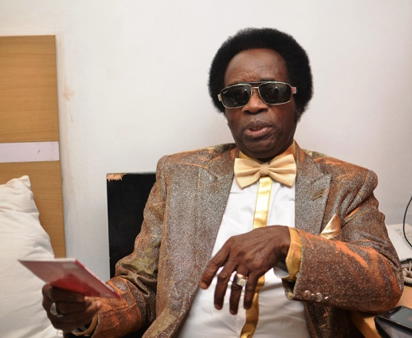
Sir Victor Uwaifo
By Osa Amadi
A visit on October 25, 2019, to his country home in Benin City was the climax of our tour and experience of Benin in connection with the 2019 National Festival of Arts & Culture, NAFEST. Otunba Segun Runsewe, the D.G of National Council for Arts & Culture which organizes the annual festival, had decided that our experience of the 2019 NAFEST titled “Our Royalty, Our Pride” would not be complete without visiting the then living Highlife music legend, Professor Sir Victor Uwaifo.
As a team of journalists led by Otunba Runsewe, we set out early that morning of October 25, from the Benin metropolis and drove several miles down the countryside where the music legend built his mansion and a museum – trust Uwaifo; he preferred to live outside the city, away from noise and synthetics.
We went straight to his private museum which was by the side of his mighty house. At the entrance of the museum stood a large monument of a 1969 photograph taken by Don McCullin. The following words were writing on top of the picture:
BIAFRA 1969
THE PAINS OF THE CIVIL WAR
When the Igbos of Eastern Nigeria declared themselves independent in 1967, Nigeria blockaded their fledgling country – Biafra. In three years of war, more than one million people died, mainly of hunger, in famine; children who lack protein often get the disease kwashiorkor, which causes their muscles to waste away and their bellies to protrude. War photographer, Don McCullin, drew attention to the tragedy.
The museum was designed by Uwaifo himself – a massive aircraft he used cement to sculpt, with rooms and compartments inside it. The rooms had different sculptured and carved images telling the story and ancient history of the Benin kingdom.
Our guide (not Victor Uwaifo) took us into the different rooms inside the sculptured aircraft containing different historical Benin artworks created by Uwaifo himself. Few people knew that Victor Uwaifo, apart from being one of the greatest musicians Africa has ever produced, was such an accomplished visual artist.
He was later to tell us in an interview, when he hosted us in his house, that he graduated from Yaba College of Technology in 1963 as a graphic artist, and how, at 56 years old, after bagging a master’s degree at 54 from the University of Benin, he went back to study Fine and Applied Arts, majoring in Sculpture. He also completed a Master’s degree and a Ph.D. in Architectural Sculpture.
Inside one of the rooms, we saw a sculptured scene of the 1890s encounter between an Oba of Benin and a British colonist. There were also quite a number of awe-striking scenes of the primordial Benin monarch, the chiefs and their subjects. Going through the museum was like visiting the pre-colonial Benin Kingdom.
Some rooms inside the museum also had Victor Uwaifo’s memorabilia – the very first guitar he played and other musical instruments he built by himself. He began playing guitar when he was 12 years old. We also saw inside the museum, a sculptured scene of Uwaifo’s encounter with the Mammy Water, together with the particular guitar he was playing at the Bar-Beach, according to what he told us later, when he had the encounter with the Mammy Water. The highlife maestro set that encounter with Mammy Water to music in the popular song, “Guitar Boy” which became a household tune across Africa and many parts of the world.
After touring the museum, Prof. Uwaifo hosted us inside his massive mansion. His living room was grand and almost as large as a Lawn Tennis ground. The walls were lined with golden and platinum discs which he won with his smashing hits like “Joromi”. He was the first African to win gold disc (with Joromi, 1965). In all, he won about 12 gold discs!
Looking at his acoustic guitar resting on a stand near his throne-like seat where he (Uwaifo) sat as he hosted us, Otunba Runsewe requested him to give us a live guitar performance of one of his songs. He asked us which song we would like him to perform for us. All of us exclaimed: “Joromi!”.
The master picked up the acoustic guitar and ran his fingers on the strings on the fret. “The strings are out of tune,” he said as he started adjusting the knobs, tuning the delicate, state-of-the art musical instrument. Then he struck a chord and started the Joromi rhythm, combining the lead and the rhythm accompaniment of the legendary song that had earned him gold. There was no audible difference between the recorded version of the song and Uwaifo’s live-rendition of it!
His voice was the same too. Although decorum did not allow us to stand up and dance, we rocked the memory-evoking tune siting on our seats while the master and creator of the wonderful song dished it out raw to us!
After the Joromi rendition, we pleaded with him to play “Guitar Boy” for us too, and he did. Oh, my God! There are few men born of women greater than this man, I told myself. He was a great musician who played all musical instruments. He was a sculptor and an engineer. That day, he drove around his compound for us to see, a white sports car he built by himself. He was a lecturer, historian, pastor – everything! Victor Uwaifo was just another Leonardo Da Vincci and we never knew it until we visited him that day!
After I posted on the social media one of his many pictures I took that day with these words; “Keep a date with me on the pages of Vanguard Newspaper as I tell the untold story of this great man, Prof. Victor Uwaifo”, the Saturday Vanguard Editor called me and said, “How many pages of Saturday Vanguard do you need for that story on Victor Uwaifo?” Unfortunately, I lost all the pictures and the recorded interview before I could transcribe it.
But I clearly remember one important question Otunba Runsewe asked Victor Uwaifo that day: “Would you like the government to take over your private museum?”
READ ALSO: R.E.V.E.A.L.E.D: What really killed Victor Uwaifo
We all understood why Otunba Runsewe asked that question. The private museum was in a state of neglect, and the owner and creator, Victor Uwaifo, was getting old (at 78 then) and there was no noticeable sign of any offspring or relation interested in maintaining the magnificent museum.
In fact, and on a sad note, Uwaifo’s big house was too quiet – I had expected to see wives and children, but I didn’t see any. Maybe they were grown up and in overseas, leaving the great Highlife musician all alone in the big house. It’s just the story of our lives – with all our struggles in life to build empires, our children may not be interested in inheriting or taking care of what we have labored to leave behind.
Prof. Victor Uwaifo’s answer to Otunba Runsewe’s question was simply “yes”. After all, the man has done his best and deserved his rest and retirement. It is left for us to take custody of the hidden treasures he created for us.
The best honour government can give to Prof. Victor Uwaifo now is to take over and rehabilitate his museum. With what we saw inside that museum, if properly taken care of and managed, it can favorably compete with the looted Benin artifacts in terms of attracting tourists from all over the world and generating revenue for Edo State and Nigeria.
Governor Godwin Obaseki and His Royal Majesty, Oba of Benin, over to you.
Disclaimer
Comments expressed here do not reflect the opinions of Vanguard newspapers or any employee thereof.