
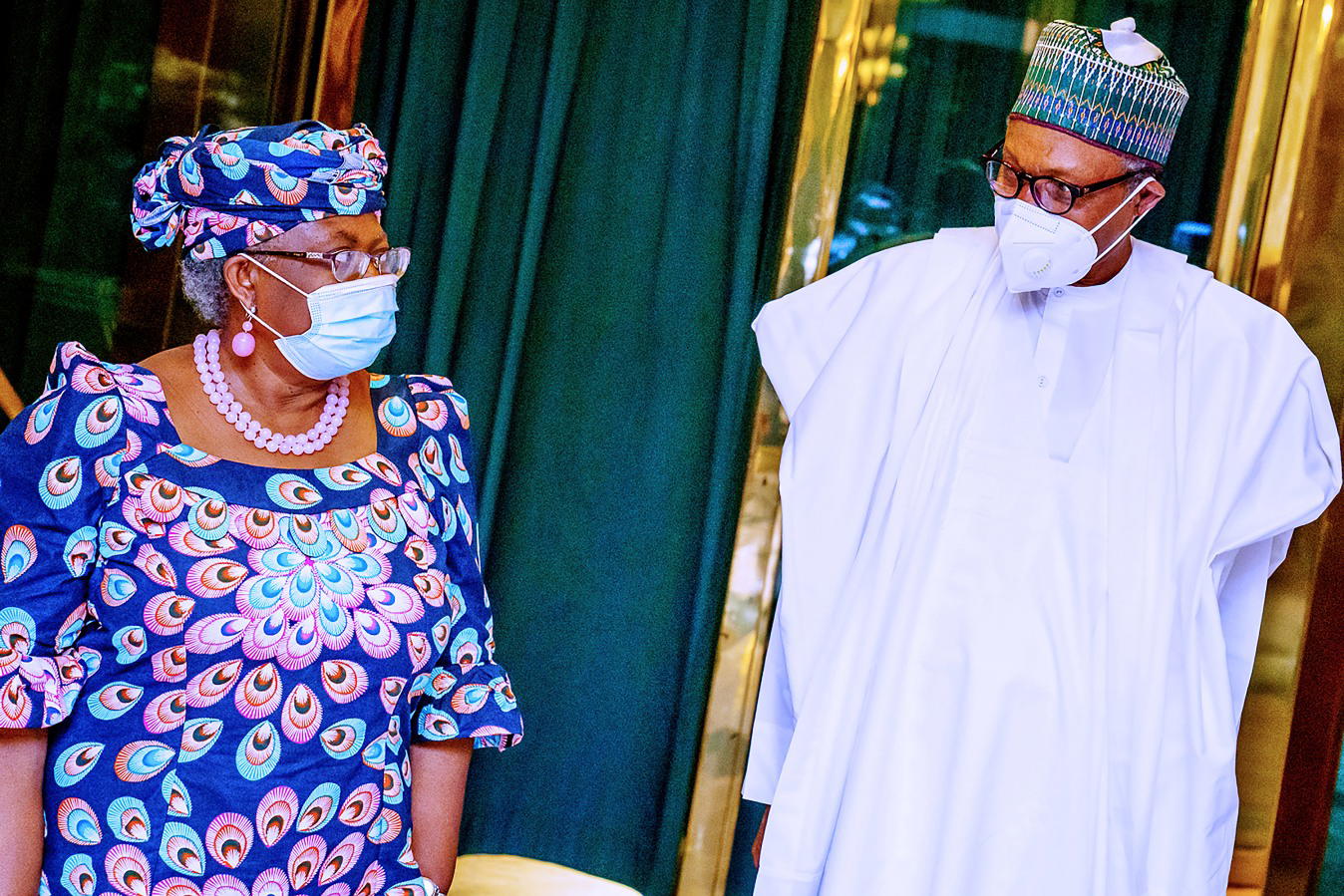
PRESIDENT BUHARI RECEIVES DR OKONJO-IWEALA 0A. President Muhammadu Buhari receives the Former Coordinating Minister of the Economy and Minister of Finance and Top Contender for the WTO, Dr Ngozi Okonjo Iweala during an Audience at the State House.PHOTO; BAYO oMOBORIOWO. OCT 12 2020.
—As WTO expresses worry over Nigeria’s exchange rate regime
—-Promises to boost Nigeria’s Shea Butter production
Johnbosco Agbakwuru, ABUJA
PRESIDENT Muhammadu Buhari yesterday met with the newly appointed Director-General of the World Trade Organization, WTO, Dr Ngozi Okonjo-Iweala, at the Presidential Villa, Abuja.
The President at the meeting which was the first official visit since Dr Okonjo-Iweala assumed duty on March 1, told the former Nigerian Minister of Finance and Supervising Minister of the Economy that despite the robust support Nigeria gave to her candidacy for the position, “You also earned it.
Buhari also said, “We are happy you made it, but you earned it with your record of performance both at home and abroad.”
The President said Dr Okonjo-Iweala was putting Nigeria more on the world map, “and I congratulate you, as well as the country. I know you will represent us so well.”
He lauded Nigerian women once again, pointing to key positions they hold like Minister of Finance, Budget and National Planning, Head of the Civil Service of the Federation, and many others. He said the same way, the government would encourage the youths, “so that they can be ready for the challenges of the future.”
The new WTO DG thanked President Buhari for the pulsating support she received from her own country in the race for the position.
She said, “You nominated me, you wrote hundreds of letters, called up hundreds of world leaders. Without your personal and direct intervention, it may not have worked. The people of Nigeria also supported me massively. The youths were wonderful, always encouraging, backing me up on social media.
Also read: Consumption of illicit drugs a major problem in Nigeria – NNPC GMD
“Mr President, the world recognizes what you have done. Since its establishment, only men have led the WTO. Now, a woman has emerged for the first time, and she’s a Nigerian. We are so honoured.”
She apprised the President of the opportunities for Nigeria in the global organization, as well as the challenges, stressing that “WTO will do more to help Nigeria, but we need to add value to our products in order to trade more. We should exploit all the opportunities in front of us.”
She added that the support and leadership of President Buhari will help her a lot in her position as DG.
Dr Ngozi Okonjo-Iweala assumed office on March 1, 2021, as the first female DG of the World Trade Organization.
Fielding questions from journalists, Dr Okonjo-Iweala expressed worries over Nigeria’s exchange rate regime.
But she assured the country that WTO will help to boost Shea Butter production in the country.
She further advised the Nigerian Government to start looking at establishing vaccine manufacturing companies to handle any future outbreak of a pandemic.
This is as the WTO DG also advised the government to start looking at the area of manufacturing so as to boost her foreign earnings and job creation.
Asked if WTO was concerned about the exchange rate in Nigeria, she said, “Yes. WTO has one of the agreements of the balance of payments, and Nigeria certainly invoked this to be able to conserve foreign exchange. It invoked this article.
“But some other members have brought a complaint against us (Nigeria) that we shouldn’t have used this article in that way. So yes, the WTO is concerned about foreign exchange, the way we manage it, the way we use it and how we use it to support manufacturing or imports and exports in our economy.
“But I think we are in discussion with them about the complaint and the exchange rate regime. Nigeria will have to explain to the WTO and those members complaining about why we are doing this.
“But eventually, having a strong exchange rate regime and being able to phase out of this, I think will be heading in that direction.
“We are also going to see the governor of the Central Bank of Nigeria and we will undoubtedly discuss some of these issues.”
Asked if the African Continental Free Trade Agreement may not prevent developing economies develop their infant industries especially those trying to diversify their economy to develop a new manufacturing industry, she said it depends on the type of economy of such countries.
She explained that developing countries are given policy space that gives them time to develop based on WTO principles.
Dr Okonjo-Iweala said that WTO has the subsidies and counterfeiting measures that check fake products which dissuade other countries from thinking of dumping cheap products into the market, adding” you can also draw that to put countervailing duties to make sure this doesn’t happen, sometimes the cheapest way.”
She said that what some developing nations have benefitted from the free trade agreement had lifted hundreds of millions of people out of poverty, even as she added also that it has also left some people behind.
“Some of the economies in the world especially the small, vulnerable, and Island, economics who are not able to produce products need free trade because they import a lot of what they need.
“So there are some economies in the world that thrive or cannot thrive without future. There are others like Nigeria, that have the ability to produce and manufacture their own products. And, of course, they will have provisions if you need for a period of time to be able to manufacture, produce a certain principle special and differential treatment, that’s what is called at the WTO that you can draw.
“This allows the developing countries to have a longer time period to implement some of the WTO agreements, they’re given a chance to what is called policy space, to be able to develop whatever industrial manufacturing it wants to develop, of course, this is not forever, because eventually, you need to open it up to competition, otherwise, you’ll be developing inefficient industries.
“But there is that provision that is that for the developing countries to have access to that. So I think within WTO principles, we can do that. We also have, you know the subsidies and countervailing measures agreements, which allows if you feel that another country is dumping cheap products into your market, you can also draw on that to put countervailing duties to make sure that this doesn’t happen and it comes in at a higher cost.
“I know that we suffer sometimes with cheaper products like our textiles which I wear. And I’ve seen that. So the measures you can draw on to be able to do this and Minister of Trade and Industry, I think they’ve already been looking at some of these measures to be able to…, so don’t worry, within the WTO principles, there are certain provisions that you can use to help us do what we need to do.
“But I just want to return to one thing, I know what you’re getting at, free trade has lifted hundreds of millions of people out of poverty. But it has also left some people behind. So there is no doubt that there is inequality, not everybody has been lifted up. They are poor people within rich countries and poor countries, in parallel with rich ones who have not benefited from trade.
“This is why we are very keen on the WTO to support women entrepreneurs. We have something at the International Trade Center called SheTrades, which aims to support women to improve their trade and get into the value chain return on national, global and regional value chains.
“In the micro, medium and small enterprises, Nigeria is actively participating right now, in some negotiations that are ongoing to reach an agreement on how we can support micro medium and small enterprises. These are economies in Africa, many of them have informal enterprises or very small enterprises.
“So if we can do that and pull these areas, these marginalized and excluded areas will also be helping with inequality. And that’s one of the things that is attractive to me at the WTO.”
She further said, “I think 19 per cent of Africa’s trade is from Nigeria. Is likely that under that of the African economy which is about the centre. I believe that Nigeria can compete within the 1.3 billion people markets that we have in Africa.
“And if we are able to export this much into the continent, I think we should be able to try more.
“We should be able to compete with other countries and even out-compete in certain areas. We are doing that already. And we should build up that we have vast potential.”
While congratulating Aliko Dangote for setting up the refinery, she said, “But we have to start thinking how we can transit from fossil fuels. And I’m really worried about that.”
Disclaimer
Comments expressed here do not reflect the opinions of Vanguard newspapers or any employee thereof.