
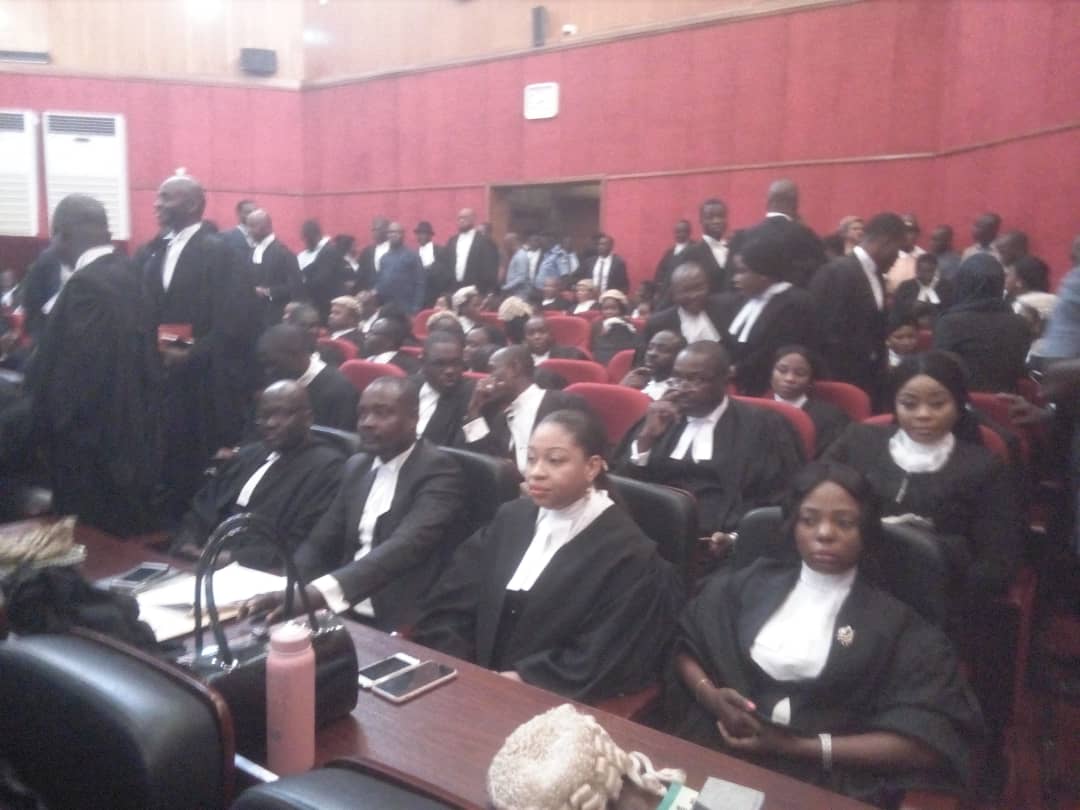
Lawyers seated at the tribunal awaiting the arrival of the judges
By Declan Mbadiwe Emelumba
‘The tribunals,not the people,have the final say on election; they are the gods of election in Nigeria, not the people’
This season of election petitions and the tribunals thereof should remind us of the enormous powers of the judiciary in our election process.
At this time many cannot but agitate their minds with a sundry pertinent,albeit , rhetoric, questions: How much of the course of Justice do the tribunals really serve, particularly those that adjudicate in the states? Why is it that an average politician will gleefully admit that he will prefer to win elections at all cost and be taken to court than lose and go to court?
Agba Jalingo’s treasonable felony trial begins Wednesday(Opens in a new browser tab)
These rhetoric questions are needful all the same to help us re-energize our psyche back to the reality of the larger than life role the tribunals play in our elections. The brutal truth is that the tribunals are the god of elections in this country, probably more than in any other country. The tribunals,not the people,have the final say on election matters. The reverse is the case in civilised climes. Most election results declared by INEC are validated or invalidated by the tribunals, making victory or defeat at the polls a mere primary step in the election process.
Truth to tell, it is a noble idea to have these tribunals serve as a level playing ground for aggrieved election contestants,to seek redress, to demand for Justice. But do they provide that level playing field?. Is Justice served at election petition tribunals and seen to be served?. My candid take is that they don’t exactly provide either a level playing ground nor do they serve or seen to be serving justice. Reason?. They are bugged down and encumbered by two major factors: Technicalities and unavoidable prospects of benefactor influence
Let us first look at the technical bottlenecks the tribunals face which block the free flow of Justice. Usually it is the litigant,the aggrieved, who should prove the case of election fraud beyond all doubts. In essence the man accused of the fraud is the one practically protected by the law.
This is in tandem with the grand norm of our statues which is that the accused is presumed innocent until proved guilty. Yet I have good reasons to think that for election matters the reverse should apply. Will return to why shortly.
So in a situation where the potential culprit is protected by our laws, is it any wonder then that many politicians will do everything, both human and inhuman, to win an election? The unwritten code of a typical politician is to break all the rules and secure victory first : Bloat the actual numbers of your votes, far above the number of registered voters, buy votes, employ brute force to intimidate everyone, including getting you declared winner by force etc., as long as you get victory. This is the unspoken political code in our clime;all is well that ends in victory. For some people from my state, Imo, these lines should sound familiar . Don’t they ?
Now is there any reason an average politician will not prefer to brazenly break all laws just to win ?
The law protects the victor thus making it a herculean task for the Vanquished to prove beyond all reasonable doubts that there was election fraud.
It is indeed an agonizing irony that in a temple of Justice a likely high crime culprit is offered protection by the law. Mark you, this is not just an ordinary likely civil offender but a possible big time criminal who most likely stole the collective mandate of the people for his personal goals.
Supreme Court orders India to restore normalcy in Kashmir(Opens in a new browser tab)
This is why I believe that election crime should be treated differently because it is a high crime against the will of the people. It actually amounts to treason against democracy. In my view, and considering the well known banditry against the will of the people by some politicians, in any disputed election, it should be the assumed winner who should prove in court that he won and also how he won. This approach will reasonably reduce the present aberration of hiding under technicalities to evade Justice
Yes, for election matters, the French legal norm should apply, which is,that the accused is presumed guilty until proved otherwise. With this in place not many politicians will find either the nerve or impudence to rig elections with reckless abandon
The second encumbering factor on the efficacy of the tribunals is the point of origin of the appointment of Judges, or where they are appointed from. These are Judges appointed to the tribunals from state judiciaries. First and foremost they are state high court Judges. Granted that all high court Judges are under one federal judicial authority, yet it is an incontrovertible fact that the state high court Judges are still largely dependent on state governments for many values. Their appointments to the bench are facilitated by the state governors just as their promotions to the higher bench are oiled by them. Moreover the state Judges depend on the governors for sundry other invisible welfare that lubricate their operations.
In a situation such as this ,it becomes obvious that the state judiciary upholding it’s much publicized independence will be an uphill task. The obvious truth is that on the contrary they are largely dependent on the Executive. Consequently they can be arm twisted to do the bidding of their benefactors. This is only natural and unavoidable
Take for instance the case of the chairman of Imo State Governorship Election Tribunal. He is a high court Judge from Sokoto state. The state Governor is a well known long time ally and friend of the Governor of Imo state. Why will anyone believe that the Sokoto state Governor may be reluctant to bring his influence to bear on the tribunal chairman to help his friend and long time ally?, Any one can raise such suspicion especially if the two governors are of same party.
The events that played out at the Imo Governorship Tribunal give vent to this line of thought. The APC candidate,Sen Hope Uzodimma, in the course of trying to prove why he should be declared the winner of the March governorship elections tendered results from 388 polling units where he won but omitted by INEC in the final tally,which gives him victory when added.
The tribunal admitted the results as exhibits and went further to subpoena the police authorities,as legal custodians of election results, to come and give evidence on the omitted results

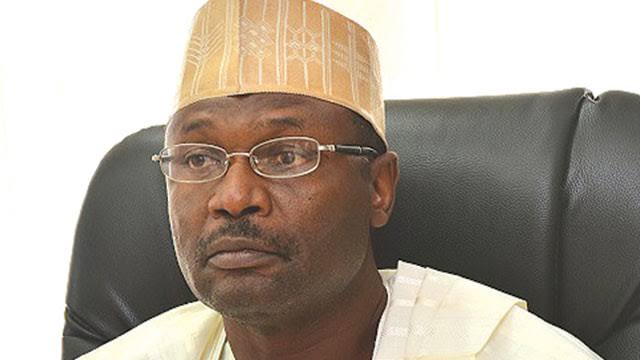
Yakubu
The police dutifully obeyed the court and appeared before the tribunal. The PDP and Governor Emeka Ihedioha objected to their being allowed to give evidence. After much ado the tribunal ruled that the police should tender their evidence and thereafter they forwarded their own copies of the omitted 388 polling unit results, which corroborated Uzodimma’s own copies . The tribunal admitted the results as exhibits
However, the same tribunal turned around in its final judgement to say that the police were at the tribunal on a frolic of their own. Quite confusing, you may agree. So how can one resist the temptation to believe that there was no influence from even where there was none.
Actually not a few observers are waiting anxiously to see how the appeal courts will resolve this.
The incident reminds one of what happened at the special military tribunal in Jos, plateau state, in 1984,where former Governor Solomon Lar faced trial for corruptly enriching himself. The chairman of the tribunal in his judgement admitted that the tribunal found no evidence of corrupt enrichment against Lar but went ahead to sentence him to many years in prison. This is by the way.
The point at issue here is that state governors being the benefactors of these high court Judges can actually influence them in an election petition trial, because of all the political interests therein. Of course it can be argued that the same can apply to the federal level. I agree. That is why my recommendations on possible remedies are all encompassing
Let us start with the plausible remedy to the encumbrance of appointing state high court Judges. My humble opinion is that election petition/ panel members, both state and federal, should be drawn from the ranks of retired judges. My take is that retired Judges will be freer from the overbearing influence of incumbent chief Executives because they are not looking up to to any favours from them. Again the membership of state tribunals need not be restricted to retired state high court Judges. They should include retired federal high court Judges. But such Judges must be those who retired without blemish and who have verifiable apolitical track record. Needless to add that such Judges are more likely to dispense Justice without fear or favour
I am inclined to believe that the encumbrance of technical obstacles can also be remedied by legally empowering the intelligence secret service agencies and independent election observers to monitor and document the conduct of every election at the polling unit level. A special intelligence secret service agency can also be set up to join the existing ones and the independent observers for this purpose. The independent observers should be credible and anonymous only known to top INEC officials.
2019: I know what it is to be cheated at polls – Buhari(Opens in a new browser tab)
After every election season and before the commencement of election petition tribunals, these intelligence agencies, and the independent observers shall make available to the tribunals copies of their reports in each polling unit as they affect the area of jurisdiction of each tribunal.
These reports will help the tribunal members to uphold or dismiss claims of electoral fraud or violence because they will objectively inform their conclusions, thereby making them less dependent on technical points of law to establish justice
I agree that to achieve this will require amendments to electoral laws. However I know that it is doable.
What is important is for us to do whatever that can be done to make the election petition tribunals really the level playing field for aggrieved contestants. Everything should be done to make them the centres for the dispensation of Justice, where justice is done and seen to be done. As the saying goes, public perception is everything. As it stands today I suspect that the public perception of these tribunals is that they are the temples, not where Justice is done and seen to be done but where justice can be derailed or even procured. This perception is a sad commentary on our polity and it is not helping to deepen our democracy
- Emelumba, a two time member of IMHA,is the Director of Media, Uzodimma campaign Organisation
Disclaimer
Comments expressed here do not reflect the opinions of Vanguard newspapers or any employee thereof.