
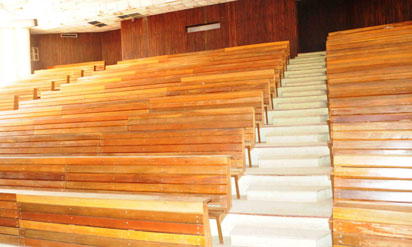
A lecture hall in the Abubakar Tafawa Balewa University, Bauchi,
By Obadiah Mailafia
A FEW days ago, I found myself hinking of Elephant. Elephant was a friend and senior at my old missionary boarding school in the defunct Benue-Plateau State. Elephant was not his real name. He was so nick-named because he was a rather fat lad with a reputation for being the school clown. Although I was by far his junior, we were best of friends. What united us was the fact that we both represented the school in inter-school quiz tournaments.


•University
In the manner in which the Almighty Creator dishes out talents to his creatures, some people are good general all-rounders while others have talents only in specific areas. Albert Einstein, for example, was in the latter category. He was poor in most subjects, the only exception being mathematics. Only a few are blessed with all-round knowledge. Bertrand Russell was a mathematician, a philosopher and a lord. Leibnitz was a mathematician, scientist, philosopher and statesman. Blaise Pascal was a mathematician as well as a religious mystic. Fermat was a career lawyer who pursued mathematics as a past-time. And yet he posed a mathematical theorem whose proofs he had discovered but kept as a secret. It took 358 years for John Wiles to successfully solve Fermat’s mathematical puzzle in 1994. My friend Elephant was blessed with just one talent – figures. He was a mathematician’s mathematician in the sense that he was not only good at proofs, he had the type of mind that would re-derive independently the formulae underlying the proofs. And like all one-eyed geniuses, Elephant had a big problem. He excelled in only three subjects and perennially flunked everything else. Those three were: General Mathematics, Additional Mathematics and Physics. During his WAEC he scored A’s in all three subjects and got F9 in everything else. His performance also sadly meant that he could not proceed to A-Levels. Then as now, the rules require that you pass a minimum of six credits, including English. It also meant he couldn’t proceed to university.
I have no doubt in my mind that my friend was a genius. His was a very intense mind. His creativity with figures was way beyond the level of even the best of his peers. I have met a few geniuses in my life. Like beauty, you don’t need to be told – you know it when you see it. Like my Oxford friend, G.G., a Russo-Canadian Jewish Rhodes Scholar. He got his first degree in Physics and Mathematics. He then developed curiosity about the things of God and switched to Biblical studies. He had mastery of 10 languages: Russian, English, German, Italian, Spanish, Hebrew, Aramaic, Syriac, Arabic and Latin. When we were graduate students he used to earn extra money by working part-time as a computer programmer. He currently works as a professor of theology at a top American university. There is also my friend Iqbal from Pakistan. We are still expecting him to be announced as a Nobel Prize Winner in the field of theoretical physics.
https://newlive.vanguardngr.com/2019/04/insecurity-we-re-going-to-recruit-more-personnel-in-security-agencies-buhari/
None of my schoolmates have been able to tell me what happened to Elephant. He has simply disappeared without a trace. I see it as a great loss not only to Nigeria but to the world of higher mathematics. If he had been born in North America there is no doubt that universities such as Harvard, Yale, Princeton, Stanford, MIT or Caltech would have discovered his talent and nurtured him into a giant in his field. It says so much about our rigid and archaic education system that it is unable to identify such unidirectional geniuses, let alone mentor them to fulfil their fullest potentials. It reminds me of the remarkable career of the Indian mathematical prodigy Srinivasa Ramanujan(1887-1920). Ramanujan was born into a Brahmin family in Erode in the Tamil Nadu region of India. Like Elephant, he failed everything at school except mathematics. The only job he could get was a clerical employee in the postal services. My gentle readers would also recall that Albert Einstein had to settle for a similar clerical job at the Zurich Patent Office in Switzerland. While working as a lowly clerk, Ramanujan continued doing creative mathematics. The local professoriate looked askance at him because he had no degree, let alone a doctorate. He decided to send some of his work to Professor G. H. Hardy at Cambridge University. Hardy was widely regarded to be the world’s greatest living mathematician in his day. He could not believe his eyes. He gathered his colleagues and showed them the work. They unanimously agreed it was the output of a genius. They later arranged for Ramanujan to move to Cambridge where he was made a Fellow of Trinity College. He was later appointed to the exalted fellowship of the Royal Academy of Sciences. Although he died young, Ramanujan goes down in history as one of the immortals in the history of mathematics.
I believe that many talents have perished in Nigeria because of our backward universities where the professors are clannish, tribalistic and highly prejudiced against “outsiders”. They have no capacity to “think outside the box” or to identify talents who can enrich the academic community. Former Secretary of State, Henry Kissinger, himself a former Harvard man, famously noted that university politics are so vicious because the stakes are so low.
A friend of mine with a doctorate from the London School of Economics who also happened to be MD of a bank, volunteered to teach weekend MBA classes at a top Northern university. Every Friday he used to fly at his own expense from Lagos to give those lectures free of charge. He became extremely popular with the students. He was not only teaching theory; he was giving real insights from the practical world of banking and high finance. The local academics launched a vicious attack on him out of jealousy. He had no option than to call it quits.
It is extremely rare for a senior public servant or CEO of a bank or any industrial organisation to be made a professor in a Nigerian university. The highest they would get is Senior Lecturer. By contrast, in Britain and North America the topmost Ivy League universities would be begging such people to take up professorships. Alex Ferguson, veteran coach of Manchester United Football Club, was made Professor of Leadership at Harvard Business School. One of the rare exceptions is University of Benin where highlife musician Victor Uwaifo was made Professor of Music. Bringing in relative “outsiders” into our universities would not only enrich higher education; it would bring real value-added to teaching and research.
Interestingly, more than a decade ago while I was in the CBN we decided to throw open the competition for director positions. We were sure that a rigorous examination system would bring in more outsiders. Several senior university academics applied. However, when the tests were released we were surprised that CBN staff with just bachelor’s degrees were scoring far higher marks than senior academics with doctorate degrees.
The CBN invests heavily in training and research. The staff worked very hard in those days, although I am told standards have fallen considerably. One thing I can testify, though, is that the reports from the bi-monthly Monetary Policy Committee, MPC, meetings alone amount to several dissertations. Many of the staff work at the cutting-edge of research and practice. University people, on the other hand, are often stuck in 1980s methodologies. The ideal is for town and gown to synergise in a manner that generates value-added to both. We should be hunting for talents from wherever we can find them, without regard for titles, ethnicity or religion.
Disclaimer
Comments expressed here do not reflect the opinions of Vanguard newspapers or any employee thereof.