
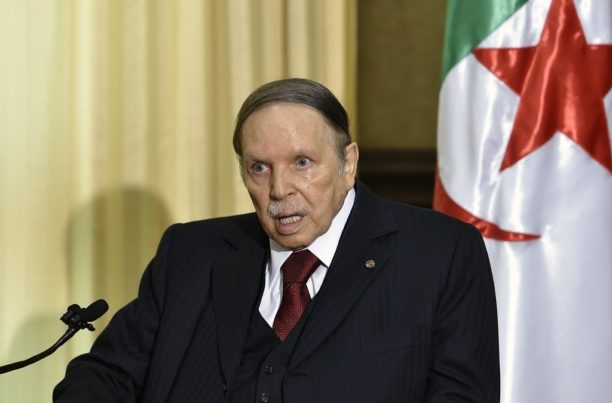
Bouteflika
THE curtain has finally fallen on the iron rule of Algerian President, General Abdulaziz Bouteflika. He ruled his country for 20 years (four five-year terms). He was preparing to run for another term in office when his countrymen and women rose with one voice and asked him to go.

Bouteflika
They had very good reasons to take this decision. Since April 27, 1999 when he won an election to replace former leader, Liamine Zeroual, the veteran of the Algerian war of independence against the French colonial masters provided political stability in Algeria. He successfully contained Islamist insurgents operating in the mountainous deserts, and made it impossible for the “Arab Spring” (which toppled several Arab leaders from January 2011) to infiltrate his country.
But the tide went against the 82-year-old sit-tight leader when he suffered a stroke in 2013 and became reclusive. He spent a lot of time in Swiss hospitals. His announcement of his intention to run again in the scheduled April 18, 2019 presidential election brought out Algerians to the streets in protest starting from February 22.
Reminiscent of the “Arab Spring” revolutions that managed to evade Bouteflika eight years ago, the protests spread from sector to sector, the latest joiners being railway workers who stopped work, judges, clerics and most importantly, Bouteflika’s own constituency, the all-powerful military which pledged not to go against the people.
On Monday, April 1, 2019, Bouteflika’s announcement that he would no longer participate in the election sparked off wild jubilations across the country. He also postponed the scheduled April 18 presidential election, though no new date has been announced.
Two main issues stand out in the story of the rise and fall of Abdulaziz Bouteflika. One is the enduring reality of the people’s power. This has shown its hand throughout history.
A leader is only strong and able to hold the people in thrall because the people have not taken the effort to say “enough is enough”. When the people are pushed to the wall no force can withstand their collective resolve.
If, in Nigeria, we continue to endure bad leadership; we complain and whine about bad leaders, and we bemoan the “uselessness” of our voter’s cards, it is because we have not had enough.
The other noteworthy issue is that a strong man like Bouteflika who survived the “Arab Spring” which claimed Tunisian President, Zine El Abidine Ben Ali; Libyan leader Muammar Gadhafi; Yemen’s President, Ali Abdallah Saleh and sparked civil wars in Libya, Yemen and Syria, left office without a single shot fired when the people were tired of him.
Western countries should stop exporting “democracy” to countries which already have systems that work for them. It pays to allow the political dynamics play out.
Indeed, power belongs to the people!
Disclaimer
Comments expressed here do not reflect the opinions of Vanguard newspapers or any employee thereof.