
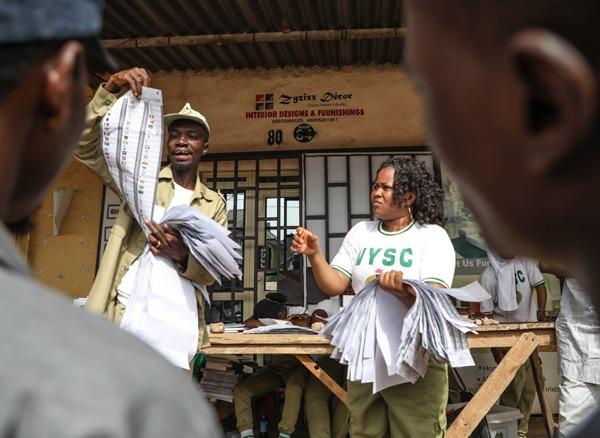
An electoral official count ballots at a polling station in Kaduna on March 9, 2019, after Nigeria’s governorship and state assembly elections. – For the second time in a fortnight, Nigerians went to the polls to elect governors in 29 of Nigeria’s 36 states, all state assemblies and administrative councils in the Federal Capital Territory of Abuja. The Independent National Electoral Commission (INEC) is expected to announce the results in a few days. (Photo by AFP)
By Joseph Erunke and Dirisu Yakubu
Democracy as a system of government thrives on plurality of opinions. As a government of the people and by the people, freedom of expression and liberty of association is one of the striking features that differentiate democracy from other governance systems.

An electoral official count ballots at a polling station in Kaduna on March 9, 2019, after Nigeria’s governorship and state assembly elections. – For the second time in a fortnight, Nigerians went to the polls to elect governors in 29 of Nigeria’s 36 states, all state assemblies and administrative councils in the Federal Capital Territory of Abuja. The Independent National Electoral Commission (INEC) is expected to announce the results in a few days. (Photo by AFP)
In the build-up to the First Republic, the nation experimented with a multi-party system with such parties as the National Council of Nigerian Citizens, NCNC, the Action Group,
AG, Midwest Democratic Front, MDF, Borno Youth Movement, BYM, Dynamic Party, DP, to mention but a few, which played prominent role in the nation’s journey to political development.
Although, the democratic experimentation came to an abrupt end following the military coup of January 15, 1966; the nation again returned to the part of civilian administration when the then military government of General Olusegun Obasanjo handed over power voluntarily to Alhaji Shehu Shagari of the National Party of Nigeria, NPN, in 1979.
Alongside NPN, the Unity Party of Nigeria, UPN, Great Nigeria Peoples Party, GNPP, Nigeria Advance Party, NAP, Peoples Redemption Party, PRP, and the Nigeria People’s Party, NPP all won representation in the National Assembly in the Second Republic.
The botched Third Republic, however, witnessed a ditch of the multi-party model as the then military government of General Ibrahim Badamasi Babangida foisted a two-party system on the country with the registration of the National Republican Convention, NRC, and the Social Democratic Party, SDP. Although the military government conducted what generally passed for credible polls with the election of Chief Moshood Kashimawo Olawale, MKO, Abiola in 1993, the polls were annulled, sparking a spate of violent skirmishes that culminated in the death of many Nigerians, particularly in the South-West region of the country.
The nation walked a similar path with the return of the men in khaki to the barracks in 1999 as three dominant parties made a bold statement of intent. The Peoples Democratic Party, PDP, All Peoples Party, APP and the Alliance for Democracy, AD, won big in their respective strongholds with the PDP however showing its strength as a truly national party.
The big three as it were, continued to dominate the political space, until the late legal luminary, Chief Gani Fawehinmi, SAN successfully won his case in court for the opening of the political space, thus compelling the electoral commission to register more political parties provided they meet basic registration criteria.
The recently concluded 2019 general elections witnessed an unprecedented 91 political parties fielding candidates for various elective positions, but at the end, only a handful justified their status as parties seeking political power to formulate and implement policies and programmes.
This has again led to call for a return to a two-party system given the fact that apart from the ruling All Progressives Congress, APC, and the PDP, none of the existing registered parties won a state in the governorship elections held on March 9, 2019.
Vanguard went to town to seek opinions of eminent Nigerians many of whom bared their minds on the development.
Senior Advocate of Nigeria and renowned rights activist, Chief Mike Ozekhome, told Vanguard that plurality of opinion is the beauty of democracy, saying “I do not believe in the regimentalisation of political parties. Many will die naturally. Democracy is about choices, about plurality, about preferences, and leanings.
“Even in the United States of America, there are many fringe political parties though only the Republican and Democratic parties are dominant and most visible. It’s true that the existence of many parties give the Independent National Electoral Commission, INEC, more job, and nightmares,” adding that it will be a step in the right direction to introduce independent candidature.
This position enjoys the support of Inebehe Effiong, Convener of the Coalition of Human Rights Defenders.
https://newlive.vanguardngr.com/2019/04/okorocha-speaks-on-his-certificate-of-return-after-meeting-with-buhari/
According to Effiong, a two-party system will breed dictatorship and stifle the democratic space and as such, should be avoided for now.
He told Vanguard: “I do not support a two-party system. It will breed dictatorship and stifle political and civic space. In a country where the two leading political parties are plagued by corruption, criminality, and abuse of power, it will be counterproductive to give them a monopoly.
“Nigeria is not suitable for a two-party system. If we reform our electoral process and strengthen election financing laws, both the APC and the PDP will be politically decimated. These two parties depend on the public treasury for existence. This is not the case in any advanced democracy.”
He further hit the APC and the PDP: “They have no ideology or principles. Therefore, to give them the right of exclusive participation in the political process in the name of a two-party system will lead to more impunity and criminality by the political elites. I am opposed to a two-party system.”
For Andre Echono, Managing Consultant at Perfect Pitch Consults, Abuja, there is need to prune the number of existing political parties. He, however, insists that two will be inadequate for a country of close to 200 million people.
https://newlive.vanguardngr.com/2019/02/the-stranded-squirrels-in-ezekwesilis-party/
His words: “I do not support a two-party system. At the same time, I am not in support of 91 parties. I support a system that provides Nigerians with an alternative to the two dominant parties. Let’s have more options, at most, five parties. Redemption for Nigerians cannot come from either PDP or APC.”
In advanced democracies, parties do not exist principally to struggle for political power. Education of the electorate in civic duties, political socialization and participation is a key component of democracy that parties in this part of the world should not gloss over.
https://newlive.vanguardngr.com/2019/04/inec-under-1999-constitution-amend-inec-law-to-permit-electronic-transmission-of-results-2/
Disclaimer
Comments expressed here do not reflect the opinions of Vanguard newspapers or any employee thereof.