
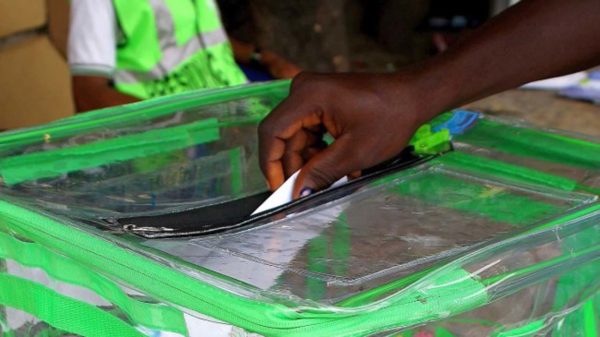
File image
BY BOLAJI AKANNI
In 2015, March was Nigeria’s golden month. On the 31stMarch 2015, the then President of the Republic Dr. Goodluck Ebele Jonathan, and presidential candidate of the then ruling People’s Democratic Party (PDP) in that year’s presidential polls wrote his name into history when he called his main opponent and candidate of the All Progressives Congress (APC) Muhammadu Buhari to accept defeat. He also congratulated the former army general for winning at his fourth attempt to claim the coveted prize.


Elections
March 9: Anambra Govt appeals to residents to come out en-masse
The next day, April 1, there were many who thought that people were springing “April fool” jokes on them when the news of Jonathan’s most commendable action filled the airwaves. They were most probably those who had walked away from their television sets when, in the midst of the announcement of results on live television by then Independent National Electoral Commission (INEC) chairman Professor Attahiru Jega, the great “Elder” himself, Godsday Orubebe, staged his award-winning show of shame as he tried, screaming and cursing, to truncate the announcement process. Anyway, the results from all the states were all but in, save for Borno, which the retired general clinched by a mile. The rest is history: the 16-year reign of the People’s Democratic Party (PDP) had come to an end.
The old general has repeated the 2015 feat by defeating the PDP candidate in the February 23, 2019 presidential polls, former Vice President Alhaji Atiku Abubakar, by quite a handsome margin (15.1 million to 10.7 million votes), to clinch a second-term mandate. But March has literally lost the” gold medal” it won four years ago. There would be no call from the defeated to the victor this time. And the reason is that some Nigerians are hell bent on a vicious campaign to erode public confidence and faith in the electoral process simply because their beloved candidate had lost.
Since the announcement of the final results, President Buhari has received well-deserved greetings from the international community and prominent national groups and statesmen. The United States, on its part congratulated President Buhari on his re-election and also commended Nigerians for the generally peaceful elections. In particular, the US noted “the assessments of international and domestic observer missions affirming the overall credibility of the election, despite localised violence and irregularities.”Whist congratulating Buhari on his re-election, the United Kingdom noted that “the result declared by the Nigerian election Commision is consistent with the result obtained through the civil society Parallel Vote Tabulation process. Along with our international partners, the UK believes the Nigerian people can have confidence in the result.
Although President Buhari has implored his supporters not to gloat over his victory, the outcome of the election, was,in reality, quite predictable–a resounding victory for the APC flagbearer whose relentless anti-corruption campaign has been the signpost of his first term in office. Apart from his battle against sleaze and unrelenting plugging of most of the loopholes exploited for official malfeasance, President Buhari had embarked on what many have described as the most ambitious infrastructural projects in the country’s history as his government built and rehabilitated roads and rails massively across the country, stabilized many states that were on the brink of bankruptcy and invested heavily in education, agriculture and social intervention schemes targeted at poor and the most vulnerable members of society.
The New York Times called the contest between Buhari and Atiku, “ a referendum on honesty”. That reasoning is hinged on the fact that, for a vast majority of Nigerians, the attraction of integrity in leadership remainsthe strongest on the quality and desirability spectrum, far more than the primordial considerations of tribal and ethnic leanings, and even religion.
Thankfully, we did not witness another “Elder Godsday Orubebe show” during the announcement of the results of the February 23 2019 polls at the INEC’s National Collation Centre in Abuja by the unflappable Professor Mahmood Yakubu, INEC chairman. But what we seem to have instead of a repeat of that despicable spectacle four years ago, is, in my opinion, even more condemnable. And, that is the clearly unpatriotic attempts by some Nigerians, especially the opposition PDP and their supporters, to totally denigrate and discredit our electoral process whilst also condemning the conduct of the February 23, 2019 Presidential and National Assembly elections in its entirety.
Indeed, the media, both mainstream and social, have lately been awash with an orchestrated campaign to paint the process that produced President Buhari’s re-election as heavily rigged in his favour and preponderantly tainted with irregularities. Nothing could be farther from the truth.
Yes, there were irregularities here and there and there were also pockets of violence in some parts of the country. There were reports of late arrival of electoral materials leading, inevitably, to late voting at some centres; malfunctioned card readers, snatching of ballot boxes, alleged seizure of electoral materials from unauthorized persons and groups, alleged tampering with poll results between polling stations and collation points, heavy military presence in a couple of states and, sadly, the loss of some lives arising from election violence.
Wherever they are widespread or become the norm, these violations would definitely detract from the minimum standards expected of a free and fair election. However, there is no record or evidence that the irregularities and violations identified by local or international observers generally characterized the February 23 2019 election.
Clearly no election anywhere can really be deemed perfect and totally hitch-free.
To be sure, the entire spectrum of our electoral system and institution needs constant fine-tuning, amendments and adjustments. The process can only get better. After all, after more than three centuries of conducting elections the United States is still doing just that.
*BOLAJI AKANNI is a Public Policy Analyst based in Lagos
Disclaimer
Comments expressed here do not reflect the opinions of Vanguard newspapers or any employee thereof.