
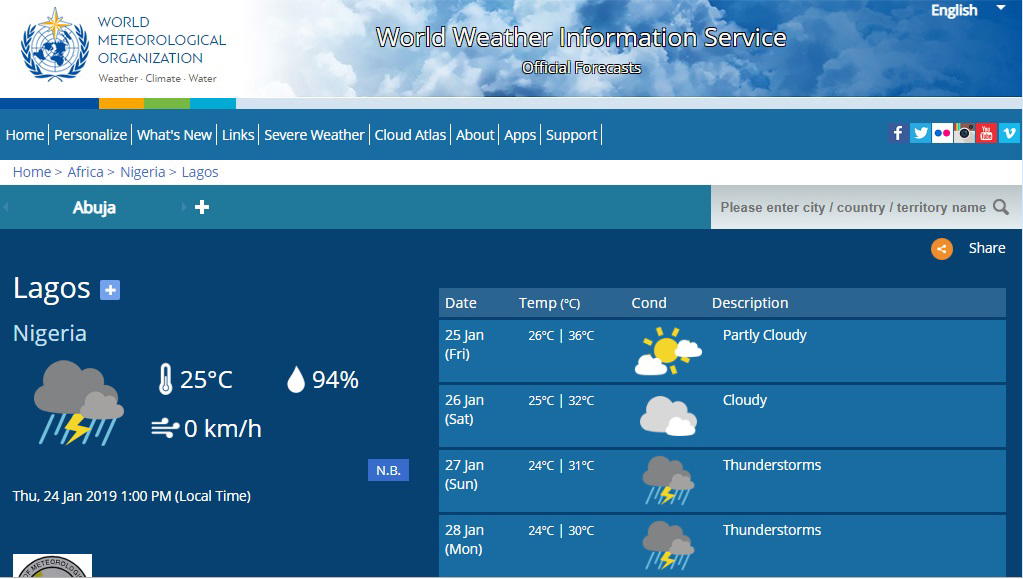
NiMet weather report
Victor Ogunyinka
No, this isn’t that time of the year where we get prepared for rainfall and muddy floors, that is if you ask the weatherman. But if the early signals are anything to go buy, Lagosians and maybe Nigerians might be in for an end-to-end ‘water baptism’ all year round.


Flood affected area
The first rain of 2019 dropped Sunday, January 20, and it kicked off like it never stopped raining in previous years. dropped thick and heavy and the ground couldn’t swallow it all up and then comes the perennial worry of flooding.
Some areas where the rain fell, admitted that it was quite unusual for rain to come in that strength and that might mean it is a rainy year.
ALSO READ: Hungarian experts to help Nigeria tackle flooding
But since the first one, there had been two other (depending on what part of Lagos you live) and interesting, as at the time of writing this piece, it is still raining at Vanguard Media Head Office, Kirikiri.
Looking on to the bright side, following a yuletide season that was devoid of the usual hazy, harmattan weather in Lagos, it means there was enough heat to go round all corners of Lagos and so much was the effect that the early rainfall comes as a sigh of huge relief to many, but the dividend might be cut short if, when the downpour becomes the more consistent.
To say the least, as the raindrops on Thursday, the effect on the road and the commuters was there for all to see. The already crowded road, plagued by longtail gridlock grew even worse in some areas of Lagos like Okota, Ejigbo road, Ikotun among others.
According to the Nigerian Meteorological Agency (NiMet), the next four days will be overwhelmed with cloud, thunderstorm, and rain, with a temperature as low as 24 degrees in Lagos.


NiMet weather report


The story is not any different in Abuja as the temperature is expected to fall as low as 19 degrees and cloudy in the next four days.
If these predictions are anything to go by, it is no gainsaying that 2019 might produce more rainfall, just as 2018 was predicted to witness 60 per cent more rain than 2017.
It boils down to just one question: How ready are we for the effect of raindrops?
With flood victims estimated around 1.9 million which spanned across 103 Local Government Areas in 10 states as at October 9, 2018, according to NiMet, it only reechoes the established fact that rainfall comes with some casualties in Nigeria and sadly, 2019 will not be an exception.
According to the report made available by the agency, 561,442 people have been internally displaced while 351,236 are in need of immediate humanitarian assistance.
According to NEMA: “The death toll stands at 199 people since late August with 1,306 injuries reported.”
“The Bayelsa State Governor has ordered the closure of all schools in the state for safety reasons, and emergency evacuations for affected communities are on-going.
“NEMA has installed tents in some communities, and additional homes for displaced persons are being identified in sports complex, schools, and nursing homes.
“NEMA is already providing relief material but there is the need for more especially food items as farming communities have seen their farmlands and crops destroyed by the flooding.”
“Consequently, water levels in the Niger and Benue rivers are starting to drop after reaching a peak in late September/early October, reducing the likelihood of further flooding.
“The maximum level reached in 2012 was 12.84 meters (29 September). The forecast for the next two weeks continues to predict light to moderate rainfalls across the southern part of Nigeria and parts of Cameroon, with rainfall of over 150mm only likely along coastal areas”, it said.
As much as the government might be culpable in not building adequate facilities year in year out to stay on top of the disaster, developed countries of the world have also had their fair share when heaven let lose (that is not to say the Nigerian government should go to sleep).
Communities and citizens must be their on guard by doing everything possible to ensure that nothing stops the flow of water in their communities to reduce the damage in their own little ways.
While it is not danger zone yet, it is all important that sensitisation and emergency response from agencies like National Emergency Management Agency (NEMA) is on standby so as to reduce the number of damage likely to be caused by the aftereffect on a full-fledged raining season.
Disclaimer
Comments expressed here do not reflect the opinions of Vanguard newspapers or any employee thereof.