
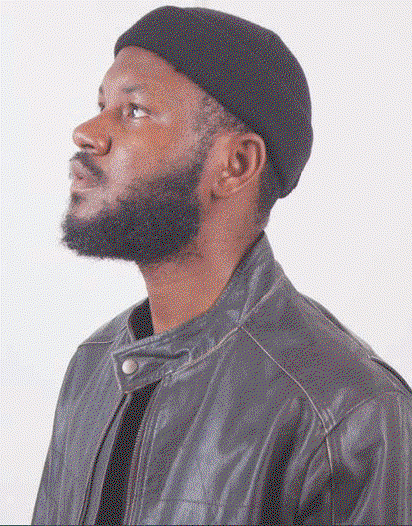
By Prisca SamDuru
Born in Lagos in 1979, Abraham Onoriode Oghobase studied at the Yaba College of Technology’s School of Art, Design and Printing in Lagos, majoring in photography.
In this interview, Oghobase spoke about the industry, journey so far as well as how his quest for the purpose of existence has led him to a unique form of art that explores issues relating to human emotions and identity. Excerpts:
Nigeria: 58 Years of What? (3)
Discovery of art and journey so far?
In an environment where having a university education and studying law, engineering or medicine were the only [practical] options to securing a better future, it’s difficult to even think of art as a way out.
A discovery of art (or one’s artistic tendencies) doesn’t happen overnight; I feel it comes from deep experiences, anxiety, seeking purpose and meaning in life. I discovered purpose in telling stories and finding ways of questioning and decoding why things are the way they are and how I could make my intangible feelings tangible. I struggled with the decision to pursue art as a career.
LIMCAF transforms coal city to art city
In 2003, I decided to undergo an apprenticeship with Deji Ajose, whom I regard as one of the best “light-drawing” artists but who has been reluctant to share much of his work with the public. I was exposed to his rich library of contemporary photography.
After that, I studied for another year under Uche James Iroha, who, besides guiding my artistic process, drilled into me the values of integrity and a love for God. Another mentor in the early stages of my journey who challenged conventional photography and exposed me to visual poetry was French-Algerian photographer, Bruno Boudjelal.
What issues do you find yourself engaging with?
I believe that art is a very powerful medium that can provoke thought and discussion, evoke emotions, poke our consciousness and sensibilities, but I think it is the individual artist’s prerogative to decide on what his/her art should address.
My artistic practice engages the notions of human emotion, identity, culture and existence, among other themes, through the exploration of the visual and social character of cities and places. My work has constructed visual narratives of emotional and physical space – chronicling experiences, feelings and notions alongside the economic, aesthetic, social and political dimensions of places of personal importance to me such as Lagos, Berlin, and (most recently) Jos. I view my work as a process of self-interrogation; questioning specific ideas and challenges as well as seeking answers to the larger questions of existence.
Do you incorporate your Nigerian identity in your work?
Being Nigerian is not a primary factor in my artistic practice. I explore issues of identity throughout my work, and try to locate/interpret myself within the context of whatever subject matter I am exploring at the time, but my identity is not limited to my cultural upbringing or place of birth, and I prefer to see it as layered and complex, fluid and evolving with time and one’s experiences.
Senate committee frowns at delay in Apapa trailer park project
What motivated your recent exhibition “Layers of Time and Place” ?
“Layers of Time and Place: What Lies Beneath” was motivated by my first visit to Jos, Plateau State, where I was instantly captivated by the rich history of the landscape and what – beyond being aesthetically striking – the tin mining ponds symbolize. They represented layers of social and environmental history and I wanted to understand and experience this history by undergoing a personal journey.
Why the choice of Art Twenty as a home for your work for the 26 days?
I had a vision for the scale and importance of my proposed project, and the impressive physical space at Art Twenty One as well as the commitment of the institution and its founder, Caline Chagoury, to contemporary art aligned with my plans for the work. I approached Art Twenty One about the idea and the rest is history, really.
What was the core message in that body of work?
My aim was to engage people on an emotional and poetic level, to create an entry point for us to reflect on our history and take a critical look at ourselves in relation to the environment. And to hopefully do this in an uncomplicated way while employing a broad visual language (that goes beyond photography). This body of work is, however, first and foremost a personal journey. It’s a privilege to have people take an interest in something very personal.
It’s tough operating Pay-TV business in Nigeria — Nwafor
What is the impact of Art Twenty One’s sponsorship to your body of work?
This project was, like any ambitious project, carried out to gain an indepth understanding of the world, and sometimes to do this in a meaningful way, requires financial resources. I was primarily able to just focus on being an artist and making my art without having to think about the logistical, practical issues that would hinder me from realizing my goal.
With funding from Art Twenty One, I was able to travel and undergo a period of research, and had the freedom to experiment with various visual mediums and explore the relationship between photography, history and anthropology, geology, etc. Financial backing from an institution often also indicates a kind of validation for the work one is doing, as well as a sense of responsibility.
Fayemi stops shop allocation at Oja Oba market
How else do you think Nigerian artistes can be encouraged?
Support can begin with access to quality art education in the country, where the right environment is created for learning and exchange. There also needs to be an indication of commitment and validation of the critical role that art plays in society, through the creation of arts councils, public and private endowment funds and prizes, amongst other things, and other resources that will promote and encourage a sustainable environment for artists to practice and enable the sector to really flourish.
Where do you think Nigerians are in the spectrum of art collectors?
I really don’t have much knowledge on the spectrum of art collection globally or have a sense of the local landscape for art collection, unfortunately.
What are your thoughts on art consumption and why do you think people buy art?
People buy art for many reasons. I suppose there is a certain value placed on a piece of work before someone decides to buy it, either from an emotional point of view, acquiring it for a personal/institutional collection or for more financial / commercial reasons.
Alonge emerges new NYCN chairman in Kogi
Contemporary art has become relatively accessible, thanks to art spaces like Art Twenty One, how does this impact the industry?
I believe it can only be a good thing for the art sector to have multiple spaces and platforms for engagement with contemporary art in its many forms. We all have a role to play in respecting each other as stakeholders and learning to collaborate with institutions and amongst ourselves as artists.
We are seeing the possibilities and potential for art in Lagos and Nigeria – that it is possible to create critical art, develop groundbreaking exhibitions as well as grow and sustain art markets, festivals, and biennials.
Disclaimer
Comments expressed here do not reflect the opinions of Vanguard newspapers or any employee thereof.