
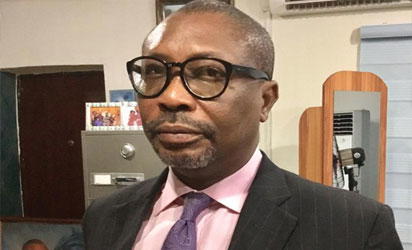
Reginald Ebitimi Bayoko
By Victor Ahiuma-Young
Reginald Ebitimi Bayoko is the Head of Service, HoS, of Delta State. Since 1990 when he joined the service, he has slept, dreamt and woke up in the civil service. In this interview, he gives insight into the challenges facing the civiol service and what he has been doing to ensure that Delta State Civil Service, work in synergy with Governor Ifeanyi Okowa, among others, to deliver services and keep the state with developmental realities. Excerpts.

Reginald Ebitimi Bayoko
I started my career about 28 years ago, in 1990 in the old Bendel State. After Youth service, the first youth work I did was through the civil service. I started then as an administrative officer, then in the ministry of finance and I was assigned to investment and loans department. My job then was examining matters related to government investments in that level as well as government revenue and loans affairs. Because of the reforms then, we were to grow in the MDA which we started our career.
It was a very long while when Delta State was created, I was in the ministry of finance in the investment and loans department like I said. I virtually grew up there, but in between I had the opportunity of having adhoc assignments serving in a number of committees, sometimes as a member and sometimes as secretary which gave me broad experience. Then sometime in 1996 or so, I was deployed to Urban Water Board, it was a creation of Delta State Public Utilities Board and I served in the office of the sole administrator then as it was initially designated, and later General Manager.
Thereafter, I returned to the ministry of finance,where I was made a functioning director in 2000 in a relatively young age. But what I experienced in the ministry of finance, investment and loans was that it exposed me a lot to the activities of the private sector, because managing government investments at that time government was very active and up till now anyway, in investments. Part of our duties was to ensure that portfolio was robust and it exposed us a lot, even as sometimes serving on the board of some of private sector companies as government representative, and attending strategic sections with them and also, the annual general meetings and lots of other meetings.
In a way, I have a cross breed of a government man having private sector insight. So, that was where I was until 2006 when governor James Ibori considered it wise to make me a Permanent Secretary. Thereafter, I was deployed to ministry of environment as Permanent Secretary. From then, I crossed over to the office of the Head of Service, then I went back to the ministry as permanent secretary again in the Ministry of Finance where I stayed for a long while until my elevation as Head of Service in 2016.
Last two year
The civil service has a commemoration of skilled staff, but from assumption of office, what I can actually say I made was a functional bureaucracy which has some challenges obviously like in every other human endeavour. For me, the major thing, was a deviation from the core values that the system had. Poor work ethics and poor work attitude. Many of the staff have had a change of mindset, which is not the system of a typical civil servant. That is why I said the focus is to reinforce these core values.
There are many of them; integrity, objectivity, impartiality, commitment to the rule of law, professionalism and a whole lot, that I think were the major challenges from what we were deviating from. I believe that if we can get that right, back to the basics, then many of the criticisms directed toward civil servants, and the shortcomings, will be largely addressed.
These issues has been there since time immemorial and is still here till today. But what we need to do is to recognize it and apply it to our daily activities, and those core values have been brought to us by the colonial masters because that is where we drew our civil spice from. I can tell you’ if you look at them, they are still apt till today, essentially, don’t deviate from them, renovate in terms of what the times are, but basically that foundation remains.
So, the major challenge really is the mindset deviation from what the typical civil servant, and civil service should be, and all we need to do is to refocus in that direction.
Ghost worker syndrome
The reality is that it is the syndrome that has given rise to what is known as ghost workers. Indeed, in the state we could classify “ghost workers” in to several categories. They are those who have multiple employments. Yes, there were some people who were in government service and had employment somewhere else. There were even those with multiple employments within the government. I can tell from my experience as interim chairman of the Delta State Oil Producing Commission, where some people were in the government payroll and also in the commission payroll. We tried to weed them out.
Another category were those who had travelled abroad but still on the government’s payroll. Essentially, they are not here, but were being paid by the system. Then, there’re cases of also dead officers who had been dead for several years , but were still on the payroll. Then of course, there were some who were not coming to work for various reasons, maybe they were sick, or were dissatisfied and had no courage to leave, and some who had businesses running side by side at the same time they were supposed to be in government.
So, the Hakerbella was an all encompassing process that we had to tackle and it involved introduction of electronic data management system to capture each and every employee and make them undergo biometric verification. And to integrate them into a centre data base which will now be linked to the payroll and driven by a time and attendance process involving clock in and clock out, so that, if you are abroad , you can not come in and clock out everyday. If you have any other business, you must come to the office to clock in and clock out. So, that system tried to address these things.
Of course, it also dovetailed into checking some of our attitudes in terms of timely attendance at work, to check late coming. Ultimately, the system is integrated into the payroll so that at the end of the day, it will tell you the time you came to work and the day you didn’t come. So, essentially, it has helped to eliminate those ghost workers out of the payroll. The moment you do not come to work for a particular time, it is detected immediately and decision is taken on it. So, that is the whole essence.
Size of state civil service
If you want to look at it strictly, it is about 12, 000.
But, the entire public service as a whole is about 47,000. Majority of this is in the teaching service, where they have about 15,000 staff. There you have top level up because from the teaching service it start from level seven and above. and another sizeable portion of that is in the Health sector where they have about 24,000, or there about, that may not be too accurate, but that is the range. We are not talking about tertiary institutions yet, the doctors and so on. If you translate and add the tertiary institutions, you will a fair idea of what we are taking about and impact on the wage bill”
Pending arrears
First, let us put the situation into perspective which I have always tried to tell civil servants, because the question of promotion arrears in the first instance is caused by us. In the sense that if we have done what we are supposed to do, and do it on time, then the question of arrears wouldn’t have come up. It means that essentially, a man is ready for promotion in January or June, you have completed that process at that time, and it is possible, if we do what we are supposed to do. But even if you don’t complete it right on time, it is just a question of one or two months. So we have seen situation were there is backlog of promotion, but, unfortunately, some being promoted three years after. That is a reality.
Some two years after. And it brought up this accumulation of arreas. And got to a stage that the governor saw it when he was grappling with what constitute the payment of current salaries and said no, let’s put a halt first to this payment until we have a clear picture. He gave a directive to that effect. To be honest, we have been on the neck of many MDAs. I had a review few days ago and there are a still a number despite the pressure we have applied on them, who have not responded. We hope to draw the line very soon.
But for those who have responded, we are saying that, the arrears which we have compiled is over N4billion, which are accumulation of unpaid arrears many years ago. And part of the mandate His Excellency gave to me was that promotion is at when due. We have tried as much as possible to bridge it up. I would be telling you a lie if I say that we are up to date. But, at least where we are now is nothing more than three months and we intend to close it going forward. So the arrears from what we have completed is about 4.1billion
What plans do you have to ensure that the civil servants have what it takes to meet the modern day reality, the challenges facing development in the state?
I had a discussion on this issue with His Excellency, under the SMART agenda has a huge focus on building infrastructure which he is currently doing. You put so much investment in infrastructure and to maintain it. And who are to maintain, it is the people you engaged who are to run the system. That is the governor has agreed with me on so much emphasis on training. But in that respect too, we discovered that , though they tried in the past, there have been some hiccups in the past which we have to now fine tune.
The trust is to have a real needs assessment and for all MDAs to draw up their annual training plan based on the needs assessment, that the training must have value, not just for training sake. It must ultimately be tied with the SMART agenda and we have done a lot of work on that, though a lot of people will not know. Another issue is the quality of the training institutions that we send our people for training. The governor was particular about having quality institutions to run the trainings, and I agreed with him that we need to have quality institutions for these trainings for us to get the value at the end of the day for the money spent and the people would deliver
Remembrance
I will put it down to also my outlook, essentially I was a man who came, saw and tried his best. I will try from the message I always try to preach, which is let’s try to do things in the simplest form in which they are. If you do them in that simplest form, you could solve them, but when you leave, it becomes complex, and it will require complex solutions to deal with them. I use this Hakerbella as an example, as a man, I came into office and I after briefing I am told that I need to come into office at 8 clock, it is simple. All I need to do is to I arrange myself well, and at 8 o’clock, I am in the office.
Number, two I come to the office and do what is expected from me and a the end of the day, I go. If I do so, nobody is going to talk about bringing Hakerbella to come and clock you in and clock you out. It is the same principle of the ghost workers we were taking about. If you are satisfied, turn in paper and go .
But, overall, my special focus I want to be remembered for at the end of the day, God willing, if everything works into play, as it is already working into play, as somebody who has tried his best to focus on productivity and introduced quality innovations , ideas, that would enhance discipline and integration, and ultimately to create a forward looking civil service or public service that is market driven and motivated to meeting the challenges of rapid development.
Relationship with labour
We have been very cordial , although in saying so, let me tamper it, I am not a man who blows his horns, you can confirm from them whether what I have said is correct Or not, and I must thank them for providing the atmosphere, and truly the credit goes to governor Okowa who has provided the atmosphere and rarely interfere in the civil service matters
Disclaimer
Comments expressed here do not reflect the opinions of Vanguard newspapers or any employee thereof.