
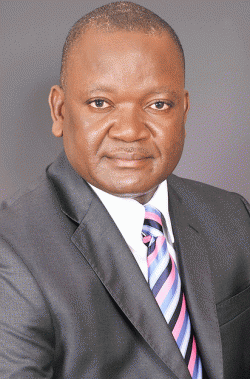
Gov Samuel Ioraer Ortom
The move by eight of the 30 members of the Benue State House of Assembly to impeach Governor Samuel Ortom may have been an act of desperation by the political class to control a state that has been a factor in all presidential elections since 1979.
By Emmanuel Aziken, Political Editor
The desperation of the political class was clearly shown by the strong security cordon that was thrown around the premises of the Benue State House of Assembly from dawn last Monday. Heavily armed policemen and operatives of the Department of State Services, DSS took positions around the assembly allowing only the eight members of the All Progressives Congress, APC set with the agenda of removing the governor.

Gov Samuel Ioraer Ortom
The opposition to the men of arms was mobilised by locals who came with sticks and their bare arms to fight off those they called the intruders. The men of arms eventually prevailed setting the tone for the political storm that eventually saw strong reactions from every section of the polity.
The seeming desperation by the two major political parties for the control of Benue State is only reflective of the pivotal significance of the state in the country’s presidential elections.
Whether by happenstance or by strategy, Benue State has voted for the winning political party in all presidential elections since 1979.
The state’s significance as an election decider is partly reflected in the account of President Muhammadu Buhari’s experiences in the state. Buhari who never won the state before 2015, scored a miserable 10% of the votes in the 2011 election when he came third behind Nuhu Ribadu, the candidate of the Action Congress of Nigeria, ACN and Dr. Goodluck Jonathan of the Peoples Democratic Party, PDP.
Four years later, Buhari won the state by 54% over Dr. Jonathan who was the only other major candidate in the election.
Benue State had in the past acted as a bulwark against the major political and cultural tendency of the Hausa Fulani North. Senator Joseph Tarka who first emerged as a youth activist in pre-independence Nigeria came to form a bridge with the South with his United Middle Belt Congress, UMBC and for some time fighting off the dominance of the Northern Peoples Congress, NPC led by Sir Ahmadu Bello.
However, at the onset of the Second Republic when Tarka aligned with the conservative National Party of Nigeria, NPN, the tone of the state’s politics was temporarily redirected. In the aborted Third Republic, Benue State seemed to have found its way back to the progressive tendency when the state with the late Father Moses Adasu sided with Chief Moshood Abiola’s Social Democratic Party, SDP.
In 1999 when the Fourth Republic commenced, the state was won by the Peoples Democratic Party, PDP in every election cycle until 2015 when the state changed with the majority of the country to enthrone the All Progressives Congress, APC at the federal and state levels.
However, recent developments in the state, notably the killings by herdsmen have tended to put the state against the conservative North given the insinuations that the killers were backed by the authorities.
Governor Ortom in his reaction to the developments on Monday, however, put the crisis squarely on his penultimate predecessor, Senator George Akume who helped to navigate the state to Buhari and the APC in 2015.
Whatever is the issue between both men have not been publicly relayed, but the governor’s insistence on implementing the anti-grazing law has been a popular chorus with many in the state.
Mr. Jonathan Asake, a former member of the House of Representatives and leading chieftain of the Middle Belt Forum, told Vanguard yesterday that the apparent bias of the federal authorities against the anti-grazing law was a major challenge for the governor.
“The minister of defence who should help to enforce laws made by the House of Assembly is quarrelling with the law. It means that the minister of defence and other key functionaries of this administration found a common ground of agreement,” he told Vanguard.
Mr. Caleb Muftwang, a chieftain of the PDP in Plateau State told Vanguard that the governor’s decision to stand with his people in the spate of the herdsmen killings was a major challenge for him.
“In the crisis, he stood with his people unlike the situation on the plateau. And yes, the crisis in the state certainly could have impacted on his performance to perform because scarce resources were devoted to resolving the crisis.”
Mr. Asake, however, firmly links the present crisis in the state to two major factors, the herdsmen killings and the defection of Governor Samuel Ortom from the All Progressives Congress, APC to the PDP.
“It is a result of two factors, the defection of the governor from the APC to the PDP was like a blow to their ego, and that is why they have suddenly they realised that he (governor) had committed some impeachable offences and they are going about it in a very unconstitutional and crude manner which will not work.
“If it worked ten years ago as with Joshua Dariye in Plateau and in Oyo with Rasheed Ladoja, this is 2018, and we are well advanced, and it will not happen. All men of goodwill and lovers of democracy will resist what is happening in Benue.
“Second, I think this is happening because they have found a window of opportunity to implement the very agenda set by the Myetti Allah who had consistently kicked against the anti-grazing law set by the House of Assembly. They want to remove the governor so that they can put a stooge who will now come and implement what they want.”
Disclaimer
Comments expressed here do not reflect the opinions of Vanguard newspapers or any employee thereof.