
By Foluso Lalude
A little over three years ago, I was one of many Nigerians fuming at the upward price reviews made by MultiChoice, the leading Pay TV operator in the country. I believed, like many others, that the prices being charged for the service were extortionate.
Explanations by the company that it had no option than to increase prices because of increased costs of operation made no sense to me simply because I had told myself that they just could not be reasonable.
I flirted with the idea of switching providers, but was also aware that doing so carried the risk – a bold one – of having reduced family entertainment. I tried to see if I could get a provider offering what was close to the standard I have become used through DStv, but was luckless.
I told myself that I would bear the price review. A few weeks after, I thought I needed to even check the validity of the claims made by MultiChoice in response to the price increase backlash. What I found on the internet was not surprising. What was surprising was the fact that it should have been obvious to me. My point: Rather than join the popular queue of those slating the company, I should have attempted to find out the situation in the Pay TV industry in other climes.
At the time, the company explained that rising costs of programming, including programmes produced locally; devaluation of our national currency as well as the fact that the country’s economy is a high-cost one conspired to make the upward price adjustments inevitable.
The Pay TV industry, I discovered, is one that subscribers know very little, if anything about. Until then, I also knew next to nothing about it, the reason I was duped into believing that Pay TV operators happily extort their customers through criminally high prices for their packages.
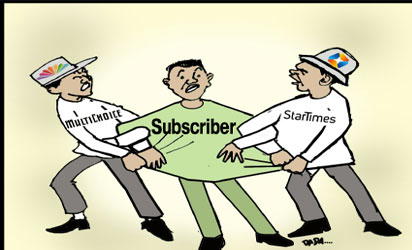
At the time I woke up, so to speak, I discovered that a Pay TV company is just one link of the chain that also includes the content creators/owners and aggregators, who wield most power. The consumer, important as he/she is, is at the mercy of the latter category.
The consumer, however, does not see it that way because he/she has no direct interaction with the content owners, but the television companies, which distribute the content. Subscriber anger, everywhere in the world, goes in the direction of Pay TV companies. Early this year, six major Pay TV operators in the US gave hints of price hikes. Comcast announced an average rise of 2.2% beginning in January, while AT&T/DirecTV announced an across-the-board hike of $8.
Charter announced that most of its packages will go up by as much as $10 per month
Dish: Most channel bundles will go up by $5 beginning this month, the same as Cox. Verizon, which at the time gave no specific figure, said it had finalized plans for rate increases.
Programming costs have continued to rise, in part, because of the competition among Pay TV subscribers, on the one hand to have the best programmes/channels in their bundles, as well as because content in the same category is also desperately sought by Video-on-Demand (VOD) operators/streaming services.
It is boom time for content owners, who seek to exploit the advantage that competition brings. I guess that is business.
Content is generally the largest cost item for Pay TV operators and the cost is astronomically high for two categories: sports and movies/general entertainment. The Los Angeles Times estimated up to 40 per cent of programming costs of US Pay TV operators goes to paying for sports content.
According to SNL Kagan, a media and tech research firm, the operating cost for Pay TV operators in the United States will continue to rise until 2021. The research firm stated that 47.5 percent of major US operator, DirecTV’s revenue in 2014 was expended on programming costs. Based on the current fees, it estimated that DirecTV would have expended 57.2 percent of its total revenue on operating costs by 2021.
The situation leaves the subscriber with the responsibility of bearing the rising costs of programming, which Pay TV operators have to pass on or risk a denudation of their margins.
In many situations, content owners sell to Pay TV operators in bundles, lumping top-tier programmes and channels with duds for which the operator pays regardless of whether they are watched or not. Hardly ideal, the powers lie elsewhere and it is not with the operators.
- Lalude writes from Ibadan
Disclaimer
Comments expressed here do not reflect the opinions of Vanguard newspapers or any employee thereof.