
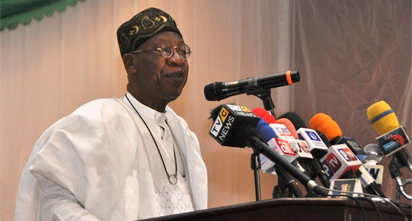
Alhaji Lai Mohammed
This event brings us together today to celebrate the successes and opportunities in Africa.
Alhaji Lai MohammedAs we all know, popular depictions of Africa can be (grim):
Poverty, violence, disease – this is an image that all of us here today are familiar with.
Yet so too do we know how this obscures, rather than reveals.
It masks the success stories, the positive trends, the democratic gains that are evident, if only you look closer. But – perhaps – more importantly, it obscures the human potential and future possibilities that lie within these 54 nations.
This is not to say there are no challenges. Rather, it is to realise that they should not limit us – nor our scope of ambition. For it is only a part of the picture.
The continent has often been presented as a problem to solve – a web of issues that require untangling – rather than a place of people, culture and ingenuity.
We face challenges. Which continent does not? But challenges also bring opportunities. One is the flip side of the other.
So when I speak of opportunity, I do not speak of shutting one’s eyes to the reality, but rather to see it clearly, fully and – indeed – optimistically.
For it is what we do today as members of government, policy makers, civil society groups, citizens, members of the diaspora and international partners that will change what shall follow. This may seem obvious, but is worth underlining.
Because development does not fall from above. It takes hard work. However first, we must see properly the task ahead of us.
One such challenge – or opportunity – is demographics – the so-called youth bulge.
Africa’s population is expected to double by 2050. By this time, a quarter of the global community will be African. Urbanisation – as migratory flows increase from the countryside to city – is also accelerating.
To some, this is a ticking-time bomb. What if there is no opportunity? What will youths without jobs do? Mobilise? Destabilise?
True, in Africa, urbanisation has not correlated with poverty reduction as it has in other regions.
However, where some see looming clouds, I see a concentration of energy. The number of people reaching working-age will be larger than the rest of the world combined by 2035. And they will be young. This great pool of vibrant and energetic labour has the potential to transform the continent’s development. In fact, it could transform Africa into the major driver of global growth.
If there is one country that is emblematic of this, it is perhaps Nigeria.
Indeed, it will be largest contributor to this surge. We shall move from being the 7th largest nation on earth to the 3rd. And amongst the ten largest nations on earth, Nigeria will be the fastest growing.
So, what does this all mean?
We must create jobs. It is that simple.
Rather than fall prey to fatalist predictions, that is what we must do.
I can only speak authoritatively on Nigeria. So I hope to share some of the successes we have had.
Investing in people
Without a decent level of education or the right skills, we cannot supply the developing sectors with the human capital they require. And with the median age so low – comparative to other regions – we must focus our efforts on the youth.
This means education for those not yet in the labour pool, and skills training for those that are.
Firstly, education. Now we can get into a debate about what good education is, or what will suit the shifting dynamics of the modern world. But let’s start at the basic level.
In my country, school enrolment is a challenge we face. And one of the main culprits is malnutrition. Government must step in. And in Nigeria we have: 8.2 million are being fed daily free meals in 45,000 schools. Not only does this increase attendance and provide children with a – in some case only – nutritious meal a day, it enhances learning efficacy in class and boosts cognitive development over the long term.
This is an investment you would expect a delay before feeling an economic response. However, this programme creates material benefits in the present. For it also supplies farmers with a ready market to sell into, giving them indications on how much to produce and when – engendering stability and reassurance amongst our growers. At the same time, we provide farmers with training in seeds and fertiliser, applying best standards to increase our food security. It also provides jobs for the chefs and those that transport the food. It is an investment which looks at the whole picture, looking at ways to do more with your money, to reach as many as possible.
This is increasingly urgent given how stretched government resources across the continent have become. The days of bounty are over: we cannot expect a return to the high commodity prices that characterised the 2000s. Instead we must act now, by doing more with less; and looking at investments that have manifold benefits. We must always ask ourselves: what are the indirect knock-on effects?
Secondly, skills shortages in the labour pool now. Once again, government must step in – we must look clearly at the issue. Where are the skills shortages? Where are the future gaps? Identify the priorities and pursue. The era of stretched budgets allows for nothing less.
For instance, under Nigeria’s N Power programme – which currently employs 200,000 youth and provides vocational training for 75,000 – we are currently training 40,000 health extension workers to bolster the medical outreach in remote and disadvantaged communities.
This provides jobs whilst fulfilling social need. It is nothing new. Franklin D. Roosevelt lay down his new deal for America in the 1930s. But somewhere along the way, these valuable insights were lost in the folds of time – pushed aside by a singular focus on innovation and disruption.
- The business environment
There is too much red tape across the continent. It makes it cumbersome for business, stifling innovation and job creation.
Much of our programme has honed-in on business reform. Nigeria has moved up 24 places on the World Bank doing Business index – putting it amongst the top 10 global reformers, along with Zambia, Malawi and Djibouti.
The two areas we have prioritised are starting a business and access to credit.
Firstly, In Nigeria, registering a business used to take months. Now it takes 24-48 hours.
Unwrapping the bureaucracy and streamlining processes encourages an uptick in new official enterprises. For whilst business still face a burdensome regulatory environment across the continent, registering in the formal economy holds many benefits. Perhaps most importantly, it allows companies to access legal and financial services that formal recognition confers to companies. Therefore, simplifying the registration process will result in more new companies, giving succour to business growth and job creation.
So how does this translate to government action? In the Nigerian case, we have introduced online registration, with features such as the electronic stamping of documents. Not only is this cheaper, but more convenient. And to ensure this brings with it the maximum benefit, Micro, Small and Medium Enterprises clinics have been deployed across a variety of states to provide regulators a contact point with informal business and budding entrepreneurs to clarify any issues.
Secondly, in Africa, a major obstacle to scaling up business – especially for MSMEs – is access to credit. How this impacts job creation is too obvious to state.
In Nigeria, we have made it possible for MSMEs to register their movable assets, such as vehicles and equipment, and use them as collateral to raise loans and finance. This removes the need for traditional – and moreover, expensive – assets (such as real estate, offices and factories). This will allow many of those smaller companies to put capital behind their ambition and begin developing their future.
What these business reforms also amount to is widening tax revenue base. By bringing more into the formal economy, we widen our tax base. Tax to GDP ratio across the continent remains too low. We must deepen it. For the sustainability of our future growth depends on it. When government’s depend too heavily on the natural wealth to fund the government purse, it leaves them open to the vicissitudes of global fluctuations. In my country, we know this all too well.
Since 2016, Nigeria has added 5 million taxpayers – from 14 to 19 million. This has resulted in a tax revenue increase of over 50%. This gives the nation a steadier inflow from which to plan.
- National infrastructure
For these enterprises to thrive, now barriers have been lowered, they need buttressing from below. This means infrastructure. The two most critical things holding back business is decent transport connections – in the form of road and rail networks – and a reliable electricity supply.
With better roads and train networks, we can move goods around more cheaply and efficiently. It also provides access to regional and international markets.
With a reliable electricity supply, businesses can plan for the future, knowing they will not be hampered by energy outages.
In election campaigns across the country, transport and power come up over and over again.
Government must invest, and where they cannot, look to international investors to plug the shortfalls.
For instance, Nigeria earmarks 30% of its annual national budgets for capital expenditure. That means almost US$7.5 billion has gone towards our infrastructure – unprecedented in our history. Power generation has climbed to 7000MW (from just over 2500MW), to which we hope to add another 2000 by the end of the year. We have also laid down thousands of km of road.
But when it came to our railway, we had to look to other solutions. Our rail network – whilst extensive at 3500km of narrow-gauge – had been neglected since it was established. Trains are delayed, if they run at all. This gives the population little predictability, let alone business. At the moment, it is not functioning as the engine of growth it should be.
We took the project to international businesses, and the Government has now signed a concession agreement with an International Consortium led by General Electric. This will breathe new life into the tracks, increasing capacity and speed. Not only will this allow for goods to be moved around cost effectively, it will allow the prosperity of the nation to be more equitably spread through increased connectivity. Those far from the coast will be able to get their goods to the ports of the South, and building supplies and capital goods can be freighted around the nation. It will also allow for the efficient movement of people, allocating labour where it is needed.
At the same time, the government deepens our network through constructing a new standard-gauge railway to run parallel. Lagos to Kano has already commenced.
Youth unemployment is a problem across African Nations. And given the surging, we will have to create jobs faster than we ever have before.
The scale of task is great, but reform by reform, initiative by initiative, block by block we begin to lay the ground on which we can build. Momentum begets momentum. New connections are made. Excitement and innovation begin to coagulate.
However, we must stay focused.
We must share our experiences. To see what has worked for individual nations and see if they have applicability elsewhere. For the solutions are sometimes not the same. However, some issues cut across the diversity of our countries. We must therefore eagerly share if we are to thrive. Then we shall see more clearly the opportunities that are present and those untapped across the continent.
- BEING TEXT OF THE SPEECH BY THE HONOURABLE MINISTER OF INFORMATION AND CULTURE, ALHAJI LAI MOHAMMED, AT THE 2018 ‘AFRICA TOGETHER CONFERENCE’ OF THE AFRICAN SOCIETY OF THE UNIVERSITY OF CAMBRIDGE ON SATURDAY, 16 JUNE 2018
Disclaimer
Comments expressed here do not reflect the opinions of Vanguard newspapers or any employee thereof.