
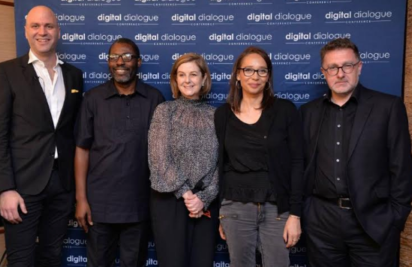
L-R: Caroline Creasy; GM Corporate Affairs, MultiChoice Africa, Femi Odugbemi, Film maker, Jenkins Alumona, CEO Strategic Outcomes, Yolisa Phahle, CEO Video Entertainment, MultiChoice Africa, Paul Papadimitriou, Founder, Intelligencr, Anthony Lilley OBE, Professor, Creative Industries, Ulster University
…predicts brighter future for movie industry
By Prince Osuagwu (Hi-Tech Editor)
One of Nigeria’s frontline movie makers, mr Femi Odugbemi says the fame and fortunes the Nigerian movie industry, Nollywood, enjoy today couldnt have been possible without the tech disruption earliest practitioners brought about when they migrated the industry from Video Home System VHS to Video Compact System, VCD.

L-R: Caroline Creasy; GM Corporate Affairs, MultiChoice Africa, Femi Odugbemi, Film maker, Jenkins Alumona, CEO Strategic Outcomes, Yolisa Phahle, CEO Video Entertainment, MultiChoice Africa, Paul Papadimitriou, Founder, Intelligencr, Anthony Lilley OBE, Professor, Creative Industries, Ulster University
Odugbemi who addressed participants at the 5th edition of Digital Dialogue Conference holding in Dubai, the United Arab Emirate, said that singular attempt at digitisation of the industry opened up a lot of opportunities which have collectively launched Nollywood to global reckoning.
Making presentations on the development of Nollywood, he argued that the consistent growth the industry has achieved is attributable to that earliest disruption and again, the rich cultural heritage of the African people, which forms greater part of the stories of Nollywood products.
,He also predicted a promising future for the industry, at the rate it applies digital technology in all its activities. “Digital solutions will open up a number of possibilities across Nollywood’s sub-sectors, including distribution, production, manpower and governance” he said.
For him, the industry which started in a leisurely outlook has transformed itself to a strong business community assessed at $3.3 billion in 2014, and today enjoys a projection of N585 billion earnings, per annum .
According to him: “Nollywood found its audience and its audience found it because its story telling connected to the cultural experiences of its audience.”
Because of this cultural connection, he said, Nollywood was bound to continue to grow in leaps and bound, provided, however, it did not lose focus and took advantage of the emerging opportunities provided by digitalisation.
” So far, increased innovations in arts and forms, has moved Nollywood’s box office earnings to N3.5 billion ($11.5 million) in 2016, and the industry is cited as one of the priority sectors identified in the Economic Recovery and Growth plan of the Federal Government of Nigeria and projected to attract $1 billion export revenue by 2020.
“The industry is becoming more formalised. In terms of governance, business proposals, right contracts and change of title, agreements are becoming a necessary part of the business of Nollywood, helping to create a new line of roles and new businesses. There has been increased government participation in Nollywood in the areas of funding and grants, copyright legislation, and taxation. The industry is also being closely watched by guilds, lobby groups, and other relevant stakeholders.”
He also argued that filmmaking in Nigeria was gradually becoming more sophisticated due to growing digital options, including applications that could create a virtual rendition of a scene for filmmakers.
He put the current capacity of Nollywood at an average of 50 filmmakers per film set, 2,000 film projects per year and estimated two million workforce.
Disclaimer
Comments expressed here do not reflect the opinions of Vanguard newspapers or any employee thereof.