
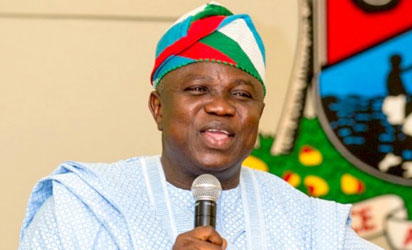
Governor Ambode of Lagos State
BY MONSURU OLWOOPEJO
Lagos is experiencing population explosion as people from different parts of the nation in search of greener pasture troop to the state daily. With estimated 24million people now living in the state, this obviously has security implications. This among others was the reason the first edition of Lagos State Security Summit took place recently.

Governor Ambode of Lagos State
The summit was attended by security experts and conflict resolution experts, including the Vice Principal, King’s College, London, Professor Funmi Olonishakin, and Deputy Inspector General of Police, Marvel Akpoyibo, ret., who proffered solution to security challenges in Lagos.
They noted that the authorities had stemmed the tide of kidnapping and crippled the cult group, Badoo, which terrorised residents of Ikorodu.
While declaring open the summit, held under the theme: Securing Lagos State: Towards a Sustainable Framework for Modern Mega City, Governor Akinwunmi Ambode stressed the need for stakeholders to have properly defined roles and stay ahead of crime.
According to him, that became imperative in view of the vulnerability of Lagos to security threat due to continuous influx of foreigners into Lagos daily.
Ambode, who was represented at the occasion by the Chairman of the state Security Trust Fund, LSSTF, Mr. Oye Hassan-Odukale, said his administration had been implementing its cardinal programs built on the tripod of security, infrastructural development and poverty alleviation through employment generation, adding that the efforts had been yielding fruits.
The governor argued that there was need for clear direction to expand security in Lagos to deal with future challenges.
He posited that in spite of the state government’s support for security agencies through LSSTF, there was need to do more.
“We must create a sustainable security framework which will stand the test of time and enable every stakeholder in Lagos to participate,” Ambode added.
Possible threats
Olonishakin told the gathering that the location of Lagos had made it a destination for all and susceptible to threat not only from contiguous states but also from other countries, particularly Republic of Benin.
While using the Ebola analogy, the conflict resolution lecturer said: “Lagos is the only megacity in Africa that is not ravaged by arms conflict. Lagos is essentially stable but it must work hard towards environmental issues because it is a coastal megacity.
“Food security must also be strengthened in order to prevent a community of people with nothing to lose. And if such exists, we would be breeding insecurity and violence.”
The Nigerian Ambassador to Republic of Benin, Kayode Oguntuase, who also spoke at the occasion, hinted that some of the crimes committed in Lagos were planned outside the state, especially neighbouring countries, blaming the situation on the porous borders.
Oguntuase lamented that the protocols signed between Nigeria and Benin Republic only exists on papers, affecting proper protection within the seven borders between both countries.
“There is need for both countries to obey the protocols signed earlier. We have the Badagry protocol, Economic Community of West African States, ECOWAS, free trade protocol. We discovered that some of these protocols only exist on paper. We must show more commitment,” he added.
The ambassador argued that though Benin shares border with Nigeria, the neighbouring country poses more threat to security in Lagos.
“Most of the goods in Benin Republic weren’t made within the country, they were brought there. These goods, especially the bad, which are in transit, find their way into Nigeria. The Federal Government talks more of rice and vehicles but there are other more goods that find their way into Nigeria; among them are fake drugs.”
Oguntuase stressed that the manufacturers realise the porous state of the borders between both countries, and explore it, adding, “I have passed through the seven borders between Nigeria and Benin Republic. Of the seven, only Seme-Kraki is a bit up to standard and it was built by the European Union, EU.
“When I went to Warra-Iluwa towards Malumfashi, there was nothing to call border there. We need infrastructures in those border posts. That is why I must commend President Muhammad Buhari for not signing the agreement to allow free flow of goods because it would have been a disaster for the country.”
Another possible threat raised by participants’ was the source of funding security apparatus considering the huge population of Lagos, noting that there was need for LSSTF to have enough funds at its disposal to help security agencies with equipment rather than looking for donations.
Lagos State Commissioner of Police, Mr. Imohimi Edgal, said, at the occasion, that equipment was needed for the police in the state to function optimally, disclosing that the ratio of police to residents had increased to 1:800 persons.
Solution
While reeling out statistics to buttress the achievements of the police since 2014 till date, Edgal said 1,315 armed robbery attacks, 359 cult-related cases and 392 kidnapping cases were recorded, with several arrests made and suspects prosecuted.
To prevent crime in the state, the commissioner advocated for increased manpower and a policy to stop the spread of fear on crime through the social media, as well as legislation that compels all businesses to install Close Circuit Television, CCTV, cameras within their premises.
The CP called for the deepening of intelligence-led policing, involvement of traditional leaders in security architecture and investment in training of security personnel to ensure efficiency.
Speaking on the statistics released by Edgal, Olonisakin urged the state government to deploy technology to resolve security challenges.
The Director of International Collaboration and Linkages, Akwa-Ibom State University, Professor Otaobasi Akpan, suggested that the state government should establish Lagos State Security Commission to which five per cent of the state budget would be allocated
On his part, Prof. Oshita Oshita urged that peace and conflict feedback mechanism be created to feel the pulse of residents on issues that could threaten peace and harmony in Lagos.
‘Our plans’
On LSST plans to tackle security, the Executive Secretary/ Chief Executive Officer, Dr Abdurrazaq Balogun, said with the population of Lagos, it was certainly important for technology to be fully incorporated into the security architecture of the state.
He said: “I think technology is just the way to go for security in a state like Lagos with the huge population. Certainly, you cannot have men on ground only policing the whole state; you have to involve technology in the policing and security of the state.
“Again, all over the world, technology comes in different ways and manners from the applications on the phones to alert systems on the phones, from drones to heli-kites where you can have something like a balloon up in the sky where you can watch everything happening in the whole city from the control centre and so technology is the way to go for us to have an efficient policing system.
“From what we have heard here at the summit, it is not only about the physical policing. There are so many aspects of security we are speaking to. People raised issues about environmental security, bio security, terrorism, maritime security, among others.
I think basically, technology can do a lot in monitoring and ensuring a more robust security system in Lagos State.”
Speaking further, Balogun said the state government, through the summit, would bring forward a robust framework for security in the state for the next four years.
Responding to a comment by one of the participants at the summit for a robust security system to police the waterways and coastal areas of the state, the LSST boss said the state government was already working in that direction.
He said at the end of the summit, a policy document to ensure safer Lagos would be developed based on the recommendations by experts and stakeholders.
“The biggest work we have on our hands is post-summit. What we have here is just a day summit but we will go back, analyze this information we have got; sit down together to separate the wheat from the chaff.
“We have also received a lot of documents from well-wishers and individuals telling us suggestions of where to go and so we are not in a hurry to have a document at the end of this summit. It may take us weeks but we have to ensure that we do a proper job.
“There has been suggestion of legislation to take care of some issues but there is a lot we are going to do and that is why part of the objectives of this summit is to proffer a home-grown solution to those things we can do independently of the federal government because you also recall that all security agencies are under the federal government.
“We are going to seek homegrown solutions and so issues of CCTV and profiling of private security guards are under the purview of the state; we can pass legislation to that effect, but like I said, we are not in a hurry; we will collate everything we have gathered and come up with a very robust document for the state”.
Disclaimer
Comments expressed here do not reflect the opinions of Vanguard newspapers or any employee thereof.