
By Prof. Steve OlaOluwa Afolami
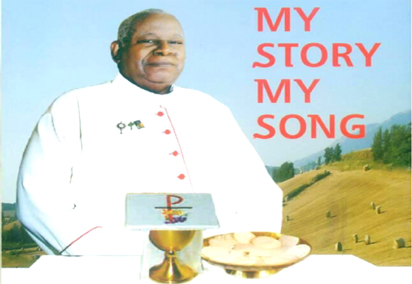
The Book, My story, my song, opens with a dedication that gives an insight into three of the most respected persons in the life of the Author: Pa Thomas Kudieyin Boyo, his father; Madam Eleanora Ayodele Boyo (nee Hughes), his mother, and Most Reverend Dr. John Akwao Amuzu Aggey, the first indigenous Archbishop of Lagos Catholic Archdiocese. The acknowledgement is as usual an array of persons who have contributed in one way or another to the publishing of the book. However, because it is the story of the life and times of a 76-year old Monsignor, it is understandably a very long list of those who have in one way or another contributed to what the youthful Christopher Edema Boyo eventually became; parents, siblings, fellow clergy, male and female Religious, generous benefactors, and lay collaborators.

The Foreword written by the Bishop Emeritus of Lagos Archdiocese, His Eminence, Anthony Cardinal Olubunmi Okogie is a very apt summary of the entire book and makes the work of the reviewer a little less arduous. This is followed by the Profile of Msgr Boyo written by Fr. Edmund Hogan and the Prologue whets the appetite of the reader and guides towards what the autobiography presents in detail. For those who are not present at the launching to listen to this review, the Foreword, the Prologue, Profile and Acknowledgement will be the shortest route to understanding the purpose of the Memoirs.
In the Beginning
Monsignor Christopher Adebowale Edema Boyo was born into the family of Pa Thomas Kudieyin Boyo and Madam Eleanora Ayodele Boyo (Nee Hughes) on October 29 1940, the third child of his Mother’s. The story of his childhood is laced with parental affection and closely-knit family life that was bound to have live-long influence on the choices and pathways of the young Chris Boyo. The memoirs, with such detailed record of royal and aristocratic ancestry reveal very clearly that Msgr. Boyo was born with a silver spoon in his mouth.
From the age of nine, having been exposed to deep family piety and Holy Communion from so early, grace started manifesting in the life of the young boy. The influence of good example at home was further heightened by the good example of a good priest in the person of Fr Pedro-Martins at that early age especially the role Fr Pedro played as a young Priest in the Marian Congress of 1949 at Tafawa Balewa Square in Central Lagos and the ordination of two Priests. From that early point, all that the young Chris Boyo wanted to be was a Priest. His vocation to the priesthood was clear to him, his parents desired it, his mother promoted and sustained it throughout her life, his sister Helen Ayodele Ekwueme (Nee Boyo) took over the maternal role after the death of Mama Eleanora and God who did the calling in the first instance provided the grace that was necessary to successfully navigate the thorny, sometimes slippery path of a diocesan priest.
Talking of the thorny and sometimes treacherous path of a celibate life in a culture that puts so much premium on child-bearing and earthly success, an incident which occurred back home in Itshekiri land after young Fr. Boyo’s ordination to the priesthood exemplified how deep the failure to understand the self-denial and sacrifice involved in priestly or celibate vocation in general can be: Msgr Boyo related in his Memoir how an elderly female relation walked up to him after the burial of another member of the extended family and told him in very unkind words what a waste his life was if, with all the handsome body God had endowed him with he saw nothing else to be but a priest without a wife, child or house of his own! As God would have it, just as she disappeared after those scathing, wounding words, another elderly lady walked into the scene with admiration and praise for such a handsome young man who had brought honour and glory to the Boyo Family by choosing to be a Catholic Priest. That was clearly an angel sent by God to neutralize the poison that the devil had just injected into the mind of the young Priest through the agency of an old relation. (Msgr Boyo indicated elsewhere in the book that he is the second Itshekiri catholic priest, the first having been ordained some 200 years earlier)as a Missionary Priest.
Those who met Rev Fr. Chris Boyo in the eighties when he was a dashing young man always came away with a feeling that there was some royalty and aristocracy about him and quite a number who knew little about the wonder called grace could not help wondering how he still managed to become a priest of the Catholic Church, celibacy and all! His memoir, My Story, My Song provides an answer to such musings.
Talking about royalty and aristocracy, Msgr Boyo, as revealed in My Story, My Song has a full dose of it from grand-parenthood to immediate parents. The Memoir contains a detailed documentation of the genealogy of the Boyos through Chief Diare who was Governor of the Benin River in the western Niger Delta in the year 1981 to 1870. Apart from Okoro-Boyo, Msgr Chris Boyo’s Grandfather, the Governor had two other sons, Jemide Diden (light-skinned Jemide) and Jemide Dudu (Dark-skinned Jemide), the Progenitors of the Rewanes and the Dediares.
The Hughes from whom Madam Eleanora Boyo descended were themselves products of royal dynasties. According to the lineage traced by Msgr Boyo in his memoirs, one was a crown prince violently kidnapped and sold into slavery in order to ensure he did not get crowned, but luck smiled on him to the point that he returned from South America in freedom, settled in the Brazillian quarters of Lagos and got married to a direct descendant of the Olu of Warri in the person of Princess Francesca Tone De-Souza, Msgr Chris Boyo’s Grandmother.
The Historical Value of the Memoir
The historical value of Msgr Boyo’s Memoirs is unquantifiable for the Itshekiris. His paternal and maternal lineages in addition to the royal dynasties of the Kingdom are clearly useful documents for history lovers and chroniclers. Similarly, some early history of the Catholic Church in Nigeria can be gleaned from the historical records that Msgr Boyo flooded the book with in many parts, especially in relating his times in the various parishes in the Archdiocese of Lagos and Abeokuta which was later carved out of the former.
Even within the Church, money can be the root of all evil
Msgr. Boyo did not exactly use these words in this book. However, going through his experience in the various parishes, he obviously did not hide the fact that amongst humans, even within the Church, money can become the root of evil. This was the case among the Church Council in two locations (page 84, 99-100) where Church funds became the target of pilfering by those entrusted with it and the subject of controversy as to who had authority to take custody and administer it respectively. On each occasion that happened, Msgr Boyo did not hesitate to let it be known who was in charge in the eyes of the Catholic Church as expressly stated in the Codes of Canon Law. Where the Council members became recalcitrant, the Monsignor, even as middle-aged Parish Priest did not hesitate to seek both the concurrence and protection of higher Church Authorities for enforcement.
His Grace, Anthony Olubunmi Okogie, not only provided the necessary support for the Priest, but read the riot Act to the Council Members and also tore in their presence, the cheque for a relatively huge sum of money which the Archbishop had intended for the Parish in support of its expansion plan. A re-issue would only be on condition that they cooperated with the Parish Priest in developing the Ijaiye Mass Centre first and expand their own Parish house/Church building later as the Priest had selflessly desired and promoted.
In a similar incidence in Itesi Parish in Abeokuta when it was still under the Archdiocese of Lagos, the Parish Council members decided in the absence of the Parish Priest, a Missionary Priest, that he had become persona non grata in the Parish and gave him 24 hours to vacate the Parish. As related by by Msgr Boyo, the same Archbishop promptly slapped an interdiction on the Parish and denied them the Eucharist and all other sacraments until they repented, apologized and demonstrated that they had learnt their lesson in Church discipline and code of behaviour.
Humility as sine qua non for persevering in the priesthood
The life of a Priest, especially the Diocesan Priest, can be described as a continual test of humility and meekness patterned after Christ, the High Priest. Monsignor Boyo had enough challenges in this regard in his Pastoral Apostolate through the course of his Service, and to God’s glory, he survived the huge challenges such demands on his character posed. No doubt, a young priest who reads the Memoirs will learn a lesson or two on stooping to conquer. The book is replete with examples of such challenges and the technique employed to err on the side of obedience and humbly do what was commanded or requested, not without pain, no doubt, but obviously with reward in the increase of sanctifying grace and the perseverance to remain in the Priesthood of the Church until retirement and thereafter. Msgr Boyo is coasting home to final perseverance in the Priesthood at over 75 years of age.
Talking about perseverance, Msgr Boyo has had the support of his family and in particular, as so generously expressed all over his Memoirs, the support and sound advice and dependable wisdom of a sister he loves so much, Dr (Mrs) Helen Ekweme (Nee Boyo). How invaluable is the love and support of good family and friends in the journey of life. In this regard, The Ekwuemes have been very exemplary in their support for the Monsignor.
Tests of obedience to the Archbishop
Msgr Boyo demonstrated obedience to his ordinary in very exemplary ways. On one recorded occasion in his memoirs, Msgr had carefully made plans to celebrate the 10th anniversary of his priestly ordination in a grand style in his Idumagbo parish when he was transferred to Abeokuta and then represent the Archbishop in Liberia at the Episcopal Ordination of a new Archbishop of Monrovia. At another point of his priestly life, he faced the challenge of having to abandon his postgraduate studies and return home to the Lagos Archdiocese in response to a gentle request to “come over to Macedonia to help us” made by the Archbishop. This particular request challenged his obedience to the point that he had to consult his Chief Adviser, Dr (Mrs) Helen Ekwueme, who admonished him to head home immediately since he signed up for the Priesthood not to become a scholar but a holy, obedient priest. He took that advice.
Other issues dealt with in the Book include syncretism as a major vice among indigeneous Catholics in Egbaland; Church politics; encroachment on Church land and the battle to secure or recover them; prison apostolate in Abeokuta, etc. They will all provide good guide for the young priest. The book closed with an epilogue which acknowledged the magnanimity of His Grace, Most Revd. (Dr) Alfred Adewale Martins, the Archbishop of Metropolitan Lagos, for approving that he Msgr. Boyo) spends his retirement in close proximity to his dear Sister, Dr Helen Ekwueme in the apartment generously provided for Monsignor Boyo within her Ikoyi residence.
Conclusion
I choose to conclude this review by quoting two authors that inspired Msgr. Boyo to write this book. First is Mark Link who Msgr. Boyo quoted in the prologue as saying “Don’t tell me what to do, show me what you did” The second is Chief J. Adelusi Adeluyi who Msgr Boyo also quoted as saying in a keynote address to an Archdiocesan gathering in Lagos “Aspire to inspire before you expire.”
In the words of Msgr Boyo, “I took the decision to combine the two suggestions of both Mark Link and Julius Adelusi Adeluyi as the guiding principles in the writing of these memoirs…highlighting my numerous life experiences and challenges, …the way I responded or reacted to them with varying degrees of successes and failures. This has been done with a view to educating and/or alerting the younger generation about what it takes to be a Catholic Priest within the Nigerian environment and specifically within the confines of the Archdiocese of Lagos where I carried out most of my Sacerdotal and Pastoral Ministry.”
Reading through the Memoirs, I am especially delighted that Msgr. Boyo not only succeeded in achieving his purpose for writing, but also showed that the opportunities of a good retreat can lead to the conscious realisation of the need to meditate on the Scriptures daily, live a contemplative live and commune with God at our work and in the various circumstances of daily life so that our friendship with him becomes not only continuous but increases in depth in spite of our wretchedness and failures in the upward climb towards our Maker.
The lesson from how long it took the author to become interiorly converted, and start a contemplative life is that a priest can become so absorbed in doing the work of the Lord that he forgets gradually the Lord of the work. In other words, his duties become so routine that they become the sepulcher of his interior life rather than its promoter. Action is worth very little without contemplative prayer flavoured with mortification. The very life of a Priest is full of so much sacrifice that if those sacrifices do not become wood for feeding the fire of his love for God, they will sooner or later lead to regrets and frustration; two evils that the Devil can use to turn a good priest into a monster or one that battles with doubts about his divine vocation throughout his life.
Monsignor Boyo’s honest admission in his memoirs of becoming a genuine contemplative soul only after two decades in the Priesthood as he revealed in his sabbatical odyssey in the UK and Scotland is a clear signal of the need to embed in the formation of the Priest from the very beginning how to find time for God in contemplative prayer, a major guarantee of his happiness as a priest and fidelity to his divine vocation. Any Priest, Religious or Lay Christian who does not have a thriving and vibrant relationship with God in contemplation is most likely going to end up doing a lot of work for the Lord while forgetting the Lord of the Work; and that is a major tragedy.
Did Msgr Boyo achieve the purpose of writing the Memoirs? Well, the taste of the pudding is in the eating. Monsignor Boyo has aspired to inspire before expiring. The book is written in very simple but admirable prose that makes very interesting reading. The ball is now in the court of the readers.
It is therefore my cherished privilege to recommend this book, My Story, My song to all and sundry, particularly the Clergy, Ecclesiastical Authorities, Church historians and Seminaries.
Prof. Afolami is the Vice-Chancellor of Augustine University, lara-Epe, Lagos State.
Boyo. C.E (2017) My Story, My Song: Memoirs of Monsignor Christopher Edema Boyo
Paulines Publications Africa: Abuja
Disclaimer
Comments expressed here do not reflect the opinions of Vanguard newspapers or any employee thereof.