
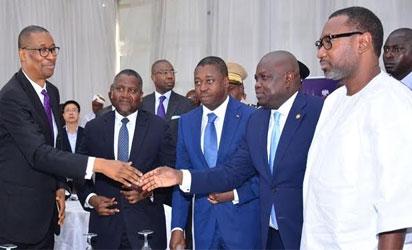
Lagos State Governor, Akinwunmi Ambode (2nd right), in a handshake with Minister of Trade, Investment & Industry, Mr. Okechukwu Enelamah (left) during the visit of the Togolese President to the Dangote Refinery at the Lekki Free Trade Zone, Lekki, Lagos, on Tuesday, August 2, 2016. With them are President of Togo, Mr. Faure Gnassingbe (middle); President, Dangote Group, Alhaji Aliko Dangote (2nd left) and Chairman, Zenon Petroleum & Gas Limited, Mr. Femi Otedola
By Emma Ujah, Abuja Bureau Chief
Less than 14 of the nation’s 34 Free Trade Zones (FTZs) are operating, actively, the Managing Director (MD) of the Nigeria Export Processing Zones Authority (NEPZA), Rt. Hon. Emmanuel Jime, disclosed at the weekend.


Osinbajo in Garki, Abuja market, interacting with traders
He told journalists in Abuja, that lack of infrastructure, especially electricity power supply, good roads and water, among others had made the FTZs unattractive to investors and that immediate steps must be taken to address the challenge.
“As at last count, we had about 34 Free Trade Zones (FTZs) but the truth is that less than 14 of the FTZs are actually operating actively. The idea of a FTZ is an environment where business can be done at less cost.
“For you to be able to operate your business at less cost means that there would be certain things in the FTZs that you will not find elsewhere. We are talking of infrastructure. There has to be power in the FTZs 24/7, otherwise it is not a FTZ. You must have water running, roads and everything a company needs for it to run at less cost.
“You have got to put those incentives in place in a way that the businessman who has to take an investment decision can see that Nigeria is the preferred destination for his investment. Don’t forget that we are in a competitive environment,” he said.
The MD lamented that the high profile TINAPA in Calabar has become a stain on the nation’s capacity to do things right.
He noted the challenge of investors moving to other neighbouring countries on the West Coast and urged that both state actors and private sector operators must synergise to raise investor confidence in the Nigerian economy.
He said, “Today, most foreign investors coming to Africa, the first place they think of is Ghana. That should be a critical concern for us. I hear some people say ‘Nigeria has a big market.’ Oh yes, but we should recognize that there have been partnership agreements and platforms that enable a businessman to set up his factory in Accra and be able to access the Nigerian market. He can use the ECOWAS platform. So that argument, quite frankly is defective and we must be honest with ourselves.
“This is what I think we must engage ourselves with at the policy level, that without putting our house in order, the likelihood that we will be able to attract foreign investors is very slim.”
PPP
Rt. Hon. Jime commended President Buhari for increasing the budgetary allocation to NEPZA from about N2 billion to N50 billion in the 2017 budget which has been sustained in the proposed 2018 budget to enable the organization provide massive infrastructure at the FTZs.
He said however, that budgetary provisions would never be sufficient to make the FTzs as attractive to businesses as they should be and that as such a Public-Private Partnership (PPP) model has been adopted to fast-track the development of facilities in the zones.
He said, “The model that we have chosen in Nigeria is PPP because it is not likely that we can achieve massive infrastructure development from budget line provisions due to paucity of funds. Consequently, we are working with development partners to get funding through international funding mechanisms.
GE and Genesis to provide electricity in Calabar, Kano FTZs
“We have a partnership right now with GE. GE is located now in Calabar and the partnership is a massive boost to what Calabar FTZ is going to turn into. We have already discussed power with GE in conjunction with Genesis. The idea is for us to provide our own sources of power. Not in the way it used to be done where everything you produce goes into the National Grid.
“We believe that our partnership with GE and Genesis will produce sufficient power supply for Calabar and Kano FTZs and any businessman that invests in any of the two would be glad that there is uninterrupted power supply and that power supply will no longer be a problem.”
Disclaimer
Comments expressed here do not reflect the opinions of Vanguard newspapers or any employee thereof.