
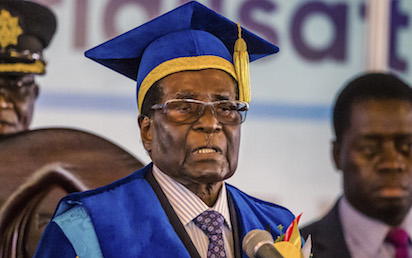
Zimbabwe’s President Robert Mugabe delivers a speech during a graduation ceremony at the Zimbabwe Open University in Harare, where he presides as the Chancellor on November 17 2017. Zimbabwean President Robert Mugabe attended a university graduation ceremony today, making a defiant first public appearance since the military takeover that appeared to signal the end of his 37-year reign. / AFP PHOTO / –
By Awa Kalu SAN
The world woke up in the early hours of Wednesday,15, November, 2017, to learn that the long standing Zimbabwean Head of State and Commander in Chief of its Armed Forces had been placed under house arrest. The events of that day also culminated in the arrest of key officials of President Robert Mugabe’s government.
This development gave rise to nothing but speculations, more especially hints of a coup d’état.
The Press release by the High Command of the Zimbabwe Defense Forces was a denial that there has been a coup.
According to the earliest statement, the military stated: “We wish to assure the nation that his excellency, the President, and his family are safe and sound and their security is guaranteed. We are only targeting criminals around him who are committing crimes. As soon as we have accomplished our mission, we expect that the situation will return to normalcy…we have made it abundantly clear that this is not a military takeover of government.”
Guided by that statement, there are several questions, which call for answers. For instance, how did the military choose to target “criminals around him who are committing crimes?” Aside from targeting those criminals, when will the military accomplish their mission and at what stage can the public be assured that normalcy has returned? If anything, it is President Mugabe who should target criminals as Chief Executive or at least initiate the process for targeting identified criminals.
But in the Zimbabwe’s unsettled situation, he has had to be kept under house arrest in order to let the military do things that the President should be doing. We must hasten to ask the question, has there been a coup d’état in Zimbabwe?
The discerning reader, particularly lawyers, would immediately recognise that Zimbabwe has had a checkered history, having emerged from colonialism, found its way out of white minority rule, including the survival of Ian Smith’s Unilateral Declaration of Independence (UDI). In itself, UDI was recognised as a gentle revolution and thus a coup. As Professor Ben Nwabueze noted as far back as 1973 in his seminal work, Constitutionalism in the Emergent States, “The
German legal philosopher, Hans Kelsen, has made perhaps the best exposition of the nature and effect of a revolution, and it might be helpful at this point to look at what he has said.
He writes: ‘A revolution occurs whenever the legal order of a community is nullified and replaced by a new order in an illegitimate way, that is in a way not prescribed by the first order itself, from a juristic point of view, the decisive criterion of a revolution is that the order in force is overthrown and replaced by a new order in a way which the former had not itself anticipated.No jurist would maintain that even after a successful revolution, the old constitution and the laws based thereupon remain in force, on the ground that they have not been nullified in a manner anticipated by the old order itself. Every jurist will presume that the old order, to which no political reality any longer corresponds, has ceased to be valid.’
Along the lines established by Hans Kelsen, we need to acknowledge immediately that there are snippets from Zimbabwe’s Constitution of 2013 to show whether or not there are indeed hints of a revolution or a full blown one.
In the preamble to the said Constitution, the People of Zimbabwe affirm that they are united in their diversity by their common desire for freedom, justice and equality and their heroic resistance to colonialism, racism and all forms of domination and oppression. The Constitution points at “Exalting and extolling the brave men and women who sacrificed their lives during the national liberation struggles” and promises to honour “our forbears and compatriots who toiled for the progress of our country.”
The framers of the Constitution have reaffirmed the nation’s “commitment to upholding and defending fundamental human rights and freedoms” and similarly acknowledge the richness of the country’s natural resources.
In a forward-looking manner, Zimbabweans, through the Constitution, confirm that they are “determined to overcome all challenges and obstacles that impede our progress.” The preamble also confirms that Zimbabweans cherish freedom, equality, peace, justice, tolerance, prosperity and patriotism in search of new frontiers under a common destiny; “acknowledging the supremacy of the Almighty God in whose Hands our future lies.”
It is in the light of the foregoing that the good people of Zimbabwe have resolved “by the tenets of this Constitution to commit ourselves to build a united, just and prosperous nation, founded in values of transparency, equality, freedom, fairness, honesty, and the dignity of hard work” and upon “imploring the guidance and support of the Almighty God, hereby make this Constitution and commit ourselves to it as the fundamental law of our beloved land.”
Having declared the 2013 Constitution as the fundamental law of Zimbabwe, it follows irresistibly that no change can occur in the framework of government or legal order established by the Constitution, except in the manner ordained by the Constitution itself. For that reason, any person who has had a birds’ eye view of that Constitution would acknowledge as significant, the unilateral removal by President Mugabe, of his Vice-President, Emmerson Mnangagwa.
The Constitution makes provision for a President and two Vice-Presidents – a first Vice-President and a second Vice-President, and the Constitution clearly stipulates that the President and the Vice-Presidents “are directly elected jointly by registered voters throughout Zimbabwe.”
Furthermore, the term of office of the President or a Vice-President extends until- (a.) He/She resigns or is removed from office; or (b.) Following an election, he/she is declared to be re-elected or a new President is declared to be elected; and except as otherwise provided in this Constitution, their terms of office are five years and coterminous with the life of parliament.
Significantly, the Constitution provides for the possibility of resignation by the President and similar provisions are made for the resignation of a Vice-President. Furthermore, the Constitution stipulates conditions for the removal of the President or a Vice-President and it is by a joint resolution passed by at least one-half of the total membership of the Senate and the National Assembly who may resolve that the question, whether or not a President or a Vice-President should be removed from office for –
(a.) serious misconduct;
(b.)failure to obey, uphold or defend this Constitution; (c.) willful violation of this Constitution; or (d.) inability to perform the functions of the office because of physical or mental incapacity, should be investigated.
The Constitution further directs that upon the passing of such a resolution, the Committee on standing rules and orders must appoint a joint committee of the Senate and the National Assembly, consisting of nine (9)
members, reflecting the political composition of parliaments, to investigate the removal from office of the President or Vice-President, as the case may be. If the joint committee so appointed recommends the removal from office of the President or Vice-President and the Senate and the National Assembly, by joint resolution passed by at least two-thirds of their total membership, resolve that the President or Vice-President, as the case may be, should be removed from office; the President or Vice-President, thereupon ceases to hold office.
What seems obvious at this stage is that there are ingredients of a revolution in the unfolding events in Zimbabwe.
First, by removing the Vice- President unilaterally, the President acted unlawfully. In addition, by taking the President into custody (house arrest) and thus preventing him from executing the functions of his office, the military also acted unlawfully, in that two wrongs do not make a right. As events continue to unfold, it is acknowledged in the news that the ZANU-PF is examining options for the President to have a dignified exit from his exalted office and there are calls from the masses for the President to resign.
Accordingly, if the President eventually exercises the option of resigning, it would be clear that something fundamental has happened in Zimbabwe.
The Zimbabwe situation is in a state of flux, in that what seemed obvious in the beginning no longer seems that obvious, and it has been pretty difficult to track the fluctuating fortunes of the military on one hand, and President Mugabe on the other hand. However, what seems clear at this time is that a deadline was set by the ZANU-PF, the political party in power, for the President to resign; the deadline expired and the intransigent President refused to resign and consequently, his political party decided to exercise the option of removing him from office by impeachment. How long the impeachment process will last remains to be seen, and whether the President, who has had several political lives, would emerge unscathed also remains to be seen.
The Law reports bear testimony to several revolutions in different parts of Africa and indeed in the third world. As was noted by Chief Justice Muhammad Munir of Pakistan a long time ago, “A revolution is generally associated with public tumult, mutiny, violence and bloodshed but from a juristic point of view, the method by which and the persons by whom a revolution is brought about, is wholly immaterial. The change may be attended by violence or it may be perfectly peaceful. It may take the form of a coup d’état by a political adventurer or it may be effected by persons already in public positions. Equally irrelevant in law is the motive for a revolution, in as much as a destruction of the constitutional structure may be prompted by a highly patriotic impulse or by the most sordid of end. For the purposes of the doctrine here explained, a change is in law, a revolution if it annuls the Constitution and the annulment is effective. If the attempt to break the Constitution fails, those who sponsor or organise it are judged by the existing Constitution as guilty of the crime of treason. But if the revolution is victorious in the sense that the persons assuming powers under the change can successfully require the inhabitants of the country to conform to the new regime, then the revolution itself becomes a law-creating fact because thereafter, its own legality is judged not by reference to the annulled Constitution, but by reference to its own success.”
Taking into account the events so far, including the international dimensions, it appears that the only conclusion that is open is that the trappings of dictatorship have led to a gentle revolution once more in Zimbabwe and thus, an attempted and half-hearted coup d’état which may lead to the exit from office of President Mugabe who has held dictatorial sway in that once prosperous but now emaciated economy. May the good times roll in Zimbabwe once again.
This piece was submitted before Mugabe resigned.
Disclaimer
Comments expressed here do not reflect the opinions of Vanguard newspapers or any employee thereof.