
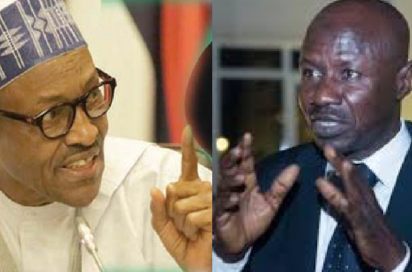
Buhari-Magu
By Innocent Anaba
That corruption is endemic in Nigeria is no longer news, be it in government, public institutions and even private concerns.

Buhari-Magu
This realisation has caused the Nigerian government to over time, set up institutions empowered to curb the menace.
The need to fight graft led to the setting up of both the Economic and Financial Crimes Commission, EFCC and the Independent Corrupt Practices and other related offences Commission, ICPC, in addition to other provisions in the Criminal Code, among others.
Despite these efforts and bold moves, the menace has proved to be a formidable foe, wreaking havoc in government, its agencies and private organisations.
In its determination to conscientise Nigerians on the need to join in this noble cause, a civil society organisation, Socio-Economic Rights and Accountability Project, SERAP, has held workshops and seminars to highlight the dangers of the trend and solicit the involvement of the citizenry to fight this scourge to a stand still, if not totally stopped.
One of such events tagged: Mobilizing the Citizenry to Demand Anti-Corruption Reforms and End Impunity and Grand Corruption in Nigeria, had Professor Akin Oyebode, as speaker.
Professor Oyebode noted that: “Forums by the various anti-corruption agencies need to be organised on a regular basis in conjunction with existing civil society organisations in order to galvanize efforts at sensitizing opinion moulders and agenda setters so that they can join the rank of forces fighting against corruption in the society. Religious bodies, churches and mosques should not be left out of the anti-corruption crusade.
“The leaders of religious organisations should be encouraged to be at the vanguard of the campaign against corrupt practices, more so as they exercise tremendous influence and impact on their various congregations.
“It is my opinion that the effort to contain corrupt practices should no longer be seen as just that of the government.
Of equal if not, in fact, more important role is that of society, which needs to be on the same page if the anti-corruption war is to succeed. Admittedly, no country has been able to wipe out corruption in its entirety but there are examples of countries where the vermin has been curtailed to its barest minimum. “Despite the difficulty entailed in defining corruption, there is a
consensus that it poses a challenge to societal well-being and needs to be combated in order to reduce its deleterious consequences on good governance.
The corrosive effect of corruption is debilitating, especially in this country where it has posed a threat to its very existence. “There seems to be a commitment within the international community to confront corrupt practices as witnessed by treaties forbiding the heinous practice.
The international resolve against corruption has impacted on countries domestically by enacting requisite legislation prohibiting corrupt practices.
“It is on record that Nigeria has a set of anti-corruption laws reflecting the will and intention of the government to battle the virus to the hilt. However, the efficacy of anti-corruption legislation coupled with judicial pronouncements and conviction and sentencing of corrupt elements would require the complement of mass action and commitment arising from general awareness and resolve to collaborate with on-going efforts. Inevitably, government action in this regard must be undertaken for the anti-corruption struggle to bear fruit.”
Speaking at the same event on “Ending the Culture of Impunity, Corruption, and Official Graft: The Role of the Citizens,” OkoiObono-Obla, SA to the President on
Prosecution And Chairman Special Presidential Investigation Panel on Recovery of Public Property, said “Even as the administration of President Buhari is inclined to fighting corruption,citizens have not complimented the efforts even though results are coming in trickles.
Disclaimer
Comments expressed here do not reflect the opinions of Vanguard newspapers or any employee thereof.