
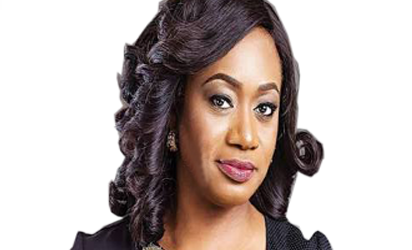
Aishah Ahmad
By Josephine Agbonkhese& Chris Onuoha
THE appointment of 40-year-old Aishah Ahmad recently as a Deputy Governor of the Central Bank of Nigeria, CBN, was greeted with excitement amongst young Nigerians and women who were glad another woman is being given a place in the apex bank’s top echelon at her relatively young age.
Quota system: Her appointment was expected to fill the void created by the exit of Dr Sarah Alade who was Deputy Governor in charge of Economic Policy and who retired from the CBN in March 2017. But while her appointment might be seen as an effort by the apex bank towards ensuring and sustaining quota system for women in the nation’s apex bank, the choice of Ahmad instantly drew heavy criticism, with some describing her as unqualified on the grounds of her gross lack of public sector experience and her not being a trained economist; the appointment was, therefore, dubbed political. Ahmad actually hails from the North-Central, the same geopolitical zone as Dr. Alade, who had served two terms as deputy governor; thus her appointment was touted as a straight replacement for Dr. Alade.
Round peg in square hole?
While development experts like Jide Akintunde, Director, Nigeria Development and Finance Forum, see nothing wrong about it being political in respect to federal character principles, they, however, have a problem with the different academic background as Ahmad is a graduate of Accounting with postgraduate degrees in Business Administration and Finance & Management.

Aishah Ahmad
“Dr. Alade was deputy governor in charge of economic policy. She has her first degree in economics and has a doctorate. Therefore, in replacing her, there were supposed to be two considerations. One, geopolitical zone. And, two, the job function. But it appears only the geopolitical consideration was made for her appointment. Appointment of women or young Nigerians to senior public positions need not mismatch qualification and experience with position and function.
Affirmative action for women
In fact, another young Nigerian or woman that fails to inspire in a public position is an argument against inclusivity. Advisedly, a young Nigerian intellectual (with a degree in economics) as CBN deputy governor might help. Or, is she (Ahmad) going to head the Economic Policy Directorate of the CBN with no degree in economics?”
Such rhetoric, as thrown by Akintunde, has capacity to make anyone think the much touted affirmative action for women, which is already being implemented in the form of ‘Quota System’ in some countries, is a strategy for getting women into position, regardless of qualification and competence. However, according to affirmative action expert, Mrs Oby Nwankwo, Coordinator, Affirmative Action Initiative for Women, NCAA, affirmative action is not a cover for any woman’s incompetence.
She said: “Affirmative action requires state parties to put in positive measures that will help close the gap which has been created by past marginalisation and discrimination of women. As you know, in the past, women were socialised to see themselves as people who were supposed to be seen and not heard. We all grew up with that mentality, but as time went on, we found out men could not cope, even within the home, talk more the workplace. In the past, they would ask their wives to stay at home and take care of children, but the economic situation has made them realise they need two incomes to be able to sustain their families. The same things have changed in governance! You find out that men alone cannot keep the system going and development is becoming slow!
The United Nations observed years ago that development was slow because women were being excluded from the entire process. Now that women have been brought on board, because of past marginalisation, they find it difficult to compete favourably with men, especially in terms of attaining high-ranking positions; since the men have always been there. This is why special provisions have to be put in place for them temporarily, to close that gender gap. Note the word ‘temporarily’ because once that gap is closed, affirmative action could be withdrawn. We’re not asking to be spoon-fed or given what we do not merit as women. Attainment of positions still has to be by merit and competence, the truth is, we have plenty of competent women already.” Recall that a couple of months ago, the Nigerian Senate, in a constitution amendment session, had officially rejected allowing a 35 per cent affirmative action for women both at federal and state levels.
Meanwhile, across Africa, several countries, including Rwanda, South Africa, Uganda, Mozambique and Senegal, have long adopted the use of quota system for improved women’s participation in leadership – the most notable of them being Rwanda, with the highest number of women in national parliament. As far back as 2003, Rwanda had 48.8% of women as members of the Chamber of Deputies with 39 out of 80. In the Upper House, women constituted 30 per cent with 6 women out of 20 seats. As of 2013, the Rwandan parliamentary election ushered in a record-breaking 64% seats won by female candidates.
In South Africa, the quota system imposed increased women participation from 30 per cent to 33 per cent in the African National Congress, ANC, party. Same with European countries like Finland, Sweden and Iceland (all in the Scandinavia), Bolivia, Seychelles, Ecuador, to mention but few.
On the economy: The impact of sustained gender inclusiveness on the economies and governments of these countries have also been more than resounding.
A developing nation’s example: Rwanda for example, has come a long way 23 years after the 1994 genocide that left its economy in tatters. Currently, Rwandans are generally living healthier and wealthier lives and poverty has also fallen rapidly even when the nation’s economy is largely agric-dependent. Famous for being one of the fastest growing economies in Central Africa, Rwanda notched up GDP growth of around eight per cent per year between 2001 and 2014. The nation is also successfully diversifying into construction, services and manufacturing while sticking passionately to agriculture; and according to the International Monetary Fund, IMF, these four ventures drove the Rwandan economy in 2015. The country was able to reduce the percentage of people living below the poverty line from 57 per cent in 2005 to 45 per cent in 2010. Life expectancy, literacy, primary school enrolment and spending on healthcare have all also improved while the country continues to make sterling strides in gender equality.
A developed nation’s example: Also, the impact of a bridged gender gap on European countries like Sweden has also been enormous. For instance, the World Economic Forum publishes a Global Competitiveness Index every year, and this year, it put Sweden in sixth place. “Growth has been robust, at 3.7 per cent in 2016, and the country has managed to significantly decrease its deficit in 2015, jumping 30 places to 22nd on this indicator.
“The labour market functions reasonably well and Sweden has a high employment rate, with a high level of women’s participation in the workforce,” it said of Sweden. The country was also placed 4th on the World Economic Forum’s Global Gender Gap Index 2016, having closed more than 81 per cent of its overall gender gap. It has recently seen an increase in female legislators, senior officials and managers, and has reached parity in the number of women in ministerial positions.
Corruption index: Remarkably, Sweden has a low level of corruption and ranks fourth in Transparency International’s latest Corruption Perceptions Index, which measures the perceived levels of public sector corruption in 186 countries. More importantly, Sweden is notably highly innovative, with an innovation performance well above that of the European Union average. In fact, the European Commission’s European Innovation Scoreboard 2016 placed the country in top place, alongside Finland.
Degree in economics inconsequential— Public Administration expert
Back to quota system in the CBN and the Presidency’s heavily criticised choice of Ahmad which many see as a misguided gender bias, Mrs. Toyosi Akerele-Ogunsiji, member, Women in Business, Management & Public Life, WIMBIZ, and President of the Rise Group who recently bagged a certificate in Public Administration from Harvard University’s John F. Kennedy School of Government, said more women like Ahmad were needed to transform Nigeria’s economy.
Reacting to claims that she (Ahmad) holds no degree in economics, Akerele-Ogunsiji queried, saying: “How does that matter? If somebody studied economics 20 years ago in a Nigerian university, do you think that’s the knowledge he or she will use to make policies for the CBN in 2017? The Head of the Bank of England studied English Literature.”
She went on: “We are a country that focuses on very frivolous issues. I know Aishah Ahmad, not just on a personal note but as a mentor and as a woman that I look up to. There is no reason why she doesn’t qualify for that position. You cannot say because somebody did not study economics then the person does not understand economic policies. We live in a global world where what one studied 20 years ago when Aisha left school and what one practices over that 20-year period, is immaterial and irrelevant to what one is going to be.
What’s economic policy?
“What is economic policy in the first place? Is it not being able to analyse, understand and make decisions on issues that affect the economy in a way that intertwines with policies that can drive the country forward?
Economic policy
THE appointment of 40-year-old Aishah Ahmad recently as a Deputy Governor of the Central Bank of Nigeria, CBN, was greeted with excitement amongst young Nigerians and women who were glad another woman is being given a place in the apex bank’s top echelon at her relatively young age.
Quota system: Her appointment was expected to fill the void created by the exit of Dr Sarah Alade who was Deputy Governor in charge of Economic Policy and who retired from the CBN in March 2017. But while her appointment might be seen as an effort by the apex bank towards ensuring and sustaining quota system for women in the nation’s apex bank, the choice of Ahmad instantly drew heavy criticism, with some describing her as unqualified on the grounds of her gross lack of public sector experience and her not being a trained economist; the appointment was, therefore, dubbed political. Ahmad actually hails from the North-Central, the same geopolitical zone as Dr. Alade, who had served two terms as deputy governor; thus her appointment was touted as a straight replacement for Dr. Alade.
Round peg in square hole?
While development experts like Jide Akintunde, Director, Nigeria Development and Finance Forum, see nothing wrong about it being political in respect to federal character principles, they, however, have a problem with the different academic background as Ahmad is a graduate of Accounting with postgraduate degrees in Business Administration and Finance & Management.
“Dr. Alade was deputy governor in charge of economic policy. She has her first degree in economics and has a doctorate. Therefore, in replacing her, there were supposed to be two considerations. One, geopolitical zone. And, two, the job function. But it appears only the geopolitical consideration was made for her appointment. Appointment of women or young Nigerians to senior public positions need not mismatch qualification and experience with position and function.
Affirmative action for women
In fact, another young Nigerian or woman that fails to inspire in a public position is an argument against inclusivity. Advisedly, a young Nigerian intellectual (with a degree in economics) as CBN deputy governor might help. Or, is she (Ahmad) going to head the Economic Policy Directorate of the CBN with no degree in economics?”
Such rhetoric, as thrown by Akintunde, has capacity to make anyone think the much touted affirmative action for women, which is already being implemented in the form of ‘Quota System’ in some countries, is a strategy for getting women into position, regardless of qualification and competence. However, according to affirmative action expert, Mrs Oby Nwankwo, Coordinator, Affirmative Action Initiative for Women, NCAA, affirmative action is not a cover for any woman’s incompetence.
She said: “Affirmative action requires state parties to put in positive measures that will help close the gap which has been created by past marginalisation and discrimination of women. As you know, in the past, women were socialised to see themselves as people who were supposed to be seen and not heard. We all grew up with that mentality, but as time went on, we found out men could not cope, even within the home, talk more the workplace. In the past, they would ask their wives to stay at home and take care of children, but the economic situation has made them realise they need two incomes to be able to sustain their families. The same things have changed in governance! You find out that men alone cannot keep the system going and development is becoming slow!
The United Nations observed years ago that development was slow because women were being excluded from the entire process. Now that women have been brought on board, because of past marginalisation, they find it difficult to compete favourably with men, especially in terms of attaining high-ranking positions; since the men have always been there. This is why special provisions have to be put in place for them temporarily, to close that gender gap. Note the word ‘temporarily’ because once that gap is closed, affirmative action could be withdrawn. We’re not asking to be spoon-fed or given what we do not merit as women. Attainment of positions still has to be by merit and competence, the truth is, we have plenty of competent women already.” Recall that a couple of months ago, the Nigerian Senate, in a constitution amendment session, had officially rejected allowing a 35 per cent affirmative action for women both at federal and state levels.
Meanwhile, across Africa, several countries, including Rwanda, South Africa, Uganda, Mozambique and Senegal, have long adopted the use of quota system for improved women’s participation in leadership – the most notable of them being Rwanda, with the highest number of women in national parliament. As far back as 2003, Rwanda had 48.8% of women as members of the Chamber of Deputies with 39 out of 80. In the Upper House, women constituted 30 per cent with 6 women out of 20 seats. As of 2013, the Rwandan parliamentary election ushered in a record-breaking 64% seats won by female candidates.
In South Africa, the quota system imposed increased women participation from 30 per cent to 33 per cent in the African National Congress, ANC, party. Same with European countries like Finland, Sweden and Iceland (all in the Scandinavia), Bolivia, Seychelles, Ecuador, to mention but few.
On the economy: The impact of sustained gender inclusiveness on the economies and governments of these countries have also been more than resounding.
A developing nation’s example: Rwanda for example, has come a long way 23 years after the 1994 genocide that left its economy in tatters. Currently, Rwandans are generally living healthier and wealthier lives and poverty has also fallen rapidly even when the nation’s economy is largely agric-dependent. Famous for being one of the fastest growing economies in Central Africa, Rwanda notched up GDP growth of around eight per cent per year between 2001 and 2014. The nation is also successfully diversifying into construction, services and manufacturing while sticking passionately to agriculture; and according to the International Monetary Fund, IMF, these four ventures drove the Rwandan economy in 2015. The country was able to reduce the percentage of people living below the poverty line from 57 per cent in 2005 to 45 per cent in 2010. Life expectancy, literacy, primary school enrolment and spending on healthcare have all also improved while the country continues to make sterling strides in gender equality.
A developed nation’s example: Also, the impact of a bridged gender gap on European countries like Sweden has also been enormous. For instance, the World Economic Forum publishes a Global Competitiveness Index every year, and this year, it put Sweden in sixth place. “Growth has been robust, at 3.7 per cent in 2016, and the country has managed to significantly decrease its deficit in 2015, jumping 30 places to 22nd on this indicator.
“The labour market functions reasonably well and Sweden has a high employment rate, with a high level of women’s participation in the workforce,” it said of Sweden. The country was also placed 4th on the World Economic Forum’s Global Gender Gap Index 2016, having closed more than 81 per cent of its overall gender gap. It has recently seen an increase in female legislators, senior officials and managers, and has reached parity in the number of women in ministerial positions.
Corruption index: Remarkably, Sweden has a low level of corruption and ranks fourth in Transparency International’s latest Corruption Perceptions Index, which measures the perceived levels of public sector corruption in 186 countries. More importantly, Sweden is notably highly innovative, with an innovation performance well above that of the European Union average. In fact, the European Commission’s European Innovation Scoreboard 2016 placed the country in top place, alongside Finland.
Degree in economics inconsequential— Public Administration expert
Back to quota system in the CBN and the Presidency’s heavily criticised choice of Ahmad which many see as a misguided gender bias, Mrs. Toyosi Akerele-Ogunsiji, member, Women in Business, Management & Public Life, WIMBIZ, and President of the Rise Group who recently bagged a certificate in Public Administration from Harvard University’s John F. Kennedy School of Government, said more women like Ahmad were needed to transform Nigeria’s economy.
Reacting to claims that she (Ahmad) holds no degree in economics, Akerele-Ogunsiji queried, saying: “How does that matter? If somebody studied economics 20 years ago in a Nigerian university, do you think that’s the knowledge he or she will use to make policies for the CBN in 2017? The Head of the Bank of England studied English Literature.”
She went on: “We are a country that focuses on very frivolous issues. I know Aishah Ahmad, not just on a personal note but as a mentor and as a woman that I look up to. There is no reason why she doesn’t qualify for that position. You cannot say because somebody did not study economics then the person does not understand economic policies. We live in a global world where what one studied 20 years ago when Aisha left school and what one practices over that 20-year period, is immaterial and irrelevant to what one is going to be.
What’s economic policy?
“What is economic policy in the first place? Is it not being able to analyse, understand and make decisions on issues that affect the economy in a way that intertwines with policies that can drive the country forward?
Economic policy
What makes you think that the economics of 20 years ago, that she would have learned in her undergraduate days, is the knowledge she requires to turn around the CBN’s economic policy for Nigeria today? There is no country that uses yesterday’s knowledge to face today’s challenges like Nigeria. We should move on to other things. “Africa has 54 countries and half of them have presidents over 70 years old. So, it’s like saying we need to conform to the precedents. The precedents we’ve been following in Nigeria, how beneficial have they been to the development of our country?”
Public sector experience: To claims that Ahmad also has no public sector experience at all, Akerele-Ogunsiji again said: “In Nigeria, working in the public sector only pollutes you and gives you a stronger capacity to be corrupt and ineffective. Those are the essential elements and characteristics of the Nigerian public sector. I think that Ahmad coming from the private sector; a very structured one at that, where she is given to accountability, excellence, high levels of performance and all, has an upper hand.
They are the kinds of features that the public sector of Nigeria still needs to imbibe. I think we overrate this public sector experience. The Aisha Ahmad that I know is competent and will do the womenfolk and Nigeria proud in that position.”
THE appointment of 40-year-old Aishah Ahmad recently as a Deputy Governor of the Central Bank of Nigeria, CBN, was greeted with excitement amongst young Nigerians and women who were glad another woman is being given a place in the apex bank’s top echelon at her relatively young age.
Quota system: Her appointment was expected to fill the void created by the exit of Dr Sarah Alade who was Deputy Governor in charge of Economic Policy and who retired from the CBN in March 2017. But while her appointment might be seen as an effort by the apex bank towards ensuring and sustaining quota system for women in the nation’s apex bank, the choice of Ahmad instantly drew heavy criticism, with some describing her as unqualified on the grounds of her gross lack of public sector experience and her not being a trained economist; the appointment was, therefore, dubbed political. Ahmad actually hails from the North-Central, the same geopolitical zone as Dr. Alade, who had served two terms as deputy governor; thus her appointment was touted as a straight replacement for Dr. Alade.
Round peg in square hole?
While development experts like Jide Akintunde, Director, Nigeria Development and Finance Forum, see nothing wrong about it being political in respect to federal character principles, they, however, have a problem with the different academic background as Ahmad is a graduate of Accounting with postgraduate degrees in Business Administration and Finance & Management.
“Dr. Alade was deputy governor in charge of economic policy. She has her first degree in economics and has a doctorate. Therefore, in replacing her, there were supposed to be two considerations. One, geopolitical zone. And, two, the job function. But it appears only the geopolitical consideration was made for her appointment. Appointment of women or young Nigerians to senior public positions need not mismatch qualification and experience with position and function.
Affirmative action for women
In fact, another young Nigerian or woman that fails to inspire in a public position is an argument against inclusivity. Advisedly, a young Nigerian intellectual (with a degree in economics) as CBN deputy governor might help. Or, is she (Ahmad) going to head the Economic Policy Directorate of the CBN with no degree in economics?”
Such rhetoric, as thrown by Akintunde, has capacity to make anyone think the much touted affirmative action for women, which is already being implemented in the form of ‘Quota System’ in some countries, is a strategy for getting women into position, regardless of qualification and competence. However, according to affirmative action expert, Mrs Oby Nwankwo, Coordinator, Affirmative Action Initiative for Women, NCAA, affirmative action is not a cover for any woman’s incompetence.
She said: “Affirmative action requires state parties to put in positive measures that will help close the gap which has been created by past marginalisation and discrimination of women. As you know, in the past, women were socialised to see themselves as people who were supposed to be seen and not heard. We all grew up with that mentality, but as time went on, we found out men could not cope, even within the home, talk more the workplace. In the past, they would ask their wives to stay at home and take care of children, but the economic situation has made them realise they need two incomes to be able to sustain their families. The same things have changed in governance! You find out that men alone cannot keep the system going and development is becoming slow!
The United Nations observed years ago that development was slow because women were being excluded from the entire process. Now that women have been brought on board, because of past marginalisation, they find it difficult to compete favourably with men, especially in terms of attaining high-ranking positions; since the men have always been there. This is why special provisions have to be put in place for them temporarily, to close that gender gap. Note the word ‘temporarily’ because once that gap is closed, affirmative action could be withdrawn. We’re not asking to be spoon-fed or given what we do not merit as women. Attainment of positions still has to be by merit and competence, the truth is, we have plenty of competent women already.” Recall that a couple of months ago, the Nigerian Senate, in a constitution amendment session, had officially rejected allowing a 35 per cent affirmative action for women both at federal and state levels.
Meanwhile, across Africa, several countries, including Rwanda, South Africa, Uganda, Mozambique and Senegal, have long adopted the use of quota system for improved women’s participation in leadership – the most notable of them being Rwanda, with the highest number of women in national parliament. As far back as 2003, Rwanda had 48.8% of women as members of the Chamber of Deputies with 39 out of 80. In the Upper House, women constituted 30 per cent with 6 women out of 20 seats. As of 2013, the Rwandan parliamentary election ushered in a record-breaking 64% seats won by female candidates.
In South Africa, the quota system imposed increased women participation from 30 per cent to 33 per cent in the African National Congress, ANC, party. Same with European countries like Finland, Sweden and Iceland (all in the Scandinavia), Bolivia, Seychelles, Ecuador, to mention but few.
On the economy: The impact of sustained gender inclusiveness on the economies and governments of these countries have also been more than resounding.
A developing nation’s example: Rwanda for example, has come a long way 23 years after the 1994 genocide that left its economy in tatters. Currently, Rwandans are generally living healthier and wealthier lives and poverty has also fallen rapidly even when the nation’s economy is largely agric-dependent. Famous for being one of the fastest growing economies in Central Africa, Rwanda notched up GDP growth of around eight per cent per year between 2001 and 2014. The nation is also successfully diversifying into construction, services and manufacturing while sticking passionately to agriculture; and according to the International Monetary Fund, IMF, these four ventures drove the Rwandan economy in 2015. The country was able to reduce the percentage of people living below the poverty line from 57 per cent in 2005 to 45 per cent in 2010. Life expectancy, literacy, primary school enrolment and spending on healthcare have all also improved while the country continues to make sterling strides in gender equality.
A developed nation’s example: Also, the impact of a bridged gender gap on European countries like Sweden has also been enormous. For instance, the World Economic Forum publishes a Global Competitiveness Index every year, and this year, it put Sweden in sixth place. “Growth has been robust, at 3.7 per cent in 2016, and the country has managed to significantly decrease its deficit in 2015, jumping 30 places to 22nd on this indicator.
“The labour market functions reasonably well and Sweden has a high employment rate, with a high level of women’s participation in the workforce,” it said of Sweden. The country was also placed 4th on the World Economic Forum’s Global Gender Gap Index 2016, having closed more than 81 per cent of its overall gender gap. It has recently seen an increase in female legislators, senior officials and managers, and has reached parity in the number of women in ministerial positions.
Corruption index: Remarkably, Sweden has a low level of corruption and ranks fourth in Transparency International’s latest Corruption Perceptions Index, which measures the perceived levels of public sector corruption in 186 countries. More importantly, Sweden is notably highly innovative, with an innovation performance well above that of the European Union average. In fact, the European Commission’s European Innovation Scoreboard 2016 placed the country in top place, alongside Finland.
Degree in economics inconsequential— Public Administration expert
Back to quota system in the CBN and the Presidency’s heavily criticised choice of Ahmad which many see as a misguided gender bias, Mrs. Toyosi Akerele-Ogunsiji, member, Women in Business, Management & Public Life, WIMBIZ, and President of the Rise Group who recently bagged a certificate in Public Administration from Harvard University’s John F. Kennedy School of Government, said more women like Ahmad were needed to transform Nigeria’s economy.
Reacting to claims that she (Ahmad) holds no degree in economics, Akerele-Ogunsiji queried, saying: “How does that matter? If somebody studied economics 20 years ago in a Nigerian university, do you think that’s the knowledge he or she will use to make policies for the CBN in 2017? The Head of the Bank of England studied English Literature.”
She went on: “We are a country that focuses on very frivolous issues. I know Aishah Ahmad, not just on a personal note but as a mentor and as a woman that I look up to. There is no reason why she doesn’t qualify for that position. You cannot say because somebody did not study economics then the person does not understand economic policies. We live in a global world where what one studied 20 years ago when Aisha left school and what one practices over that 20-year period, is immaterial and irrelevant to what one is going to be.
What’s economic policy?
“What is economic policy in the first place? Is it not being able to analyse, understand and make decisions on issues that affect the economy in a way that intertwines with policies that can drive the country forward?
Economic policy
What makes you think that the economics of 20 years ago, that she would have learned in her undergraduate days, is the knowledge she requires to turn around the CBN’s economic policy for Nigeria today? There is no country that uses yesterday’s knowledge to face today’s challenges like Nigeria. We should move on to other things. “Africa has 54 countries and half of them have presidents over 70 years old. So, it’s like saying we need to conform to the precedents. The precedents we’ve been following in Nigeria, how beneficial have they been to the development of our country?”
Public sector experience: To claims that Ahmad also has no public sector experience at all, Akerele-Ogunsiji again said: “In Nigeria, working in the public sector only pollutes you and gives you a stronger capacity to be corrupt and ineffective. Those are the essential elements and characteristics of the Nigerian public sector. I think that Ahmad coming from the private sector; a very structured one at that, where she is given to accountability, excellence, high levels of performance and all, has an upper hand.
They are the kinds of features that the public sector of Nigeria still needs to imbibe. I think we overrate this public sector experience. The Aisha Ahmad that I know is competent and will do the womenfolk and Nigeria proud in that position.”
THE appointment of 40-year-old Aishah Ahmad recently as a Deputy Governor of the Central Bank of Nigeria, CBN, was greeted with excitement amongst young Nigerians and women who were glad another woman is being given a place in the apex bank’s top echelon at her relatively young age.
Quota system: Her appointment was expected to fill the void created by the exit of Dr Sarah Alade who was Deputy Governor in charge of Economic Policy and who retired from the CBN in March 2017. But while her appointment might be seen as an effort by the apex bank towards ensuring and sustaining quota system for women in the nation’s apex bank, the choice of Ahmad instantly drew heavy criticism, with some describing her as unqualified on the grounds of her gross lack of public sector experience and her not being a trained economist; the appointment was, therefore, dubbed political. Ahmad actually hails from the North-Central, the same geopolitical zone as Dr. Alade, who had served two terms as deputy governor; thus her appointment was touted as a straight replacement for Dr. Alade.
Round peg in square hole?
While development experts like Jide Akintunde, Director, Nigeria Development and Finance Forum, see nothing wrong about it being political in respect to federal character principles, they, however, have a problem with the different academic background as Ahmad is a graduate of Accounting with postgraduate degrees in Business Administration and Finance & Management.
“Dr. Alade was deputy governor in charge of economic policy. She has her first degree in economics and has a doctorate. Therefore, in replacing her, there were supposed to be two considerations. One, geopolitical zone. And, two, the job function. But it appears only the geopolitical consideration was made for her appointment. Appointment of women or young Nigerians to senior public positions need not mismatch qualification and experience with position and function.
Affirmative action for women
In fact, another young Nigerian or woman that fails to inspire in a public position is an argument against inclusivity. Advisedly, a young Nigerian intellectual (with a degree in economics) as CBN deputy governor might help. Or, is she (Ahmad) going to head the Economic Policy Directorate of the CBN with no degree in economics?”
Such rhetoric, as thrown by Akintunde, has capacity to make anyone think the much touted affirmative action for women, which is already being implemented in the form of ‘Quota System’ in some countries, is a strategy for getting women into position, regardless of qualification and competence. However, according to affirmative action expert, Mrs Oby Nwankwo, Coordinator, Affirmative Action Initiative for Women, NCAA, affirmative action is not a cover for any woman’s incompetence.
She said: “Affirmative action requires state parties to put in positive measures that will help close the gap which has been created by past marginalisation and discrimination of women. As you know, in the past, women were socialised to see themselves as people who were supposed to be seen and not heard. We all grew up with that mentality, but as time went on, we found out men could not cope, even within the home, talk more the workplace. In the past, they would ask their wives to stay at home and take care of children, but the economic situation has made them realise they need two incomes to be able to sustain their families. The same things have changed in governance! You find out that men alone cannot keep the system going and development is becoming slow!
The United Nations observed years ago that development was slow because women were being excluded from the entire process. Now that women have been brought on board, because of past marginalisation, they find it difficult to compete favourably with men, especially in terms of attaining high-ranking positions; since the men have always been there. This is why special provisions have to be put in place for them temporarily, to close that gender gap. Note the word ‘temporarily’ because once that gap is closed, affirmative action could be withdrawn. We’re not asking to be spoon-fed or given what we do not merit as women. Attainment of positions still has to be by merit and competence, the truth is, we have plenty of competent women already.” Recall that a couple of months ago, the Nigerian Senate, in a constitution amendment session, had officially rejected allowing a 35 per cent affirmative action for women both at federal and state levels.
Meanwhile, across Africa, several countries, including Rwanda, South Africa, Uganda, Mozambique and Senegal, have long adopted the use of quota system for improved women’s participation in leadership – the most notable of them being Rwanda, with the highest number of women in national parliament. As far back as 2003, Rwanda had 48.8% of women as members of the Chamber of Deputies with 39 out of 80. In the Upper House, women constituted 30 per cent with 6 women out of 20 seats. As of 2013, the Rwandan parliamentary election ushered in a record-breaking 64% seats won by female candidates.
In South Africa, the quota system imposed increased women participation from 30 per cent to 33 per cent in the African National Congress, ANC, party. Same with European countries like Finland, Sweden and Iceland (all in the Scandinavia), Bolivia, Seychelles, Ecuador, to mention but few.
On the economy: The impact of sustained gender inclusiveness on the economies and governments of these countries have also been more than resounding.
A developing nation’s example: Rwanda for example, has come a long way 23 years after the 1994 genocide that left its economy in tatters. Currently, Rwandans are generally living healthier and wealthier lives and poverty has also fallen rapidly even when the nation’s economy is largely agric-dependent. Famous for being one of the fastest growing economies in Central Africa, Rwanda notched up GDP growth of around eight per cent per year between 2001 and 2014. The nation is also successfully diversifying into construction, services and manufacturing while sticking passionately to agriculture; and according to the International Monetary Fund, IMF, these four ventures drove the Rwandan economy in 2015. The country was able to reduce the percentage of people living below the poverty line from 57 per cent in 2005 to 45 per cent in 2010. Life expectancy, literacy, primary school enrolment and spending on healthcare have all also improved while the country continues to make sterling strides in gender equality.
A developed nation’s example: Also, the impact of a bridged gender gap on European countries like Sweden has also been enormous. For instance, the World Economic Forum publishes a Global Competitiveness Index every year, and this year, it put Sweden in sixth place. “Growth has been robust, at 3.7 per cent in 2016, and the country has managed to significantly decrease its deficit in 2015, jumping 30 places to 22nd on this indicator.
“The labour market functions reasonably well and Sweden has a high employment rate, with a high level of women’s participation in the workforce,” it said of Sweden. The country was also placed 4th on the World Economic Forum’s Global Gender Gap Index 2016, having closed more than 81 per cent of its overall gender gap. It has recently seen an increase in female legislators, senior officials and managers, and has reached parity in the number of women in ministerial positions.
Corruption index: Remarkably, Sweden has a low level of corruption and ranks fourth in Transparency International’s latest Corruption Perceptions Index, which measures the perceived levels of public sector corruption in 186 countries. More importantly, Sweden is notably highly innovative, with an innovation performance well above that of the European Union average. In fact, the European Commission’s European Innovation Scoreboard 2016 placed the country in top place, alongside Finland.
Degree in economics inconsequential— Public Administration expert
Back to quota system in the CBN and the Presidency’s heavily criticised choice of Ahmad which many see as a misguided gender bias, Mrs. Toyosi Akerele-Ogunsiji, member, Women in Business, Management & Public Life, WIMBIZ, and President of the Rise Group who recently bagged a certificate in Public Administration from Harvard University’s John F. Kennedy School of Government, said more women like Ahmad were needed to transform Nigeria’s economy.
Reacting to claims that she (Ahmad) holds no degree in economics, Akerele-Ogunsiji queried, saying: “How does that matter? If somebody studied economics 20 years ago in a Nigerian university, do you think that’s the knowledge he or she will use to make policies for the CBN in 2017? The Head of the Bank of England studied English Literature.”
She went on: “We are a country that focuses on very frivolous issues. I know Aishah Ahmad, not just on a personal note but as a mentor and as a woman that I look up to. There is no reason why she doesn’t qualify for that position. You cannot say because somebody did not study economics then the person does not understand economic policies. We live in a global world where what one studied 20 years ago when Aisha left school and what one practices over that 20-year period, is immaterial and irrelevant to what one is going to be.
What’s economic policy?
“What is economic policy in the first place? Is it not being able to analyse, understand and make decisions on issues that affect the economy in a way that intertwines with policies that can drive the country forward?
Economic policy
What makes you think that the economics of 20 years ago, that she would have learned in her undergraduate days, is the knowledge she requires to turn around the CBN’s economic policy for Nigeria today? There is no country that uses yesterday’s knowledge to face today’s challenges like Nigeria. We should move on to other things. “Africa has 54 countries and half of them have presidents over 70 years old. So, it’s like saying we need to conform to the precedents. The precedents we’ve been following in Nigeria, how beneficial have they been to the development of our country?”
Public sector experience: To claims that Ahmad also has no public sector experience at all, Akerele-Ogunsiji again said: “In Nigeria, working in the public sector only pollutes you and gives you a stronger capacity to be corrupt and ineffective. Those are the essential elements and characteristics of the Nigerian public sector. I think that Ahmad coming from the private sector; a very structured one at that, where she is given to accountability, excellence, high levels of performance and all, has an upper hand.
They are the kinds of features that the public sector of Nigeria still needs to imbibe. I think we overrate this public sector experience. The Aisha Ahmad that I know is competent and will do the womenfolk and Nigeria proud in that position.”
THE appointment of 40-year-old Aishah Ahmad recently as a Deputy Governor of the Central Bank of Nigeria, CBN, was greeted with excitement amongst young Nigerians and women who were glad another woman is being given a place in the apex bank’s top echelon at her relatively young age.
Quota system: Her appointment was expected to fill the void created by the exit of Dr Sarah Alade who was Deputy Governor in charge of Economic Policy and who retired from the CBN in March 2017. But while her appointment might be seen as an effort by the apex bank towards ensuring and sustaining quota system for women in the nation’s apex bank, the choice of Ahmad instantly drew heavy criticism, with some describing her as unqualified on the grounds of her gross lack of public sector experience and her not being a trained economist; the appointment was, therefore, dubbed political. Ahmad actually hails from the North-Central, the same geopolitical zone as Dr. Alade, who had served two terms as deputy governor; thus her appointment was touted as a straight replacement for Dr. Alade.
Round peg in square hole?
While development experts like Jide Akintunde, Director, Nigeria Development and Finance Forum, see nothing wrong about it being political in respect to federal character principles, they, however, have a problem with the different academic background as Ahmad is a graduate of Accounting with postgraduate degrees in Business Administration and Finance & Management.
“Dr. Alade was deputy governor in charge of economic policy. She has her first degree in economics and has a doctorate. Therefore, in replacing her, there were supposed to be two considerations. One, geopolitical zone. And, two, the job function. But it appears only the geopolitical consideration was made for her appointment. Appointment of women or young Nigerians to senior public positions need not mismatch qualification and experience with position and function.
Affirmative action for women
In fact, another young Nigerian or woman that fails to inspire in a public position is an argument against inclusivity. Advisedly, a young Nigerian intellectual (with a degree in economics) as CBN deputy governor might help. Or, is she (Ahmad) going to head the Economic Policy Directorate of the CBN with no degree in economics?”
Such rhetoric, as thrown by Akintunde, has capacity to make anyone think the much touted affirmative action for women, which is already being implemented in the form of ‘Quota System’ in some countries, is a strategy for getting women into position, regardless of qualification and competence. However, according to affirmative action expert, Mrs Oby Nwankwo, Coordinator, Affirmative Action Initiative for Women, NCAA, affirmative action is not a cover for any woman’s incompetence.
She said: “Affirmative action requires state parties to put in positive measures that will help close the gap which has been created by past marginalisation and discrimination of women. As you know, in the past, women were socialised to see themselves as people who were supposed to be seen and not heard. We all grew up with that mentality, but as time went on, we found out men could not cope, even within the home, talk more the workplace. In the past, they would ask their wives to stay at home and take care of children, but the economic situation has made them realise they need two incomes to be able to sustain their families. The same things have changed in governance! You find out that men alone cannot keep the system going and development is becoming slow!
The United Nations observed years ago that development was slow because women were being excluded from the entire process. Now that women have been brought on board, because of past marginalisation, they find it difficult to compete favourably with men, especially in terms of attaining high-ranking positions; since the men have always been there. This is why special provisions have to be put in place for them temporarily, to close that gender gap. Note the word ‘temporarily’ because once that gap is closed, affirmative action could be withdrawn. We’re not asking to be spoon-fed or given what we do not merit as women. Attainment of positions still has to be by merit and competence, the truth is, we have plenty of competent women already.” Recall that a couple of months ago, the Nigerian Senate, in a constitution amendment session, had officially rejected allowing a 35 per cent affirmative action for women both at federal and state levels.
Meanwhile, across Africa, several countries, including Rwanda, South Africa, Uganda, Mozambique and Senegal, have long adopted the use of quota system for improved women’s participation in leadership – the most notable of them being Rwanda, with the highest number of women in national parliament. As far back as 2003, Rwanda had 48.8% of women as members of the Chamber of Deputies with 39 out of 80. In the Upper House, women constituted 30 per cent with 6 women out of 20 seats. As of 2013, the Rwandan parliamentary election ushered in a record-breaking 64% seats won by female candidates.
In South Africa, the quota system imposed increased women participation from 30 per cent to 33 per cent in the African National Congress, ANC, party. Same with European countries like Finland, Sweden and Iceland (all in the Scandinavia), Bolivia, Seychelles, Ecuador, to mention but few.
On the economy: The impact of sustained gender inclusiveness on the economies and governments of these countries have also been more than resounding.
A developing nation’s example: Rwanda for example, has come a long way 23 years after the 1994 genocide that left its economy in tatters. Currently, Rwandans are generally living healthier and wealthier lives and poverty has also fallen rapidly even when the nation’s economy is largely agric-dependent. Famous for being one of the fastest growing economies in Central Africa, Rwanda notched up GDP growth of around eight per cent per year between 2001 and 2014. The nation is also successfully diversifying into construction, services and manufacturing while sticking passionately to agriculture; and according to the International Monetary Fund, IMF, these four ventures drove the Rwandan economy in 2015. The country was able to reduce the percentage of people living below the poverty line from 57 per cent in 2005 to 45 per cent in 2010. Life expectancy, literacy, primary school enrolment and spending on healthcare have all also improved while the country continues to make sterling strides in gender equality.
A developed nation’s example: Also, the impact of a bridged gender gap on European countries like Sweden has also been enormous. For instance, the World Economic Forum publishes a Global Competitiveness Index every year, and this year, it put Sweden in sixth place. “Growth has been robust, at 3.7 per cent in 2016, and the country has managed to significantly decrease its deficit in 2015, jumping 30 places to 22nd on this indicator.
“The labour market functions reasonably well and Sweden has a high employment rate, with a high level of women’s participation in the workforce,” it said of Sweden. The country was also placed 4th on the World Economic Forum’s Global Gender Gap Index 2016, having closed more than 81 per cent of its overall gender gap. It has recently seen an increase in female legislators, senior officials and managers, and has reached parity in the number of women in ministerial positions.
Corruption index: Remarkably, Sweden has a low level of corruption and ranks fourth in Transparency International’s latest Corruption Perceptions Index, which measures the perceived levels of public sector corruption in 186 countries. More importantly, Sweden is notably highly innovative, with an innovation performance well above that of the European Union average. In fact, the European Commission’s European Innovation Scoreboard 2016 placed the country in top place, alongside Finland.
Degree in economics inconsequential— Public Administration expert
Back to quota system in the CBN and the Presidency’s heavily criticised choice of Ahmad which many see as a misguided gender bias, Mrs. Toyosi Akerele-Ogunsiji, member, Women in Business, Management & Public Life, WIMBIZ, and President of the Rise Group who recently bagged a certificate in Public Administration from Harvard University’s John F. Kennedy School of Government, said more women like Ahmad were needed to transform Nigeria’s economy.
Reacting to claims that she (Ahmad) holds no degree in economics, Akerele-Ogunsiji queried, saying: “How does that matter? If somebody studied economics 20 years ago in a Nigerian university, do you think that’s the knowledge he or she will use to make policies for the CBN in 2017? The Head of the Bank of England studied English Literature.”
She went on: “We are a country that focuses on very frivolous issues. I know Aishah Ahmad, not just on a personal note but as a mentor and as a woman that I look up to. There is no reason why she doesn’t qualify for that position. You cannot say because somebody did not study economics then the person does not understand economic policies. We live in a global world where what one studied 20 years ago when Aisha left school and what one practices over that 20-year period, is immaterial and irrelevant to what one is going to be.
What’s economic policy?
“What is economic policy in the first place? Is it not being able to analyse, understand and make decisions on issues that affect the economy in a way that intertwines with policies that can drive the country forward?
Economic policy
What makes you think that the economics of 20 years ago, that she would have learned in her undergraduate days, is the knowledge she requires to turn around the CBN’s economic policy for Nigeria today? There is no country that uses yesterday’s knowledge to face today’s challenges like Nigeria. We should move on to other things. “Africa has 54 countries and half of them have presidents over 70 years old. So, it’s like saying we need to conform to the precedents. The precedents we’ve been following in Nigeria, how beneficial have they been to the development of our country?”
Public sector experience: To claims that Ahmad also has no public sector experience at all, Akerele-Ogunsiji again said: “In Nigeria, working in the public sector only pollutes you and gives you a stronger capacity to be corrupt and ineffective. Those are the essential elements and characteristics of the Nigerian public sector. I think that Ahmad coming from the private sector; a very structured one at that, where she is given to accountability, excellence, high levels of performance and all, has an upper hand.
They are the kinds of features that the public sector of Nigeria still needs to imbibe. I think we overrate this public sector experience. The Aisha Ahmad that I know is competent and will do the womenfolk and Nigeria proud in that position.”
What makes you think that the economics of 20 years ago, that she would have learned in her undergraduate days, is the knowledge she requires to turn around the CBN’s economic policy for Nigeria today? There is no country that uses yesterday’s knowledge to face today’s challenges like Nigeria. We should move on to other things. “Africa has 54 countries and half of them have presidents over 70 years old. So, it’s like saying we need to conform to the precedents. The precedents we’ve been following in Nigeria, how beneficial have they been to the development of our country?”
Public sector experience: To claims that Ahmad also has no public sector experience at all, Akerele-Ogunsiji again said: “In Nigeria, working in the public sector only pollutes you and gives you a stronger capacity to be corrupt and ineffective. Those are the essential elements and characteristics of the Nigerian public sector. I think that Ahmad coming from the private sector; a very structured one at that, where she is given to accountability, excellence, high levels of performance and all, has an upper hand.
They are the kinds of features that the public sector of Nigeria still needs to imbibe. I think we overrate this public sector experience. The Aisha Ahmad that I know is competent and will do the womenfolk and Nigeria proud in that position.”
Disclaimer
Comments expressed here do not reflect the opinions of Vanguard newspapers or any employee thereof.