
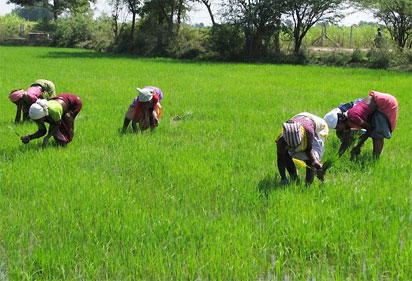
File: farmers
By Peter Duru
The President of Nigerian Association of Women In Agriculture, NAWIA, Mrs. Ngizan Chahul has appealed to the Nasawara state government to emulate its Benue state counterpart by commencing the formation of environmental friendly state agriculture policy document.

Kano govt. moves to recover N900m loans from rice farmers
Mrs. Chahul noted that the policy would pave the way for rapid private sector investment in processing agricultural products in order to promote localization of agro-markets.
Speaking at the occasion of the World Food Day Celebration, with the theme: Change the Future Migration: Invest in Food Security and Rural Development, held in Lafia the Nasarawa state capital, the NAWIA President said such a policy would also go a long away to boost support for small holder farmers in the state.
While commending the host and co-conveners of the celebration, the Young Men Christian Association (YMCA) for being in the driver’s seat for the occasion, Mrs Chahul stated that NAWlA was delighted to be collaborating in the process of making the celebration a success.
She added that, “as a constituent member of rural women, i will add to the theme thus: Invest in women.”
The NAWIA President recalled that “in March, 2017 we collaborated with Nasarawa State Ministry of Women Affairs, Association of Smallholder Agro-Producers in Nigeria (ASSAPIN), Mother and child Care Enhancement Foundation (McCEF) and Young Men Christian Association, YMCA, to hold the international women’s day celebration.
“In August, 2017, we also collaborated with ASSAPIN to hold a town hall meeting on food and climate justice in the efforts to amplify the voices of the smallholder farmers on the issues that affect their lives and livelihood, especially women who have the highest number in this occasion, and have been feeding Nigeria even before the independence.
“Hence, this year’s theme for world food day reflects the current socio-economic and environmental issues that affect the smallholder farmers most which includes; communal clashes, land rights and climate change.
“The issues as highlighted are beyond the physical ability of the smallholder farmers. therefore, there is need for the government to intervene in this issues which are policy based.
“On behalf of the smallholder farmers, I wish to call on the government of Nasarawa state to emulate the Benue state government by commencing the formation of environmental friendly state agriculture policy document to pave way for rapid private sector investment in processing in order to promote localization of agro-markets.
“Our organization is gender based, and women are our primary focus. The organization has been working in the area of livelihood support to smallholder farmers and advocacy for improved agriculture through increased private sector investment.
“And also in the advocacy for increased allocation of national and states budget in agriculture sector and most recently on states specific Agriculture policy formulations, all in the efforts to provide a favourable environment for livelihood activities of women and farmers in general.
“We therefore wish to appreciate the state actors here present and in a special way appreciate the support of Oxfam Nigeria, Voices for Food Security and Trust Africa for being the spine upon which this occasion is possible.”
On his part, Mr. Ango Adamu of the Young Men Christian Association who recalled the origin of the World Food Day Celebration said the event was celebrated every year around the world on October 16th. in honour of the date of the founding of the Food and Agriculture Organization, FAO, of the United Nations in 1945.
Adamu said “It was established by FAO’s Member Countries at the Organization’s 20th. General Conference in November 1979. The Hungarian Delegation, led by the former Hungarian Minister of Agriculture and Food Dr. Pál Romány, who played an active role at the 20th. Session of the FAO Conference, suggested the idea of celebrating the day worldwide.
“It has since been observed every year in more than 150 countries to show case the importance it is for everyone to join the fight against hunger and to make sure that we all have enough food to live healthy and active lives.
“It is on this premise that YMCA Mada Hills in collaboration with the Association of Small Scale Agro Producers in Nigeria ASSAPIN, National Association of Women in Agriculture, NAWIA, Middle Belt Small Scale Farmers Network MIBSSFANET, OGBONGE Women and other civil society organizations supported by Oxfam Nigeria agreed to work together to facilitate the celebration of today’s event in Nasarawa state.
“All over the world, the World Food Day event is aimed at drawing the attention of leaders of political and non-political organizations at all levels and at increasing press attention on topical issues around food supply and hunger.
“The theme for 2017 World Food Day is ‘Change the Future of Migration, Invest in Food Security and Rural Development’ while our Voices for Food Security (VFS) slogan in Nigeria is #UNITED4FOOD.
“We believe that adequate investment in agriculture and rural development will drastically reduce migration both internally and externally.
“Presently the YMCS Mada Hills is implementing the Village Savings and Loans Association VSLA in seven local government areas of Nasarawa state (Awe, Obi, Keana, Lafia, N/Eggon, Akwanga and Kokona.)
“We are supporting to build the capacity of small scale farmers to form groups, make savings and give out loans to support their agricultural investment.
“They are tremendously contributing to food security of the state and that is why we are joining the rest of the world to celebrate and recognize the huge contributions they are making to the state and Nigeria at large.
“There is no gain saying that the fight against poverty and hunger cannot be done by just one man or one organization, that is why we
are all united today to do it.”
Concluding Adamu noted that “Seventy percent of Nigeria’s poor live in the rural areas and derive their livelihood from small-scale agriculture therefore the need for transformation in food security can’t be more urgent.”
According to him, “small scale farmers need access to key inputs such as land, credit, technology and information/extension services.
“Therefore investment in agriculture is expected to be 11 Times more effective at reducing poverty in Africa than investment in other sectors.”
He noted that “despite Nigeria’s commitment to the Maputo Declaration’s benchmark of 10 percent investment in agriculture, on average Nigeria allocated 1.9 percent per year to agriculture during the 2010-2015 fiscal year, ending in a low of 0.9 percent.”
This he observed was not good enough if the country must meet its food needs.
Present at the occasion were representatives of Oxfam, ASSAPIN, representative of the wife of the Nasarawa state Governor, the Federal Ministry of Agriculture and Rural Development as well as the representatives of the Ministry of Women Affairs who all gave goodwill massages.
Disclaimer
Comments expressed here do not reflect the opinions of Vanguard newspapers or any employee thereof.