
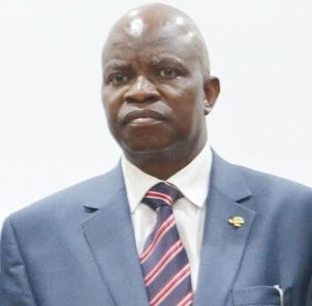
Prof Ajibola
By Dotun Ibiwoye
JUST like some successful Nigerians today, whose ascendency to the top were marked by harrowing experiences occasioned by the circumstances of their birth, Prof. Joseph Ajibola was not born into greatness. The President of the Chartered Institute of Bankers of Nigeria, CIBN, defied the deprivations of his background to achieve greatness. With experiences from his polygamous home and the lessons he learnt as a house boy, the Ekiti State-born Ajibola rose to the peak of his banking and academic careers. While others would have opted not to work again after retirement, he returned to the academia where he is currently the Dean, College of Postgraduate Studies, Caleb University. Certainly his story as a house boy, First Class Degree holder, Professor and Banking guru leaves inspirations in its trail.

Prof Ajibola
ON growing up, defining experiencesLife experiences have been that of struggle for survival from infancy to adulthood because of my peculiar background of growing up as a village boy and having to survive in a very tough polygamous setting. I am grateful to Almighty God for seeing me through primary school and secondary school. I went to a modern school and that was after some years of being a houseboy after primary school.
From modern school, I proceeded to a technical school in my home town Ekiti after which I moved to Catholic Technical College in Ile-Ife. Eventually, I was admitted into the university of Ife. All this while, I was leading the class and eventually came out with a first class degree in Economics from the University of Ife now Obafemi Awolowo University.
As a first class holder what inspired you to abandon the academia for the banking sector where you had a distinguished career?
My career has been a blessing. Hard work and being ethical in every journey along the line, helped me to rise from the lowest level of the ladder to the top of the various careers that I’ve succeeded in. In everything one does there is an element of ethics. It is not only in the banking sector or even in academia. Even in the civil service, there are ethics issues that come up from time to time. In the academia you hear people that compromise integrity because they may not have applied ethics.
I began my career at the University of Ife, Ile-Ife, as a Graduate Assistant/Assistant Lecturer 1985-1986. I later joined the services of Financial Institutions Training Centre (FITC) as a Lecturer/Training Officer in 1986. In 1989, I transferred my services to Nigerian-American Merchant Bank Limited as a Deputy Officer and rose to the position of a Senior Manager in 1996. In the same year I moved to First City Merchant Bank Limited (now First City Monument Bank Plc) where I held the post of an Assistant Vice President & Head of Credit until 1999.
I later joined the services of First Bank of Nigeria Plc as Principal Manager in 1999 and was made the assistant general manager in 2000 and deputy general manager in charge of commercial banking in 2002 before crossing over to Intercontinental Bank Plc in 2004.
Voluntary retirement
At Intercontinental (now Access Bank Plc), I held positions such as general manager and divisional head, 2004-2005; executive director and regional chief executive, 2005-2009 and managing director designate, Intercontinental Bank Plc East African Franchise, 2009. I retired voluntarily from this position in September 2009.
Your progression in the academia and banking to the point of retirement appears very smooth, was it really that smooth the way it seems?
Thank God I have not had any major instances where I encountered situations that left me with professional regrets. .Ordinarily I would have loved to remain in academia after getting into that career right from my NYSC year. Economics and pecuniary reasons prevented that from happening so I veered into banking. I thank God that I rose to the pinnacle in the banking industry. Again, upon reflection one could still say why did I join this or that bank at this or that point in time? But nothing significant in all the career decisions could be labeled as regrettable.
You have made a name in the academia, how did you get this far?
Being in the academia was a calling, not for money making. But it is always a thing of joy to belong to a group that moulds lives, generates and contributes to the body of knowledge. I believe I have the calling and it is good I am back to that primary constituency of mine. It is also a career one can pursue from the cradle unlike most other careers. These were my attractions to the academia and I thank God it is working out.
Considering your humble beginning and where you are today, what lessons do you think people, especially youths can draw from you?
It is for them to believe that nothing comes cheap and it doesn’t pay to cut corners. In everything one does there should be ethics in it. Not only in the bank where I rose to the top.
Even in academics and civil service, there are ethical issues. In the academics you hear people that compromise integrity through inducement, settlement and sexual harassment among others. It must also be shown to them that it is better to look at those who do what they talk and not those who just talk, organise talk shops and do the opposite.
The youths should know that diligence, dedication, commitment, integrity, righteousness are the ultimate. These are the things that can take anybody to the top. It is also important for them to know that the fear of God is the beginning of wisdom, so if they can combine all these virtues, then heaven is even the beginning not the end.
Some Nigerians have embraced crytocurrency as a way of making money and the CIBN sometime stated that cryptocurrency will have an impact on the traditional existing banking system. What advice do you have for those, who have embraced it?
Cryptocurrency is redefining and reshaping settlement system the world over. Visual currency would definitely reshape global economic order and will give the traditional mode of payment a good run. As a medium of exchange, it is capable of affecting the use of traditional instruments globally.However, it comes with its risks through cyber-crimes, and internet frauds among others. For it to become widely acceptable, the global environment must devise means of dealing with these inherent risks. These were the issues considered when CIBN organized a breakfast session on cryptocurrency some months back.
On Global Education Standard Board
The Global Education Standard Board was launched in Nigeria when we hosted the World Conference of Bankers in Lagos in April this year. The mandate of the board is to standardize banking education globally. The whole essence is to ensure that academic and professional curricula on banking are streamlined globally.
The benefit of this is to make banking professional and academic qualifications in different countries are universally recognized and accepted. CIBN has played a critical role in bringing this initiative to fruition.
On life style: What is putting pressure on the dollar is a function of demand and supply. Our demand is so heavy because we import virtually everything even goods that are not of primary benefit to us.
Primary benefit
Things that we can do away with, we import all of them. So our propensity to consume imported items is so high so that is why we are exposed. We are vulnerable because of our life styles, because of our orientation, because of our belief in imported items even though some of them may not be superior to what we can produce locally, then we don’t generate much apart from petro-dollar, we don’t have other sources of money making and we have not taken pragmatic steps to develop those other sources.
That is why every one of us is a contributor to the fall of the dollar. That is why we are more or less directly and indirectly contributors to the problem we have in the foreign exchange. I said that because what is putting pressure on the dollar is function of demand and supply. Our demand is so heavy because we import virtually everything even goods that are not of primary importance to us, things that are produced locally.
Things that we can do away with , we import all of them. So our propensity to consume imported items is so high and that exposes us. We are vulnerable because of our life styles.
Disclaimer
Comments expressed here do not reflect the opinions of Vanguard newspapers or any employee thereof.