
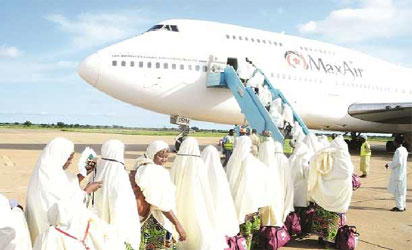
•Nigerian Pilgrims
By Muhammad Ajah
When I wrote on the high expectations over 2017 Hajj, I was just trying to prophesy from experience the nitty-gritty that has over the years controlled the fares paid by Nigerian pilgrims for their holy journeys to Makkah. May be it did not attract the attention of the authorities or the public because that was before the announcement of the 2017 Hajj fare by the National Hajj Commission of Nigeria (NAHCON) early June this year. It is interesting to note that Hajj management in Nigeria has been turned around and that going to Hajj has become as easy as any other international journeys, except for the stresses from the tedious movements to attain the spiritual upliftment while in the holy sites.
What matter much for the trip are health and cash. Everything, every service rendered to a pilgrim in Saudi is paid for by the pilgrim. All arrangements, including airlift of pilgrims, by every participating country in Hajj are subjected to the rules and regulations issued every year by the Saudi Government. And to passionately note is the fact that there is no other Kaa’ba or Masha’ir for Hajj that the one in the Kingdom of Saudi Arabia.
Concessionary exchange rate
I recalled that Hajj fares have been on the increase from the past years and that since the establishment of NAHCON the federal government has always given concessionary exchange rate to fiscal transactions for pilgrimages.


Hajj Pilgrims
For Hajj, its fare components are 98 percent transacted in dollar due to the fact that the activities and payments to service providers are outside the country. No one, including NAHCON, has control over dollar except the federal government.
Most of the service providers are Saudi-based. NAHCON can neither carry the Naira nor the Saudi Riyal from Nigeria to Saudi Arabia to pay the providers of accommodations, transportation, catering and health related services, among others. These are indispensible components of Hajj fares. For 2017 Hajj, the costs of some services in Saudi Arabia especially the transport within the holy sites and the new fire-proof tents in Mina and Arafah have increased by over 200 percent with the backing of Royal Decrees by the Saudi Government.
The facts to note are that the cost of major components of the 2017 Hajj fares is less than the 2016; they will be lower with lower concessionary exchange rates and definitely vary in accordance with airfares, accommodation and other charges by states.
Between 2009 and 2016, Hajj fares went up by over a hundred percent. Minimum 2009 Hajj fares (with US$750 was N470,737.38 for north and N477,558.88 for south. In 2016, with the concessionary rate of N197 to US$1, the minimum fares for north was N998,248.92 and N1,047,498.92 for south. In 2012, Hajj fares were based on concessionary exchange rate support of N145.
North paid N613,644.52 (minimum) and south N620,967.19. In 2013, pilgrims from the northern departure zones paid N636,496.52 (minimum), south N643,869.52. But the 2014 Hajj fares with exchange rate of N150 to one US$1 was N636,061.77 (minimum) for north and N639,636.77 for south.
The 2015 Hajj fare in dollar computation was US$4,721.93 which was equal to about N766,557.00 with exchange rate of N160 to US$1. In 2016, the total dollar component was US$5,077, in addition to US$750 BTA at N197 official exchange rate which was equal to N1,008,911. For 2017, the total dollar component is $4,839 with US$800 BTA at the official exchange rate of N305, making N1.511,223. With the addition of various local administrative charges by each state, Ondo state has the lowest fare of N1,485,095.07, while Oyo has the highest of N1,584,069.02.
It is to be noted that in an effort to curb extraordinary charges by individual state, NAHCON invited them to defend all additional charges. These charges and the differences in Makkah accommodation prices (as against for flat benchmark) are responsible for the differences in the fares from state to state. Where has NAHCON erred?
I want to share the Hajj fare analysis as posted by one Sani Baba Nasidi on a social media. The table showed the money paid by each Nigerian pilgrim who embarked on the holy trip from 1996 to the present. It showed:1996: N121,752.02, 1997:N146,318.60, 1998:N135,520.00, 1999:N131,319,75, 2000:N122,292.00, 2001:N187,322.38, 2002:N219,742.20, 2003:N248,819.36, 2004:N258,494.74, 2005:N263,338.49, 2006:N297,140.40, 2007:N352,826.40, 2008:N417,832.92, 2009:N472,736.38, 2010:N483,879.83, 2011:N521,749.75, 2012:N616,644.69, 2013:N639,496.52, 2014:N689,061.77, 2015:N723,476.57, 2016:N1,018,068.90 and 2017:N1,498,502.70. However, let us look critically at these components and how they affect the Hajj fares,
Air Fare: This is the money paid by each pilgrim for return air ticket of chartered, not scheduled, flights to Saudi. The best explanation to how the price was negotiated was given by the managing director of Medview Airlines, one of the leading airlines in Hajj operations for the long past years.
But for further clarity, it is axiomatic that the easy and modern transport system for especially international journeys is by air. No pilgrim can ever think of traveling to Hajj by any other means.
Disclaimer
Comments expressed here do not reflect the opinions of Vanguard newspapers or any employee thereof.