
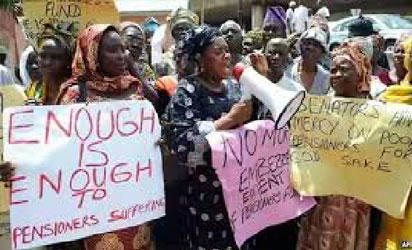
•A cross section of pensioners protesting unpaid benefits . Inset is Ivor Takor of Centre for Pension Right Advocay.
By Ivor Takor
MEDIA report on May 11, 2017 hinted of the move by the Senate to amend the Pension Reform Act, PRA 2014 to enable retirees withdraw up to 75 percent of their pension savings.
According to the report, Senator Aliyu Wamako (APC Sokoto), the sponsor of the Bill said “the Bill when enacted will provide succour to retirees in the delay and other difficulties they face in withdrawing their savings.”
The PRA 2014 came into effect on July 1, 2014, repealing PRA No. 2, 2004. Section 1 of the Act states the objectives of the Contributory Pension Scheme, CPS, established under the Act to be among others (a) ensures that every person who worked in either the public service of the federation, FCT or private sector receives his retirement benefits as and when due and (b) assists improvident individuals by ensuring that they save in order to cater for their livelihood during old age.

•A cross section of pensioners protesting unpaid benefits . Inset is Ivor Takor of Centre for Pension Right Advocay.
Conditions of employment
The Bill seeks to amend Section 7(1) of the Act as follows: (a) To exclude persons who retire before the age of 50 years in accordance with the terms and conditions of their employment from accessing their RSA balance in line with Section 7(1) of the PRA 2014. Our position is corroborated by the proposed amendment in Section 2(c) of the Bill.
This amendment seeks to ensure that persons who retire before the age of 50 years in accordance with the terms and conditions of their employment, Section 16 (2)(c) of PRA 2014, access the RSA in line with the mode stipulated for employees who disengage or are disengaged from employment before the age of 50 years and are unable to secure another employment within four months Section 16(5).
We note that such persons are only allowed to withdraw an amount of money not exceeding 25 percent of the total amount in the RSA Section 16(5). We further note that those who retire under Section 16(2)© have permanently left the service, while those who disengage or are disengaged under Section 16(5) are under frictional (temporal) unemployment and can still get another job and continue with the scheme.
We are of the opinion that this proposed amendment would be unfair on an employee who duly retires in accordance with the terms and conditions of his employment and should not be allowed.
(b) The Bill also seeks to amend Section 7 (1) of the PRA 2014 by inserting the words “of up to 75 percent” immediately after the words “a lump sum.” The import of the proposed amendment, in line with the foregoing, is to allow the following persons to, rather than withdraw a lump sum based on a computation that allows the balance in the RSA to be sufficient to procure a programmed withdrawal or annuity for life, can withdraw up to 75 percent as lump sum, irrespective of whether or not the balance would be sufficient to procure a programmed fund withdrawals or annuity for life:
(i) Employees who duly retire or attain the age of 50 years, whichever is later; (ii) Employees who retire before attaining the age of 50 years either on the advice of a suitably qualified physician or a properly constituted medical board certifying that the employee is no longer mentally or physically capable of carrying out the functions of his office; (iii) Employees who retire before attaining the age of 50 years due to total or permanent disability either of mind or body.
The promoters of the current amendment failed to note that the PRA 2014, established a CPS and not a Provident Fund Scheme. Section 7(1) and Section 2 of PRA 2014 attest to this. The ILO defines pension as old age protection, which covers if not all the population, at least a section of it, in the case of Nigeria, workers.
The difference between pension funds and provident funds is that members of pension funds are able to take out a small portion of their retirement benefits – typically one-third or one forth-in a lump up-front sum.
The remaining benefits are distributed in monthly payouts. On the other hand, members of provident funds can take out as much of their benefits as they would like in a lump sum.
The National Provident Fund (NPF) was established in Nigeria in 1961 for non-pensionable private sector employees. It was largely a saving scheme and was replaced by the National Social Insurance Trust Fund, NSITF, in 1993.
That the Senate is contemplating a back door re-introduction of a Provident Fund which was jettisoned 24 years ago through the proposed amendment is unthinkable and at best, retrogressive. In a country lacking minimum standards of social security for her senior citizens, such as medical care, sickness benefit and old age benefit as provided for in ILO Social Security (Minimum Standards) Convention, 1952 (No.102) one is at a loss as to what the Senate expects the life of retired workers would be, after collecting 75 percent of their retirement benefits as Lump Sum as being proposed in the amendment.
We are not unmindful of the fact that the proposed amendment may be popular with some workers, because collecting a huge lump sum from ones RSA immediately after retirement is very attractive. Saving for the rainy day can be a difficult pill to swallow for most middle class and low income earners.
They are not alone in this, as majority of State governments if not all, fall in this category. A case in point is the Nigerian Sovereign Wealth Fund, which some governors kicked against.
Biggest sourcesof revenue
We note that paying of taxes is not a popular thing among citizens of any country in the world including Nigeria. However, no government in Nigeria has ever promulgated a law abolishing taxes. The reason is that taxation is one of the biggest sources of revenue for the development of any nation.
The challenge facing federal civil servants under the CPS established under the PRA 2014 as highlighted in the media is that “the Federal Government has not been remitting the pension contributions of Federal Public Servants into their RSA under the CPS since October 2015” Stakeholders in the pension industry Organised Labour, NECA and the Federal Government should not allow the Senate to continue with this ill advise amendment.
Disclaimer
Comments expressed here do not reflect the opinions of Vanguard newspapers or any employee thereof.