
By Dele Cole Patrick
THE gaze of the old, it is said, is focused on the past, the young on the future. It is because of these perspectives that the old is sometimes unable to appreciate the future. Moreover, the older one gets, the easier it is for the memory to play games with one. I remember when I was young, there was a greater variety of fruits and foodstuff than now. We seemed to be forever hunting for and gathering fruits and food most of which we no longer have. Most fruits were tree crops and grew wild, except in the European quarters where mangoes, guavas, limes, lemons, oranges, African apples – a pink bell shape fruit –which we plucked.

Emeka Ihedioha under the watch of Ezeji Titus Ihuoma inspects the New Yam ban during the 2014 Iri JI Mbaise National Cultural Festival held at Chioma Ajunwa Stadium Afo-oru Ahiazu Mbaise LGA, Imo State
The European quarters and even some African quarters were littered with fruits. We could not understand why the Europeans allowed them to ripe on the trees and fall on the ground without picking them. We picked these fruits at our own peril because in nearly all cases, we were chased by dogs which also did not eat the fruits. As soon as we left the compound safely, we stopped and picked up stones to throw at the foolish barking non fruit-eating dogs. Most fruits were tree crops – pears – avocado and the African pear – ube or the African plum – agbalumo, oranges, bananas, plantains, bread fruit, sour-sup, African cucumber, garden egg, pawpaw, etc. In each town – for example, Ibadan, Enugu, Port Harcourt, Lagos, Kaduna, there were government agriculture farms where species of pineapples, pawpaw, mangoes, etc. were planted. These fruits were smaller in size, and could easily be plucked by small boys and girls like us.
The African plum – agbalumo, we described as African chewing gum because there was a core of it which is chewable like chewing gum. In the forest, we had berries which we used as sugar to drink gari or corn flour pap, because the fruit made everything you ate sweet for quite a while. Seasonally, we had plenty of guinea fowls, especially millions of guinea fowl eggs which flooded the South from the North. We played games with boiled guinea fowl eggs to see who had the strongest egg shell. We swore that we could determine the strength of the shell by listening to the sound while hitting it against our teeth. We had snails – both large and small, crabs, mudskippers, small fishing nets and hooks and baskets for fishing. We had variety of snails also, the smaller ones we used as ikoso.
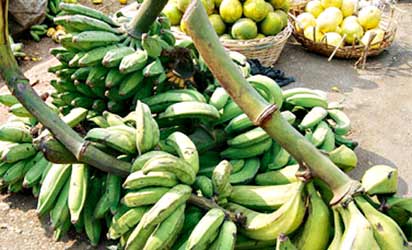
The varieties of bananas were baffling – kparanta, Akure/Ibadan, bawera, Cameroon banana, etc. okra, pumpkins, egg plants, etc. Our mothers had inexhaustible recipes to turn any of these products to food – moimoi, masa, etc. At school, we had nature study, school farms, teacher’s farms, physical education, games – bald tennis ball was the greatest gift of a small boy. There was another ball known as African ball made of rubber bound together as best as possible. The bounce of this ball was as unpredictable as the bounce of a rugby ball. Even so, we had unbelievable fun. At school, we also had to spend one day a week in a nearby Government Trade Centre, GTC, to study metal, wood work and technical drawing.
Our geography lessons told us about these incredible groundnut pyramids, the growing of sorghum and millets and canary seeds, yams and cassava, corn and cotton, goats, sheep, etc. We had cotton which we exported but there were millions of women who were spinning cotton balls into threads and selling these to weavers who made traditional African fabrics. We also had hides and skins for export (although now we have found leather to be a food delicacy we call kpomo)! Our cotton was of a good quality and formed the basis of the textile manufacturing enterprise in which we were third after India and Indonesia.
Throughout Nigeria, we had women who sold fresh milk and cheeses, various homemade delicacies and sweets from milk and sugarcane. We had sugar refineries and various kinds of African husbandry and veterinary research centres. The universities’ faculties of agriculture did research into all our animals and cross bred many breeds – the hope being, as in most countries, developing a species which produced good meat and enough milk. Down in the South, there was a specie of cow that was prized higher than the cows that came from the North especially for traditional functions such as marriages, chieftaincy installations, etc. These cows were slightly shorter than the long horn cows from the North and had little or no horns. There was plenty of them in Orlu, Ihiala, Agbor, Asaba, Umuahia, Obulu Uku, many parts of Edo and Delta. Ceremonies that demanded the gift of cows specified these types of cows. They are still in great demand all over the South although I learnt that they originated also from the North.
In these days of uncontrollable violence from farmers and cattle herders, perhaps a growth of native cows might remove the cause for these increasing bitter clashes. Why don’t we have farmers who actually herd goats and sheep as a business and not wait for the annual slaughter of rams for these animals? When these agricultural products were being produced all kinds of research institutions broke out – Palm Oil Research, Cocoa Research, etc. The lesson we learnt from all these research institutes – now well over 25 – is that their contributions to our development have been either minimal or zilch.
This is what now frightens me about the stupidity of all these special universities – Petroleum, Maritime (soon there will be Desertification University). What is a Maritime University or a Petroleum University except another spending centre that cannot be explained? Why not a normal university with the faculty of Petroleum engineering, Maritime engineering, etc.?
THE whole of Government’s economic recovery plan is based on borrowing large sums of money, growing the agricultural productive sector, massive investment in infrastructure. Thus, growing export facilities with which to pay for these large borrowings. It does not take a genius to see the fallacy in this process because there is nothing in the programme that suggests that the foundation to fighting the recession is not rooted in the belief of uninterrupted revenue from oil; a production rate of 2 ½ million barrels a day.
Let’s assume that the agriculture sector of this plan works a treat; where are the produce inspectors? Have they been trained, will they be trained to grade our products? Where are the packaging enterprises? Ghana, Ivory Coast, Kenya, and South Africa have had these capabilities in place over a long time. In Agriculture how ready are we? Agriculture should be a major industry with a long value chain for it to be optimally beneficial. We must remember the adventure by many industries into agriculture. For example, some grew corn to make cornflakes, etc. Guavas are disappearing; African apple has disappeared.
Agbalumo, the African plum could be developed into chewing gum, with development of various flavours. Animal husbandry should be encouraged e.g. African cows: – how to find the right grass for the cows and goats and sheep for maximum production. Many experiments, research in schools and universities have dried up, perhaps due to inability to fund research or pass them into viable products or just stealing of research funds by professionals in the institutions and universities.
Chicken – many large chicken farms have folded up – Mitchell farms, Ashamu farms in Ajao Estate, even OBJ farms are gradually going to seed. Plants Research gains are not translated into viable economic processes and products. Training inspectors are not available for cocoa, palm produce, cereals – corn, sorghum, rice, etc. Packaging, especially fruits for export, do not exist. Can we not emulate Kenya and flowers, Uganda and plantains? Fresh milk, butter used to be easily available in Nigeria. Why not so anymore?
Counting and measuring products, yield per hectare etc. setting production targets – these principles should govern our outlook and policy on agriculture. It is then we can really measure how well we are doing, not through the photo opportunity we now have or through the vague claims of agricultural success e.g. like saving US$ million from the importation of rice – a claim that cannot be proved.
The sizes of products – plantains, agbalumo are getting smaller mainly perhaps because they are over harvested. We need even so, to grow smaller and sweeter varieties of pineapples for export. The pawpaws we produce are too big, need to grow smaller and sweeter varieties that one family in Europe can eat at a sitting.
Improving breeds and yields, for example, the colour of oranges and other fruits can be improved for packaging. In the Operation Feed the Nation, OFN, campaign during which many companies went into agriculture, cotton, bananas and lost heavily. The support structure was temporary and inadequate. Planting new fruits crops should be encouraged. We still seem to be food gatherers, like our ancestors – our ube (African pear), plum, etc. are not planted and cultivated; they mainly growing wild. There are no orange and plum plantations; even kola nuts plantations; no new trees planted – gestation periods are largely long and schemes have to be established to sustain farmers during the gestation period.
Cocoa, palm trees, rubber trees – where government has not planted, has nothing new. The old plantations of UAC for palm trees are taken over by PZ, or the land has been sold to Arabs and Chinese. The devastation of our timber and rubber plantations continue unabated: inconsistencies are in play. The vast holdings of AT and P in Delta have not been replaced: only pillaged. The normal rules of timber harvesting were not followed: usually companies are expected to plant five trees for everyone fell. That has not happened.
The perennial wastages – tomatoes, mangoes, etc. are again with us. The only exception was the mangoes in Mambila Plateau planted by Admiral Nyako. Oil and the destruction of the ecosystem and rural economy in the Niger Delta, periwinkle, cockies (ngolo), clams, and oysters and other crustaceans are in serious danger of disappearance.
What propels most Nigerians to the United States, US, is the belief that the possibilities of achieving anything they desire is within their potentialities. These possibilities also are all here in Nigeria. There are numerous stories of grass to riches in both Nigeria and the US, which was the core stories in the US read in the US press in the 1930s. My view is that there are even many more possibilities here in Nigeria, even with poor electricity and insufficient infrastructure.
Alon Metzger is today the billionaire owner of MEGA PLAZA. He came to Nigeria with nothing and lived and sold CDs in an 18 foot container. The Chagouris were born in Port Harcourt in unremarkable circumstances and conditions. Port Harcourt, Lagos, Ibadan, Jos, Kano, Calabar were the homes of many Lebanese and Syrians (“Koras”) who turned Nigeria into their homes. They sold textiles, had mechanic workshops, electronics, cinemas, restaurants, etc. They became unbelievably successful and incredibly wealthy.
The founder of the Chellerams Empire came here with an umbrella and a cardboard suitcase. They grew and branched into almost all mercantile businesses and factories. They started water bottling (Swan) almost at the same time as the Chagouris started Ragolis and flour mills. The Challerams, with their cousin, the Bhojson and friends, Aswanis went into farming – growing corn and making cornflakes, assembling motor cycles, supermarkets, fast foods, textile manufacturers, soft drink factories, airlines, distribution of cars and machinery and chemicals and a host of other business. The Melwanis were a business octopus. The Elias brothers came with nothing and set up factories making towels (Nitol Towels at Iganmu and Port Harcourt); Khalil went into transport, soft drink factories etc. Leventis, Mandilas, Kalaberis, Thomopolous, Spiropolous (i.e. the Greeks) built car plants, motor outlets, timber, wholesale exporters of rubber, etc. Monselli was a small architect in Mushin and grew into the giant of TV, radio, construction, food, billionaire, etc.
Opportunities for new businesses, technologies, communications and successes abound in agriculture, in industries, in new enterprises and of course in oil and solid minerals. These opportunities are waiting to be exploited. They do not come on a platter.
Nigerians who had their own stories of successes from nothing include Ojukwus, Chidieberes, Odutolas, (Ogbeni Oja) as did Broderick, Ilodibes, Adejumos, Akinkugbes, etc. Obande grew to be one of the richest men in Enugu and started as a supplier of food to prisons. Ojukwu Transport and Industries were well known. Kalu was the stock fish king in Nigeria. On the luxury transport routes the grass to wealth entrepreneurs dominated and still dominate – and have diversified – to hotels, breweries, etc., the Young Shall Grow (Rockview), Ibetos expanded to cement manufacturing from transport. The Agbowu, Agofure, God is Good, transport are household names. Inyang Ete and Utuks from Akwa Ibom; the mega billionaires of Globe Motors (Anumodu) and Coscharis (Maduka) – it is tedious to go on – but one thing runs through their biographies – all started dirt poor.
These developments have continued in case people think that the rich ones were lucky or rich by historical accident. It is not their wealth that is being celebrated: rather their indomitable spirit of never say die; never give up. The parents of Elda and Bruno came from Italy with nothing. But Elda’s restless spirit pushes her for new things. She has gone into fishing, restaurants, wholesale wine importation, plans for tourism, environmental survival etc. The other day, I found her and her daughter Jenny, selling in a vegetable market they have just opened. Jumai, a young woman married at 17. After having three children she found that that world was insufficient to hold her spirit. She went to university, finished and now has a string of successful restaurants for business lunches, introducing Shangolinko type restaurants in the middle of Lagos: The same can be said of Juvenick restaurants. I believe the owner of SLOT has told his story as well as the computer manufacturer who introduce Nigerian language keyboards.
Lagos has two types of landlords – those who own the largely swamp lands now – reclaimed, known as Lekki, Jakande, Shogunle, Osopa, etc. The state having developed the infrastructure following the foresight of the owners of HFP, fabulous wealth has come to Lagosians and their families. They have Roll Royces as many as four or five, and other luxury cars; there are landlords and loan sharks who are ready to deprive the unwary and even foolish of their money. There are many fake land owners who sell a piece of land to as many unwary buyers as possible – but they exist. There are others who have organised themselves as “omo oniles” – some genuine, others parasitic – these have similar organisations in Port Harcourt, Warri, Sapele, Asaba, Abuja who arm twist people into parting with their money under false pretences; others harass genuine buyers or owners, blackmail house owners etc. But these are not the people I am asking Nigerians to emulate.
Disclaimer
Comments expressed here do not reflect the opinions of Vanguard newspapers or any employee thereof.